The views expressed herein are solely mine.
Abbas Re-Elects Himself. Iran Wins.
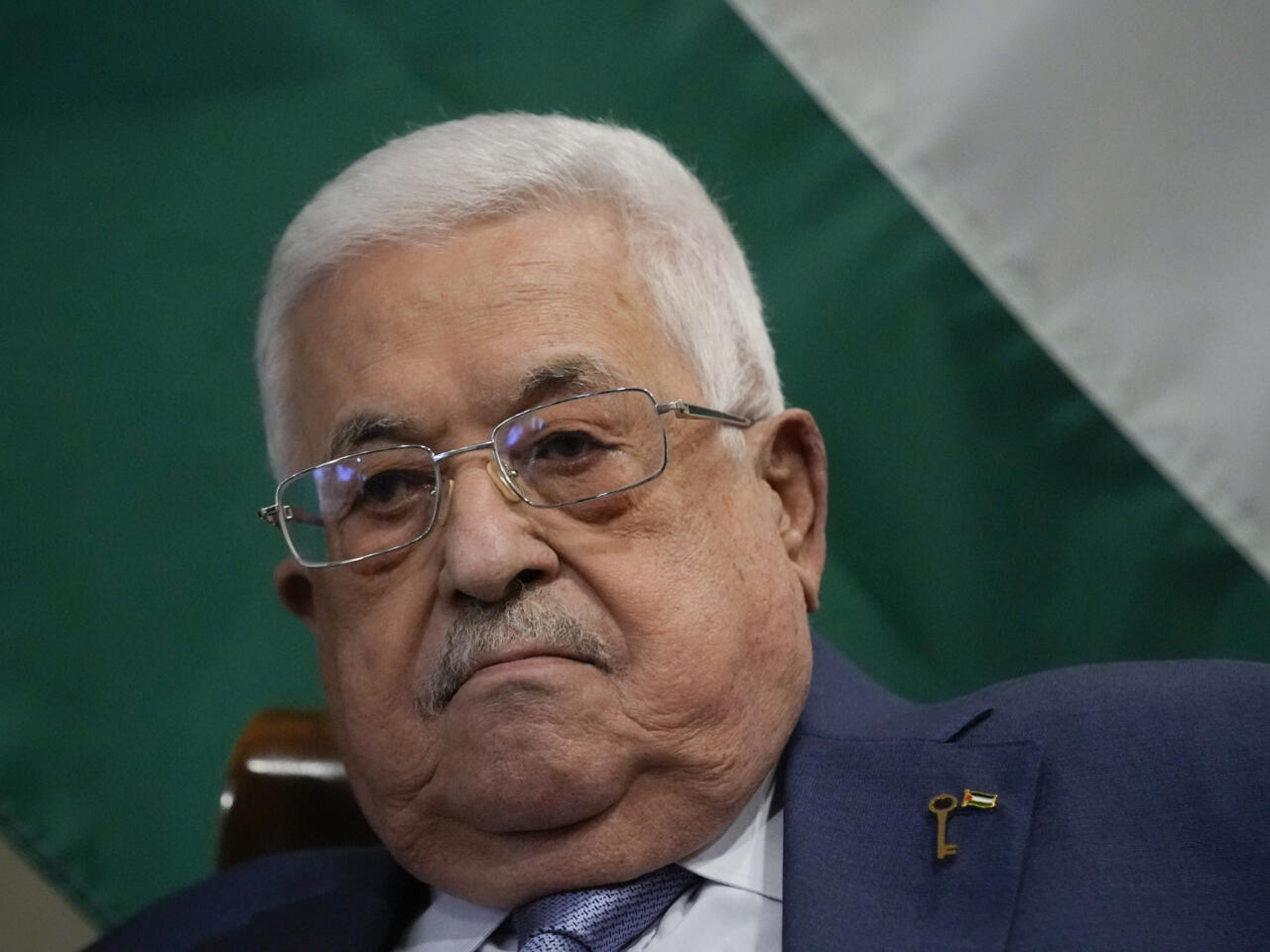
Palestinian President Mahmoud Abbas meets with US Secretary of State Antony Blinken in Amman, Jordan, on October 17, 2023. (Jacquelyn Martin / AP).
Fatah’s Eighth General Congress on May 14, 2026, delivered exactly what the Palestinian political system always produces: stagnation disguised as legitimacy. Roughly 2,514 delegates dutifully “re-elected” 90-year-old Mahmoud Abbas as head of the movement while “refreshing” the Central Committee for the first time in a decade. No real succession battle occurred. No credible reform emerged. Mohammed Dahlan’s supporters were excluded outright. The Congress was not a transition. It was a televised confirmation that Fatah and the Palestinian Authority have become closed political shells incapable of renewal, accountability, or strategic adaptation.
Abbas has now ruled for more than twenty years beyond his original four-year mandate. Elected president of the Palestinian Authority on January 9, 2005, his term legally expired in January 2009. No national legislative elections have been held since 2006. The Palestinian Authority continues to govern parts of the West Bank through patronage networks, security services, and international subsidies rather than democratic legitimacy. Even after the October 7 Hamas massacre and the subsequent Gaza war shattered the regional order, the Palestinian Authority remained almost absent — unable to shape events, impose authority, or present itself as a viable governing alternative. This paralysis is not politically neutral. It directly benefits Iran.
Tehran’s regional strategy depends on fractured Arab systems, weak Palestinian institutions, and permanent rejectionism. A functional Palestinian leadership capable of cooperating with pragmatic Arab states, pursuing stabilization, and limiting militia influence would threaten Iran’s entire regional architecture. Iranian networks therefore thrive in the vacuum Abbas has preserved: a Palestinian arena divided between corrupt paralysis in Ramallah and armed Islamist extremism in Gaza.
While Abbas clings to power, the United Arab Emirates and Egypt have moved in the opposite direction. Abu Dhabi and Cairo increasingly view the Palestinian file through a hard security lens centered on containing Iranian expansion, suppressing Muslim Brotherhood influence, and preventing Gaza from becoming a permanent launch platform for regional destabilization. In that environment, any Palestinian figure connected to Cairo or Abu Dhabi automatically acquires geopolitical relevance — not because Palestinian institutions are strong, but because they are collapsing. That is the space Mohammed Dahlan occupies.
Expelled from Fatah in 2011 after a power struggle with Abbas, Dahlan relocated to Abu Dhabi and became closely aligned with Emirati leadership. Unlike the Palestinian Authority establishment, he refused to join the hysterical campaign against the Abraham Accords and maintained close ties with Egyptian President Abdel Fattah el-Sisi. Those relationships firmly place him inside the emerging pragmatic Arab bloc attempting to contain Iranian influence across the region.
More importantly, Dahlan possesses something Abbas’s entire political circle lacks: operational experience confronting Iranian-backed Islamist networks. As head of Preventive Security in Gaza before Hamas’s 2007 takeover, Dahlan directly battled armed factions and understood the mechanics of militant infrastructure, clan politics, and coercive power inside the Strip. In today’s Middle East, that experience matters more than another speech about “national dialogue.”
However, none of this transforms Dahlan into a savior. His liabilities remain substantial. Corruption allegations have followed him for years. Palestinian Authority courts sentenced him in absentia. His domestic support base is weak and fragmented. Polling from the Palestinian Center for Policy and Survey Research places him at only around 11 percent as a potential successor to Abbas. The May 2026 congress made one reality unmistakably clear: the Abbas leadership will never allow an internal challenger to emerge through institutional mechanisms.
But that only reinforces the larger point. The very fact that Dahlan continues to matter at all demonstrates how catastrophically hollow Palestinian politics have become. In any functioning national movement, a ninety-year-old ruler governing for sixteen years beyond his mandate would not be considered political normalcy. In Ramallah, it is institutional doctrine.
The longer this decay continues, the more Iran benefits. Tehran does not need a Palestinian victory. It needs Palestinian dysfunction. A divided Palestinian arena incapable of producing pragmatic leadership guarantees continued instability, blocks Arab-Israeli normalization frameworks (October 7 took place to prevent the Israeli-Saudi normalization agreement that U.S. Senator Lindsey Graham had brokered between both sides), and preserves space for Iranian proxies to operate across Gaza and the West Bank. Rejectionism is not a side effect of the Iranian strategy; it is the strategy.
The United Arab Emirates and Egypt increasingly understand this reality. Their interest is no longer rhetorical solidarity or empty summit diplomacy. It is identifying Palestinian actors capable of functioning inside security frameworks designed to contain shared threats. Dahlan fits that description more than most figures inside the current Palestinian system — not because he is exceptionally strong, but because the rest of the field is exceptionally weak.
Any expanded role for him would trigger immediate resistance from entrenched Palestinian Authority elites and outright hostility from Hamas-aligned factions. His domestic legitimacy deficits are real. His authoritarian instincts are well documented. Yet those obstacles themselves reveal the deeper structural collapse underway: Palestinian politics currently offers almost no figures capable of simultaneously engaging pragmatic Arab states, satisfying Israeli security requirements, and countering Iranian influence.
The May 2026 congress changed nothing because it was never designed to change anything. It merely formalized the political death spiral already consuming Fatah and the Palestinian Authority. Abbas re-elected himself. The system applauded. Iran quietly celebrated.
For Israel and the pragmatic Arab bloc, the central question is no longer whether Palestinian institutions can reform themselves; they have shown repeatedly that they cannot. The question now is which external vectors, regional alliances, and security-oriented Palestinian actors can prevent the Iranian axis from fully capturing the post-Abbas vacuum.
That is why figures like Dahlan remain relevant despite their flaws. Not because they represent an inspiring future, but because the current Palestinian order has produced almost nothing else.
Abbas’s latest self-coronation leaves Palestinian institutions weaker, older, and more brittle than ever. The vacuum deepens. Iranian influence expands. And every year without succession, reform, or institutional renewal pushes the Palestinian national movement further away from statehood and closer to permanent strategic irrelevance.
Related Topics
Related Posts