Abdul El-Sayed Does Not Speak for Me
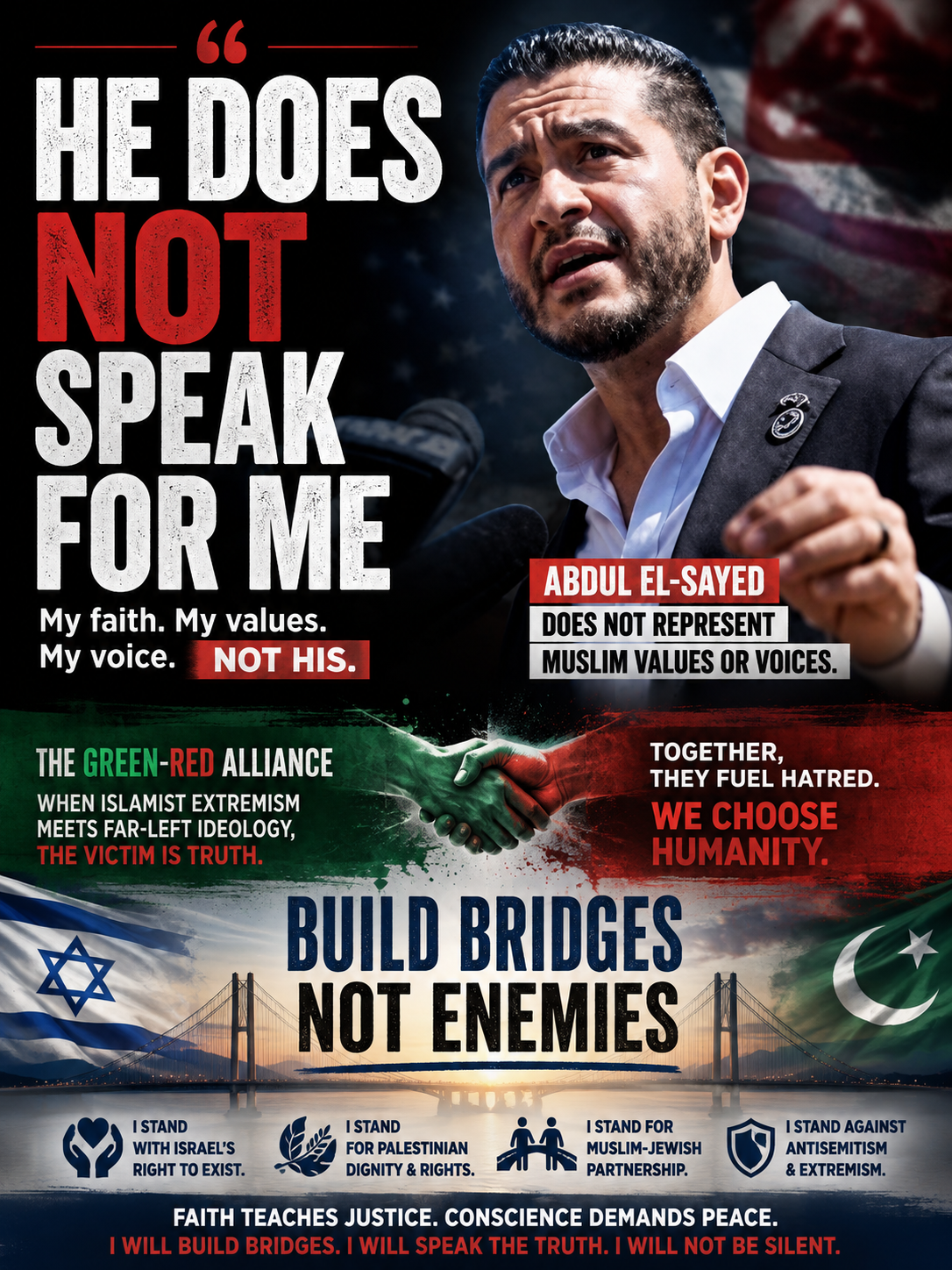
America is on the verge of making history.
The possibility of electing one of the nation’s first Muslim U.S. senators is significant. As an American Muslim, I understand why many in my community see this as a moment of pride.
But representation, by itself, is not a virtue.
What matters is what a leader represents.
When Democratic Senate nominee El Sayyed described Israel as “bloodthirsty,” he crossed an important line. There is a fundamental difference between criticizing the actions of a government and using language that demonizes an entire nation.
Israel, like every democracy, deserves scrutiny. Governments should be criticized when criticism is warranted. I have no issue with honest debate about Israeli policy.
But words such as “bloodthirsty” do not invite debate. They inflame emotion. They reduce one of the world’s most complicated conflicts into a caricature of absolute evil.
That language does not move us closer to peace.
It moves us further away.
The Responsibility That Comes With Representation
As Muslims, we have often asked America to judge us as individuals rather than by the actions of extremists.
We rightly reject the idea that terrorism defines Islam.
So why would we embrace language that collectively demonizes the world’s only Jewish state?
Representation should elevate public discourse, not poison it.
If El Sayyed wants to represent millions of Americans—including Jewish Americans—he has a responsibility to speak with moral consistency. That means condemning terrorism without qualification. It means recognizing the Jewish people’s right to self-determination alongside Palestinian aspirations. And it means refusing to use rhetoric that echoes narratives historically used to justify hatred against Jews.
The Cost of Reckless Words
Political leaders often underestimate the power of language.
Words become slogans.
Slogans become movements.
Movements shape culture.
And culture eventually shapes behavior.
When public officials repeatedly portray Israel as uniquely evil, they may believe they are attacking a government. But many people hear something very different. Jewish students on college campuses hear it. Jewish families hear it. Synagogues hear it.
The distinction between “Israel,” “Zionists,” and “Jews” is frequently erased by extremists looking for permission to hate.
That is why responsible leadership matters.
He Does Not Speak for Me
I am a Muslim.
I am also a Zionist.
Those two identities are not in conflict.
I believe Palestinians deserve dignity, opportunity, and hope.
I also believe the Jewish people have the same right to security, sovereignty, and self-determination that every other nation seeks.
Those positions are not contradictory. They are consistent with universal human rights.
So when politicians invoke Muslim identity while using language that deepens hostility toward Israel, I refuse to let them speak on my behalf.
El Sayyed does not represent my values.
He does not represent my understanding of Islam.
And he does not represent the future I want for Muslim-Jewish relations in America.
America Needs Bridge Builders, Not Fire Starters
This country desperately needs leaders who can reduce polarization rather than exploit it.
We need Muslims willing to confront antisemitism inside our own communities just as we expect others to confront anti-Muslim bigotry.
We need Jewish and Muslim leaders who can disagree passionately while recognizing each other’s humanity.
History will remember whether our generation chose to inflame hatred or build trust.
As a Muslim, an American, and a human rights advocate, my choice is clear.
I will continue standing against antisemitism.
I will continue defending Israel’s right to exist.
I will continue supporting the dignity and rights of Palestinians.
And I will continue rejecting any rhetoric—regardless of who speaks it—that turns political disagreement into moral dehumanization.
Because representation without responsibility is not leadership.
It is simply another form of division.