A Jewish trans lesbian academic in recovery from academics.
For Kara Jesella: My Witness Impact Statement
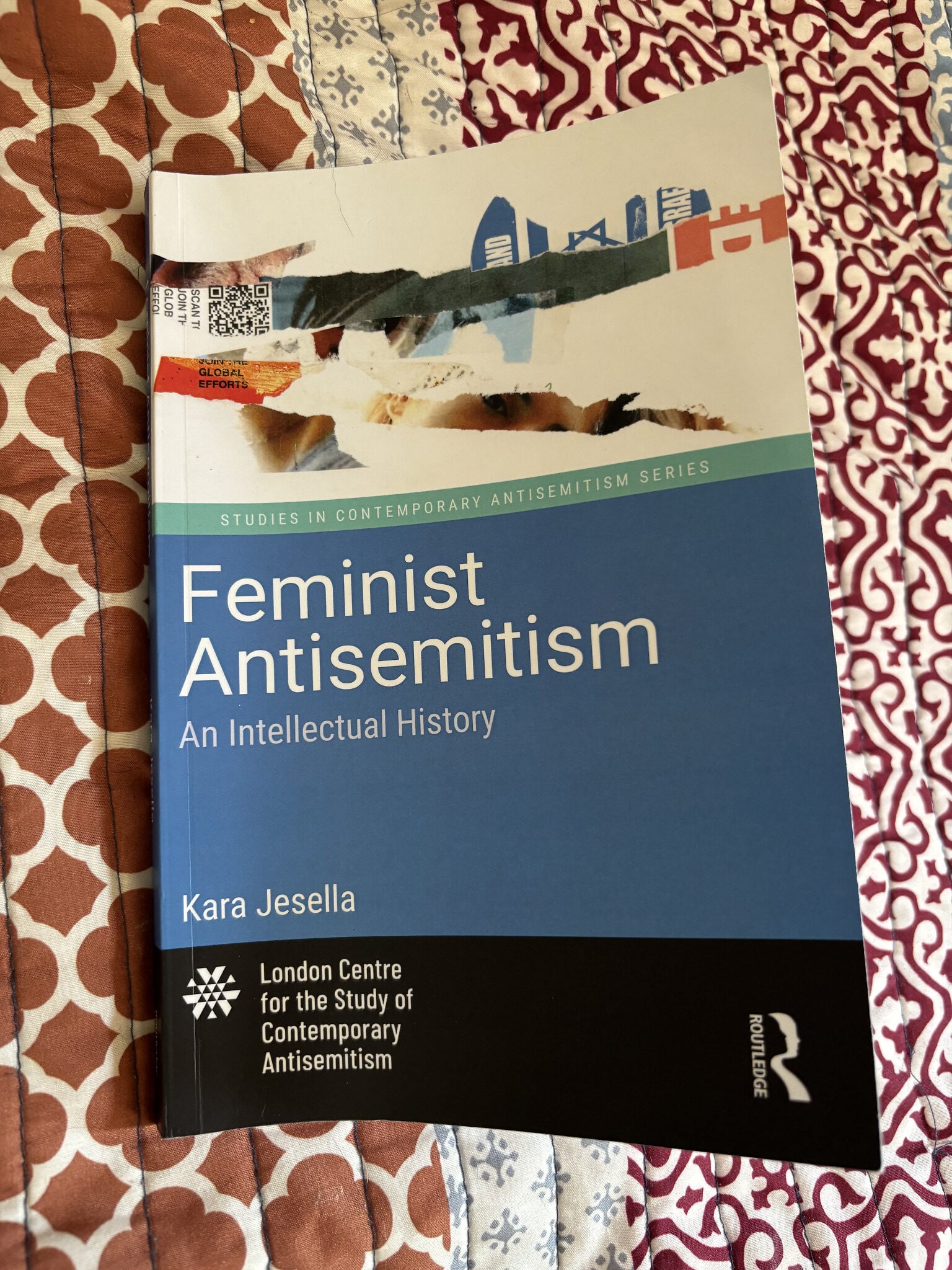
I wish Kara Jesella’s book on the history of Feminist Antisemitism was available years ago. It is a must read for all Women’s Studies students.
In a September piece in the Times of Israel, Luke Tress wrote about Kara Jesella’s academic text, Feminist Antisemitism: An Intellectual History. In it, Dr. Jesella traces the history of feminism through the 1960s, the creation of Women’s Studies as a field of study, and into modern-day Feminist and Gender Studies steeped in Queer Theory. She does this through a lens that re-frames many of the foundational theorists and their work as both antizionist in nature, and antisemitic in practice. And she is right.
I successfully passed my PhD Thesis Proposal at the University of Ottawa in July 2023. I took copious notes on the comments made by my committee members so that I may consider them for inclusion as I began work on my dissertation. Simply put, my research centered on creating autobiographical timelines so that members of the LGBT community could plot their coming out stories through moments of intersecting pop culture artifacts and identity. In my case, I would use American comic book superhero narratives to explore how my Jewish identity both prevented and facilitated my eventual coming out twenty years ago.
I was deep into ethics committee approval by October 7th, 2023. Within days, my department email box was swamped with messages of support and grief for the Palestinian victims of Israeli aggression in Gaza. By the end of the month, I received a department email from the director of the Institute of Feminist and Gender Studies with an attached petition contesting Provost Jill Scott’s recommendation that extra security be required for an upcoming protest for “Palestinian liberation” being organized on campus. The petition was signed by my department heads, members of my PhD committee, and former professors of mine at the University of Ottawa and the Simone de Beauvoir Institute at Montréal’s Concordia University. Certain names on the petition came as no surprise, but others left me in a state of disbelief. How could people so educated in social justice and identity politics blindly sign such a petition? How could they not consider the emotional impact on Jewish faculty and students? How is it that it never occurred to me after studying feminist, queer, and gender theory for the better part of a decade that Jews simply do not count? And when they do, it is as the purveyor of white capitalist patriarchal supremacy.
My home library is filled with books by the most famous names of the feminist movement. I have read volumes by Audre Lorde, Bell Hooks, Judith Butler, Linda Tuhiwai Smith, Simone de Beauvoir, Kimberlé Crenshaw, Gayle Rubin, and Adrienne Rich; The list goes on and on. I have studied Queer Theory, Critical Race Theory, Intersectionality, Marxist and Socialist Feminism, Post Colonial and Transnational Feminism, and Sexuality, Gender, and Politics. I have a strong understanding of the breadth of Women’s Studies curricula. I can speak the language of academia when called upon to do so. While I was aware of the many Jewish women who led the charge of second wave feminism in 1960s, I was not aware of how vilified many of them became simply for believing that all women and men in society should be equal. I was not aware of the antisemitism that festered under the theories I had been championing.
I read Kara Jesella’s book upon release last summer. Now I know. I know how I missed all the signs and signifiers as I focused so tightly on my own research into trans representation in media. I missed how a professor in my Women’s Studies II course at Concordia University lectured how Westerners are not allowed to criticize cultures that perform female genital mutilation (FGM) as part of religious ceremonies, or the professor at University of Ottawa who referred to herself as a “self-hating Jew” as she invited problematic speakers to guest lecture my colleagues on unverified reports of IDF actions in the disputed territories.
Most importantly, I missed how my committee members asked me, as a Jew, to “decenter my whiteness” as I moved forward in my dissertation. I missed what they meant by it. This is why I did not really know how to unpack their particular “request.” I may pass as white, but I am not white. That was made clear to my people almost a hundred years ago. I am Jewish. And being Jewish is a huge part of my identity and my research. I was being asked to erase myself from the academy. I refused.
Using the tools I had acquired during my years of post-graduate work, I wrote to the director of the Institute of Feminist and Gender Studies about my concerns for Jewish life on campus. She commended me on my message and asked for my permission to send professors a re-worked version of my letter, masking any potential identifying markers. I refused. I explained that as department head, it was her responsibility to look after the best interests of all the students and staff under her charge. She wanted to protect my identity from harmful repercussions simply for speaking my truth, but her unwillingness to write her own letter spoke hers.
In April of 2024, I decided I could no longer be the token (Zionist) Jew in the department. I did not want my presence in the doctoral program to be seen as or used as some form of consensus that I share the values or mission of the University of Ottawa’s Institute of Feminist and Gender Studies. So, after months of unsolicited department emails about feminist sit-ins “for Gaza” and zero acknowledgment of Jewish existence on or off campus, and with my trust in my PhD committee shattered, I withdrew my PhD candidacy from the university.
I learned something extremely valuable from my years in academia, and it did not become clear to me until I read Feminist Antisemitism. Theory as theory can be fascinating, but it may be built on falsehoods and animosity. When we study theory, we should also study the history of said theory. That is the true academic endeavor.
Related Topics
Related Posts