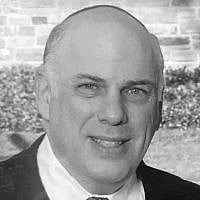
Abe Zelmanowitz (1945-2001)
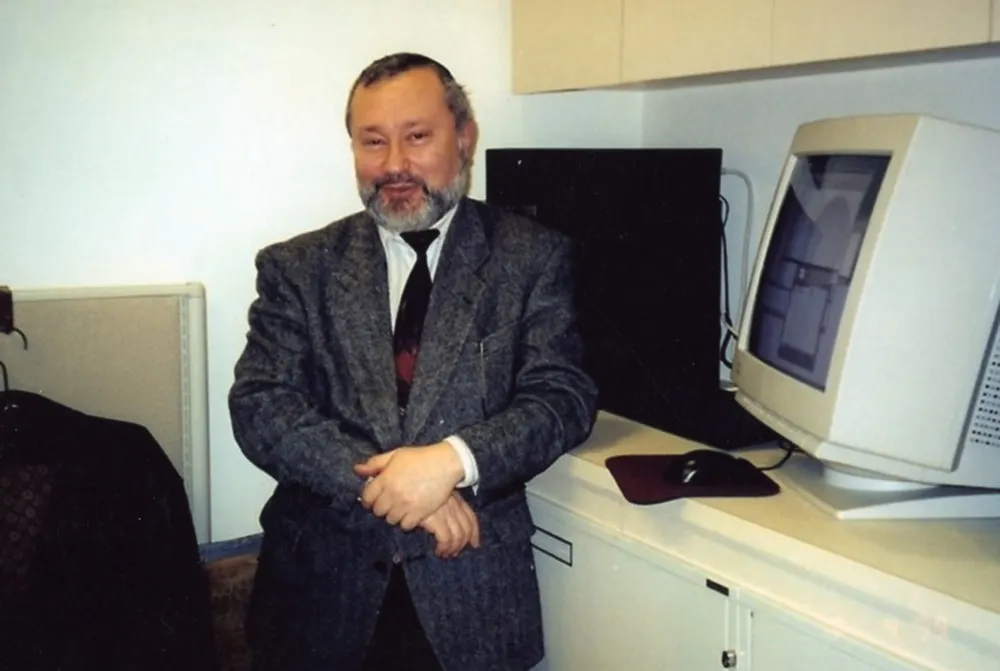
As we mark the 25th anniversary of the horrific terrorist attacks on the World Trade Center and the Pentagon, thousands of memorial tributes will honor those victims who perished on that fateful day. But few are as deeply stirring—or as profoundly Jewish—as the story of Abe Zelmanowitz.
What makes Abe’s heroism so extraordinary is that he wore no uniform. He was not a firefighter, a police officer, or a first responder. He was a 55-year-old computer programmer who was faced with an agonizing choice on an otherwise routine Tuesday morning: save himself, or remain behind with a disabled friend who could not escape without help.
He chose his friend.
Who was Abe Zelmanowitz?
To his family, Abraham J. Zelmanowitz was simply “Avremel.” Born in New York City on December 30, 1945, he lived in Brooklyn with his older brother Jack and Jack’s family. Though Abe never married, he was like a second father to his nieces and nephews and a grandfather to their children.
He was a devoutly observant Orthodox Jew whose commitment to Jewish life was absolute—he routinely walked three miles each way on Shabbat to visit his family. Yet he was also a true Renaissance man. He loved music (ranging from opera and Andrea Bocelli to the Beatles), played a formidable game of chess, possessed a dry, wonderful sense of humor, and was exceptionally gifted with his hands. His family fondly recalled that he could build a complete sukkah without using a single nail.
When New York’s garment industry began to decline, Abe retrained himself in computer programming, eventually landing a job at Empire Blue Cross and Blue Shield in the World Trade Center in 1989. Colleagues instantly recognized him as a gem—polite, sharp, analytical, and unfailingly helpful.
It was at Empire Blue Cross that Abe formed a deep friendship with a colleague named Edward “Ed” Beyea.
Ed was paralyzed from the neck down. Despite using a motorized wheelchair and requiring a full-time aide, Ed lived with inspiring independence, taking public transit to work and operating his computer using an adaptive mouth-stick device.
Abe was Jewish; Ed was Catholic. Both were single, worked long hours, and frequently ate dinner together after work. Their friendship was defined by a beautiful, unspoken reciprocity: when Ed chose the restaurant, he made sure it was kosher; when Abe picked the spot, he ensured it was fully wheelchair accessible. They looked out for one another in life—and, as it turned out, in death.
When American Airlines Flight 11 slammed into the North Tower, Abe and Ed were working on the 27th floor.
The impact was devastating. Elevators were destroyed, leaving Ed with no realistic way to descend dozens of flights of stairs. As smoke filled the corridors and panic ensued, people began to rush toward the stairwells.
Abe was physically capable of walking down the stairs and saving his own life. Ed was not.
Co-workers begged Abe to leave, but he refused. “No,” he said firmly. “I’m staying with my friend.” He instructed Ed’s aide to evacuate, promising that he would look after Ed.
Abe wasn’t confused by the chaos, nor was he frozen by fear. He understood the danger clearly. However, in a moment of remarkable moral clarity, he decided that his friend’s life was worth risking his own for.
While waiting on the 27th floor for emergency personnel, Abe spoke with his family by telephone. When a family member asked how long he planned to stay in the burning tower, Abe replied simply: “Until the Mashiach comes.”
It was a statement that captured his essence—a deeply religious man whose Judaism wasn’t merely practiced, but lived.
Then, the story took an even more remarkable turn. FDNY Captain William “Billy” Burke Jr. reached the 27th floor and encountered the two friends. Seeing their situation, Captain Burke ordered his fellow firefighters to continue down the stairs while he stayed behind to assist Abe and Ed. Together, they managed to maneuver down to the 21st floor.
At 9:59 a.m., the South Tower collapsed, sending a tremor through lower Manhattan. Everyone in the North Tower instantly realized their time had run out. Yet Captain Burke refused to abandon Abe and Ed, and Abe refused to abandon Ed.
At 10:28 a.m., the North Tower collapsed. All three men perished.
There is a powerful, sacred chain in this tragedy: Abe wouldn’t abandon Ed, and Captain Burke wouldn’t abandon Abe and Ed. Each man viewed the life of the person next to him as more precious than his own.
Abe’s story endures because his heroism was born not out of duty, but out of pure chessed—loving-kindness. He had no badge, no tactical training, and no institutional obligation to stay. Society would have understood had he saved himself. Yet he quietly chose self-sacrifice over self-preservation.
For nearly a year, Abe’s family waited for news about his body. When his remains were finally identified, his family made a fitting decision. They brought Avremel home to Jerusalem, where he was laid to rest alongside his parents on the ancient, holy slopes of Har HaZeitim (the Mount of Olives). Though he was a quintessential Brooklynite and an American hero, his final resting place reflects his eternal connection to the Jewish people.
In the end, Abe Zelmanowitz’s ultimate act was a classic Kiddush Hashem—a profound sanctification of God’s Name that inspired a grieving nation. When reporters later asked his brother Jack how Abe could have made such a staggering sacrifice, Jack replied simply that it was just “Abe being Abe.”
Abe didn’t suddenly become a hero on September 11th. September 11th simply revealed the hero he had been all along.
May his memory forever be a blessing.