
CEO of Time to Stand Up for Israel
Above the Battlefield: Why Israel Needs Its Air Force
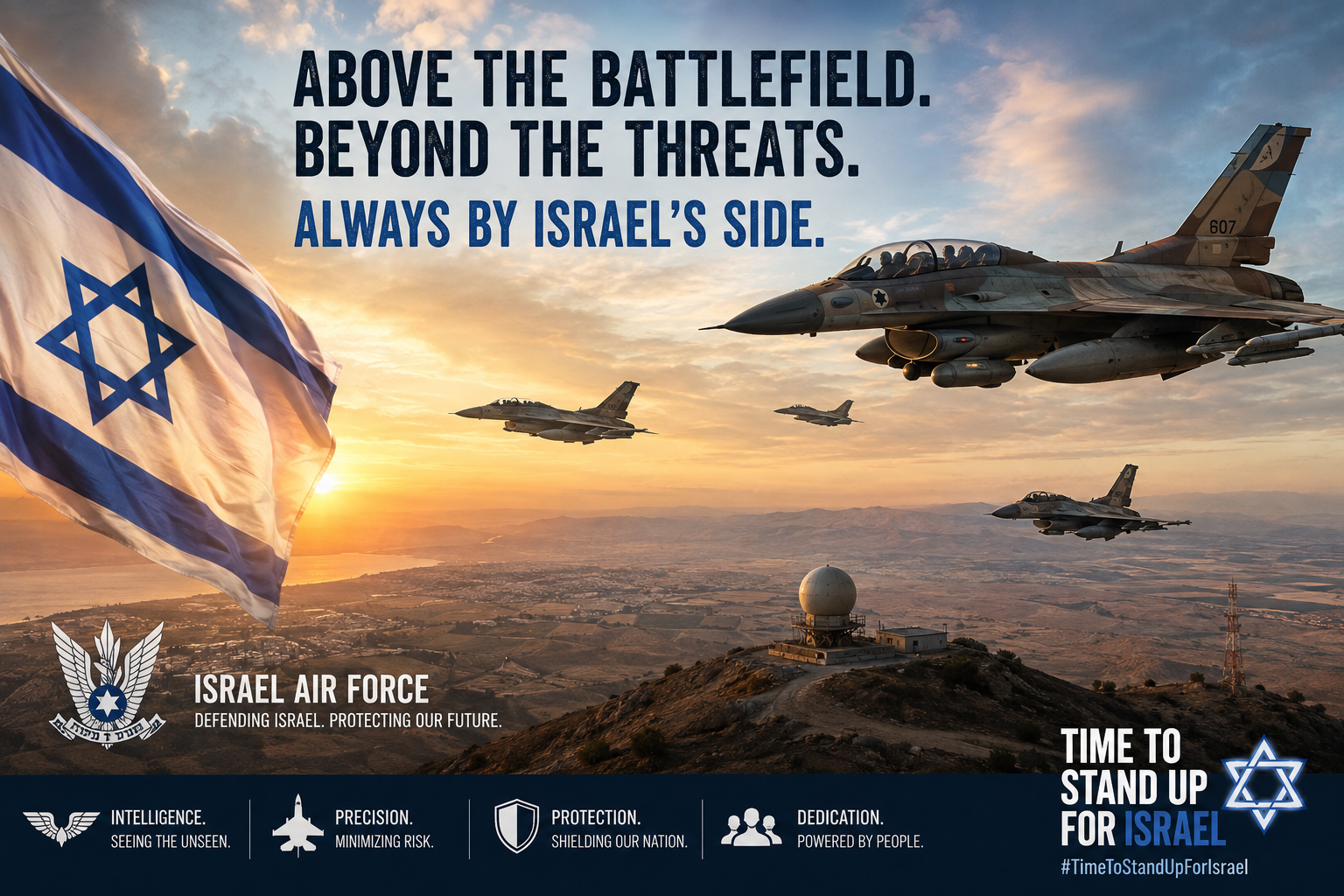
Photo Credits: Sabine Sterk (AI)
When people think about the Israel Defense Forces, their thoughts often go first to the soldiers on the ground. They see young men and women entering Gaza, operating in Judea and Samaria, guarding communities along the borders, searching tunnels, rescuing civilians, and confronting terrorists face to face. These soldiers deserve every bit of admiration they receive.
But high above them is another force that has repeatedly changed the course of Israeli history: the Israeli Air Force, the IAF.
The IAF does not always receive the same emotional connection as Israel’s ground forces. Perhaps that is understandable. Ground soldiers are visible. We see their faces. We see them carrying enormous backpacks, sleeping beside their vehicles, entering destroyed buildings and embracing their families when they finally return home.
The Air Force can seem more distant. We see an aircraft disappearing into the sky and sometimes, hours later, hear that a mission has been successfully completed hundreds or even thousands of kilometers away.
Yet behind that aircraft stands an extraordinary organization consisting not only of pilots, but intelligence specialists, technicians, air traffic controllers, weapons specialists, rescue personnel, drone operators, engineers and countless others. Their work has become one of the foundations of Israel’s ability to survive in one of the most dangerous regions in the world.
When Distance Cannot Protect Israel’s Enemies
One of the defining characteristics of the IAF is its ability to reach threats far beyond Israel’s borders.
Israel is geographically tiny. Its enemies, however, have never necessarily been located next door.
In 1981, Israeli F-16s flew approximately 1,000 kilometers to Iraq during Operation Opera, destroying the Osirak nuclear reactor near Baghdad. The operation was enormously controversial internationally. Israel was condemned, but the fundamental Israeli calculation was unmistakable: a country that had experienced the Holocaust would not simply wait and hope that a hostile regime would never use a potentially existential capability against it.
In 2007, during Operation Outside the Box, Israeli aircraft destroyed a nuclear reactor under construction in Syria. Israel publicly acknowledged responsibility years later. Once again, the message was clear. Israel might be small, but geographical distance would not automatically provide protection to those developing strategic threats against it.
Then there was Operation Entebbe in 1976.
The rescue itself was carried out by Israeli commandos, but without the Israeli Air Force there could have been no Entebbe operation. Israeli aircraft crossed enormous distances to Uganda, enabling one of history’s most extraordinary hostage rescue missions. Israel demonstrated something that became part of its national character: Jews being held hostage thousands of kilometers from Israel would not simply be abandoned because rescuing them appeared impossible.
The ground forces and Air Force were not competitors that night. They were parts of the same Israeli determination.
That distinction remains important today.
The Shield Above the Soldier
The IAF is not simply about dramatic long distance operations.
Much of its importance is far less glamorous.
When Israeli soldiers enter hostile territory, aircraft and drones can watch from above. Intelligence can be gathered before troops enter dangerous areas. Air support can strike threats that might otherwise kill soldiers on the ground. Helicopters can evacuate wounded troops rapidly to hospitals.
A pilot flying thousands of meters above a battlefield and a soldier moving through a building below may never meet, yet their survival can depend on one another.
Modern Israeli warfare increasingly demonstrates how interconnected these forces have become.
There is therefore something misleading about asking whether the Air Force deserves the same admiration as the soldiers on the ground.
Israel needs both.
A country surrounded by threats cannot defend itself exclusively from trenches, tanks and infantry positions. Neither can aircraft alone permanently control territory, search every building, destroy every tunnel or physically protect every Israeli community.
Israel’s strength comes from integration.
Precision Is More Difficult Than Destruction
There is another aspect of the IAF that deserves attention.
People sometimes imagine modern air warfare as simply identifying a target and pressing a button.
Reality is considerably more complicated.
Behind many Israeli strikes are intelligence assessments, surveillance, target verification, legal considerations, operational planning and decisions about timing and weapons. In an environment where terrorist organizations operate from densely populated areas, the difference between destroying a military target and unnecessarily harming civilians can depend on extremely difficult decisions made in seconds.
No military operation is perfect. Mistakes occur in war, including tragic ones, and Israel should investigate serious failures rather than pretend otherwise.
But what distinguishes a professional military is not the claim that mistakes never happen. It is the effort to distinguish between combatants and civilians while fighting an enemy that frequently makes that distinction deliberately difficult.
Sometimes the most important decision an aircrew makes is not to fire.
Restraint rarely produces dramatic headlines, because there is no explosion to photograph. Yet the ability to abort a mission when circumstances change is also part of military professionalism.
A Tiny Country That Cannot Afford Strategic Surprise
Israel has something many larger countries do not have: almost no strategic depth.
An enemy aircraft, missile or drone does not need hours to cross Israeli territory. Israel’s population centers, infrastructure and military installations are concentrated within an extremely small geographical area.
That makes control of the skies essential.
The IAF therefore carries two responsibilities simultaneously. It must be capable of defending Israeli airspace while maintaining the ability to strike threats far beyond that airspace.
That combination is extraordinary for a country Israel’s size.
Its aircraft have operated against threats in neighboring territories and at far greater distances. Its pilots train for missions they hope they will never have to execute. Its technicians work to ensure aircraft can launch when needed. Intelligence personnel spend countless hours trying to understand what Israel’s enemies are planning before those plans become attacks.
And when an operation becomes public, we often see only the final few minutes.
We do not see the months or years that made those minutes possible.
More Than Pilots
Perhaps this is also why we should change the way we talk about the Israeli Air Force.
The IAF is not simply its fighter pilots.
For every aircraft that takes off, there is an enormous network behind it. Mechanics keep aircraft operational. Intelligence officers identify threats. Ground crews prepare missions. Air defense personnel protect Israeli civilians. Helicopter crews evacuate wounded soldiers. Drone operators provide surveillance. Rescue units prepare for the possibility that an aircrew may need to be recovered from hostile territory.
The pilot may be the person we see.
The mission belongs to everyone.
That culture of preparation is one of the things that makes the IAF remarkable.
Israel cannot compensate for failure with enormous numbers. It does not possess an unlimited population, unlimited aircraft or unlimited territory.
It therefore depends on intelligence, technology, training, improvisation and people willing to carry extraordinary responsibility.
The Wings of Israel’s Survival
I have enormous respect for the Israeli soldiers who fight on the ground. They stand physically between Israel and those who seek to harm its citizens. Their courage deserves recognition.
But admiration for them should never make us forget those protecting Israel from above.
When an Israeli aircraft intercepts a threat before it reaches Israeli civilians, the absence of tragedy is the victory.
When intelligence and air power eliminate a strategic threat far from Israel’s borders, millions of Israelis may continue their lives without ever knowing how close that danger came.
And when Israeli ground troops know that someone is watching from above, ready to support them when everything goes wrong, the Israeli Air Force becomes much more than another military branch.
It becomes their shield.
Israel’s history has repeatedly demonstrated that survival sometimes requires doing what others consider impossible, flying farther than enemies expect, acting faster than conventional wisdom allows and accepting responsibility for defending the Jewish state even when the world objects.
The Israeli Air Force represents that philosophy perhaps better than almost any institution in Israel.
The aircraft are impressive. The technology is extraordinary. The missions sometimes become legendary.
But ultimately, the strength of the IAF comes from its people and from the purpose behind their mission.
They fly so Israel can defend itself.
They fly so soldiers on the ground are not alone.
They fly so distance cannot become a sanctuary for those preparing attacks against Israel.
And sometimes they fly precisely so that millions of Israelis below them can continue living ordinary lives.
That may be the greatest mission of all.
Related Topics
Related Posts