
Russian-American-Israeli Palestinian. Palestine is Israel.
According to the Rules of the Russian Language
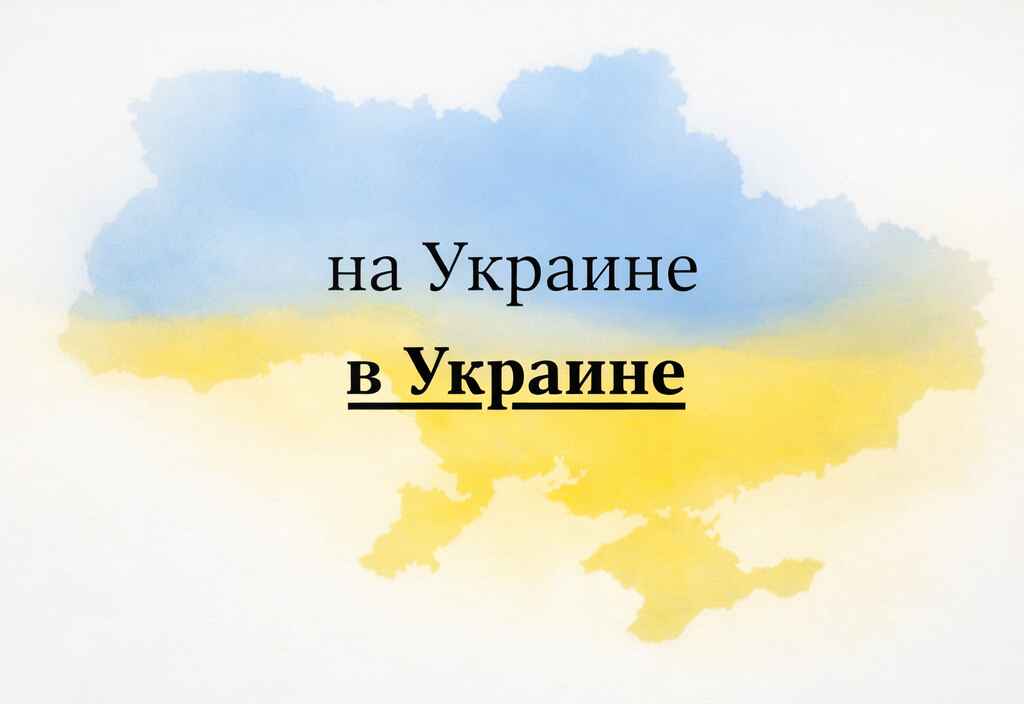
“On Ukraine” or “in Ukraine”? Sometimes politics begins with a preposition — when a linguistic form stops being background and becomes a signal. Image © Ivan Bassov, 2025. Licensed under CC0 (public domain dedication).
Note: This article is a translation of my Russian-language piece «Согласно правилам русского языка» (“According to the Rules of the Russian Language”), originally written on December 19, 2025. I postponed translating it because it relies heavily on Russian-specific linguistic nuances, semantic layers, and wordplay that are difficult to render naturally in English. This version attempts to preserve not only the meaning of the original text, but also its underlying linguistic logic.
Context for English Readers
For many English speakers, the dispute over Russian prepositions may initially seem obscure or overly technical. In reality, it concerns something quite familiar: whether Ukraine is treated linguistically as a sovereign country or as a subordinate region.
Historically, Russian used two competing forms: na Ukraine (“on Ukraine”) and v Ukraine (“in Ukraine”). After Ukraine regained independence in 1991, the Ukrainian government and many Russian speakers increasingly preferred v Ukraine, reflecting the status of Ukraine as a sovereign state rather than a geographic borderland.
Interestingly, Russia itself briefly moved in this direction during the 1990s, but under Vladimir Putin the official preference shifted back toward na Ukraine.
English went through a remarkably similar change. For much of the twentieth century, English speakers commonly said “the Ukraine,” treating the country linguistically as a region rather than a fully distinct political entity — much like expressions such as “the Northwest Territories” or “the Yukon.” After Ukrainian independence, English usage largely abandoned “the Ukraine” in favor of simply “Ukraine,” and this change became widely accepted.
Imagine, however, if English-speaking governments had refused to adapt and continued insisting:
According to the rules of the English language, one should say the Ukraine.
That is, in essence, what the Russian government is doing today.
Language as a Litmus Test
The phrase “according to the rules of the Russian language” sounds like an appeal to neutral truth. As if somewhere there exists a supra-political codebook, and all we are required to do is obey it. In reality, this expression increasingly serves as rhetorical cover — a way to present a position as grammar, and a choice as an obligation.
This article is about who actually establishes linguistic rules, why appeals to them are so convenient today, and where the boundary lies between linguistics and politics. The central example is Ukraine — more precisely, the use of the prepositions na Ukraine (“on Ukraine”) and v Ukraine (“in Ukraine”). This example is revealing because here language has ceased to be background and has become a signal.
Who Establishes the Rules of a Language
No language is governed by decrees. Linguistic norms are not imposed but recorded: in dictionaries, grammars, and reference books. Linguists describe the stable practices of educated native speakers — they do not invent the language or vote on its forms.
Therefore, the formula “according to the rules of the Russian language, one should…” is valid only in one case: when referring to an established literary norm confirmed by broad and stable usage. Everything else is interpretation.
Why Russia and the Russian Academy of Sciences Are Often Mentioned
Historically, the largest schools of Russian linguistics emerged in Saint Petersburg and Moscow. The Russian Academy of Sciences continues this tradition — as a scientific authority, not as the natural “owner” of the language.
Yet scientific authority is not a monopoly. Russian, like English, Spanish, and many other world languages, is pluricentric: it lives in different countries and communities, and its norm is shaped by the collective practice of educated speakers, not by place of residence or state mandate.
When an Academy Ceases to Be Outside Politics
But another point must also be added — a fundamental one.
Under an authoritarian, and especially a totalitarian, state, no institution remains fully neutral. Academies, universities, and expert communities inevitably become politicized, even if they preserve a scientific form. This is not unique to the Russian Academy of Sciences, nor is it a reproach toward specific scholars — it is a structural feature of systems where the state demands loyalty, not merely competence.
Therefore, when under such conditions one hears the formula:
According to the rules of the Russian language, one should…
it should be treated with heightened caution. What may be presented as the recording of a norm can in fact be an attempt to impose a political framework through academic authority.
This is another reason why appealing to the Russian Academy of Sciences does not by itself settle the issue — and certainly does not override the real usage of Russian beyond state borders and beyond ideological control.
Russian Outside Russia
Just as English does not belong to London, and Spanish does not belong to Madrid, Russian does not belong to any one state. Diasporas, academic communities, and international media all participate in shaping real usage.
This is where the conflict begins: between describing language and prescribing through language.
Russian exists in different regional and functional varieties:
- literary and colloquial;
- formalized and informal;
- diasporic — evolving or stagnating out of sync with the country of origin.
This plurality explains why appeals to “proper Russian” often ignore the living practice of speakers, their cultural context, and historical dynamics.
But even appeals to a particular “regional literary norm” often become a form of hypocrisy when politicized terms are involved: language here is used not to describe reality, but to impose a position.
Ukraine: Where Neutrality Ended
Historically, both variants coexisted in Russian: na Ukraine (“on Ukraine”) and v Ukraine (“in Ukraine”). This is documented in classical literature and journalism from different eras. For a long time, the choice was largely inertial.
Today, it is not.
After Ukraine established itself as a sovereign state, and especially after Russia’s attack on Ukraine, the choice of preposition became semantically loaded:
- v Ukraine (“in Ukraine”) is read as recognition of subjecthood and respect for self-designation;
- na Ukraine (“on Ukraine”) is read as a continuation of a regional framing and a refusal of that subjecthood.
Therefore, the statement “according to the rules of the Russian language, one should say ‘na Ukraine’” is a substitution of concepts. It is not the recording of a norm, but the imposition of an interpretation. A grammatical possibility is turned into a directive, and the directive is disguised as science.
Another point is equally important: neutrality no longer exists in either direction. Agreeing to use a people’s chosen self-designation is also a position. Refusing it is also a position. Language has become a gesture.
“It Used to Be Neutral — Therefore It Is Neutral Now”
One often hears the argument:
If these words used to be neutral, then they are neutral now as well.
Language does not work that way. Words that once had a purely descriptive function can, over time, change in meaning, register, and social weight. What was once ordinary can become a marker of social, cultural, or political positioning.
For example, words equivalent to racial terms — such as the N-word and its variations — that were once considered neutral now carry a clear social and political charge. Such transformations occur because language is tied to social power, and also under the influence of changes and trends in other languages and societies.
It is important to emphasize: this process is neither unique nor inherently political. Language contains many examples of originally neutral words radically changing their meaning or usage. For instance, the verb “bang” originally referred to a sharp blow or crashing sound (“Don’t bang the door,” “The neighbors were banging loudly behind the wall”), but in modern usage it has also shifted into a lower stylistic register.
The reader can try constructing a formally neutral sentence using such words in their historical sense and feel how such a statement is perceived today.
The same mechanism applies to prepositions: they may remain formally permissible, but no longer neutral.
Native speakers generally understand very well how their words will be interpreted by others. In this context, appealing to an older norm becomes not an argument, but an excuse.
The formal acceptability of a word or construction does not guarantee neutrality. What matters is the present context and how the word is understood here and now — not how it was used in the past.
When “Neutrality” Becomes Performative
Another revealing phenomenon is the deliberate use of the hybrid form vna Ukraine (“v/na Ukraine,” a constructed blend of two Russian prepositions meaning “in” and “on” in relation to Ukraine). This hybrid preposition does not exist in Russian: it is established neither in grammar, nor tradition, nor living usage. It cannot be explained by linguistic history, dialects, or style.
Its only function is pragmatic and mocking. It is used as a sneering gesture directed against those who consciously choose “v Ukraine” and reject “na Ukraine.” This is no longer an appeal to norm, nor even inertia of habit, but a deliberate linguistic provocation.
In this sense, “vna Ukraine” is especially important: it clearly demonstrates that the dispute long ago moved beyond linguistics. Language here is used not to describe reality, but as a tool for signaling position and displaying attitude.
After the appearance of such forms, speaking of “just the rules of the Russian language” becomes impossible. The issue here is not linguistic norm, but power over meaning.
The General Principle
When an entity defines its own name, refusal to use that name ceases to be neutral.
And symmetrically, agreeing to use it also ceases to be neutral for those fundamentally opposed to the entity’s position. Under conditions of conflict, language inevitably becomes a marker of attitude.
That is why appeals to “just language” are most often rhetorical shields.
Conclusion
The use of certain words together with the formula “according to the rules of the Russian language” has become a litmus test: it reveals not knowledge of the language, but the desire to disguise a political or ideological position as a norm.
Language is not innocent. When people are forced to “speak correctly,” this is almost never about grammar. It is about the convenience of those who dictate norms — the convenience of reinforcing their own power, ideology, or position.
In the case of Ukraine, this is especially visible: v Ukraine (“in Ukraine”) or na Ukraine (“on Ukraine”) is not a question of Russian-language norms, because formally both variants are permissible. What is at issue is political positioning, since neither variant is neutral any longer.
That is precisely their role as a “litmus test.”
Postscript: An Unexpected Parallel in Finnish
This section was added to the English version following reader comments on the original Russian article.
Interestingly, Finnish provides an unexpected parallel. Most country names in Finnish use internal locative forms roughly corresponding to “in” (for example, Ukrainassa — “in Ukraine”). However, Russia and Belarus are notable exceptions: Finnish uses external locative forms — Venäjällä (“on Russia”) and Valko-Venäjällä (“on Belarus”).
The distinction is historical and grammatical rather than directly political, but it illustrates an important point: spatial constructions attached to country names are neither universal nor immutable. Different languages encode political geography and historical perception in different ways.
In response to Russia’s insistence on na Ukraine (“on Ukraine”), some speakers began deliberately using the corresponding form na Rossii (“on Russia”) while maintaining v Ukraine (“in Ukraine”).
The effect is roughly analogous to English speakers deliberately saying “the Russia” while refusing to say “the Ukraine.”
—
See Also