
After Iran, the Strategic Vacuum
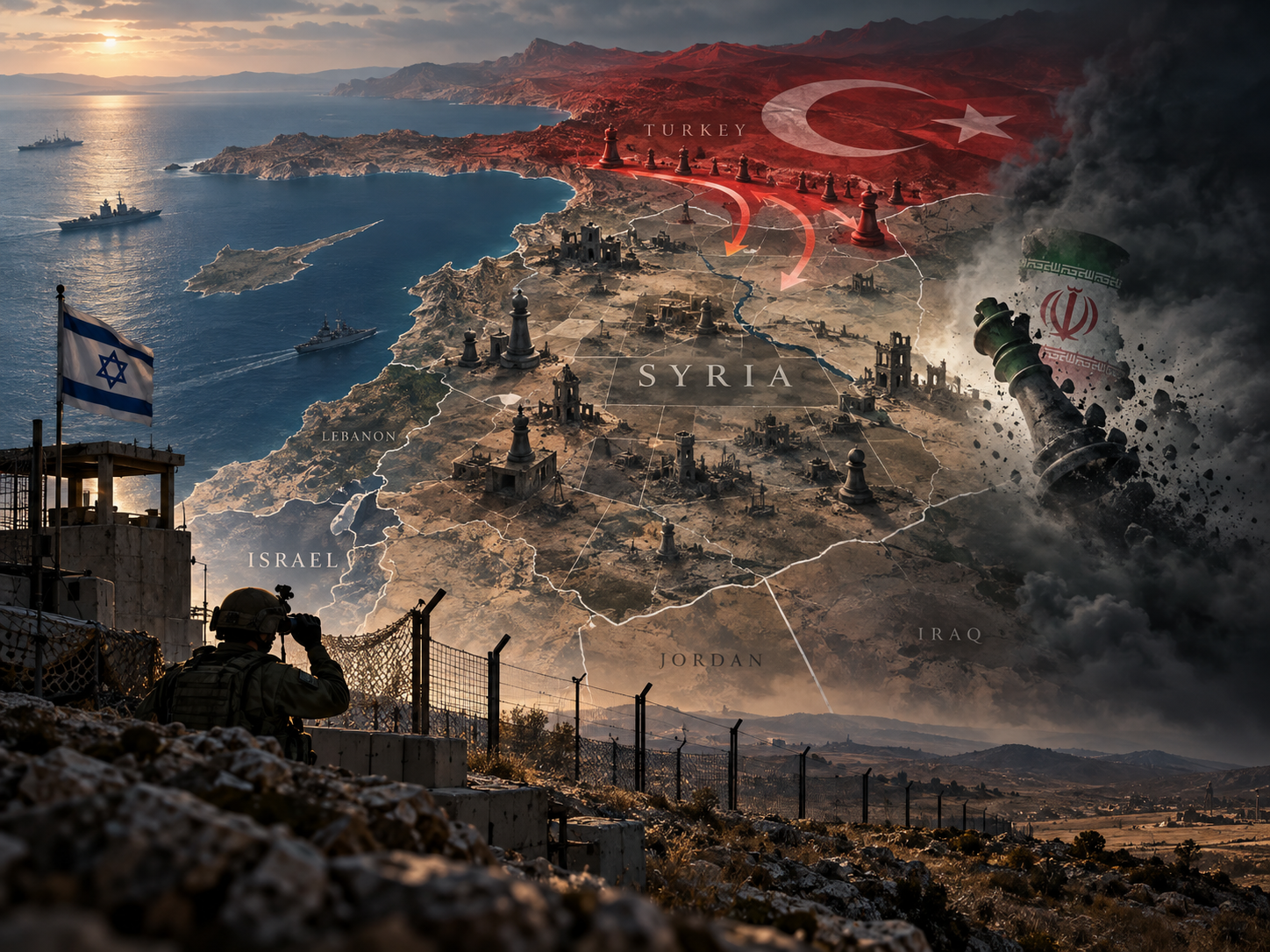
For several months, Israel has seen the weakening of Iran and its allies as a major change in its strategic environment. Hezbollah has been badly hurt, Bashar al-Assad’s Syria is gone, and Tehran must now focus more on its own struggles with Washington and Jerusalem. At first, this may seem good for Israel. But in geopolitics, when one power steps back, another often steps in.
This is happening now in Syria. Where Iran once built its influence all the way to Lebanon, Turkey is now advancing its own interests. Ankara has become a key partner of the new Syrian government and is trying to shape the country’s future. Turkey’s role is not the same as Iran’s, but for Israel the main question is: which power will have real influence just north of its border?
Recent tensions between Israel and Turkey over Syria show this is not just a theory. In August, Israel bombed the Syrian base at Abu al-Duhur, saying Damascus was about to let Turkish forces in. Ankara and Syrian authorities denied this, but the episode shows that Israel now sees Turkey’s military expansion in Syria as a security issue. Israeli and Syrian officials have even discussed this Turkish presence directly.
Another important point: Reuters reported that in September, members of the new Syrian government and Hezbollah held secret talks in Turkey to ease their tensions. Ankara and Damascus denied the meeting. Whether it happened or not, the fact that Turkey is seen as a possible go-between shows the new role it wants: not just a border power, but a country able to shape part of the region’s politics.
Turkey’s actions go beyond Syria. It is also working more closely on security with Saudi Arabia and Pakistan. Ankara now supports Riyadh with technical and defensive help against the Houthis. This does not mean a new anti-Israel bloc is forming—Turkish, Saudi, and Pakistani interests are still different and sometimes competing. But the trend is clear: several regional powers want more independence and their own security tools.
This creates a paradox for Israel. Since October 7, 2023, its strategy has focused on restoring deterrence and reducing its enemies’ abilities. Militarily, Israel has changed the regional balance. But military power alone cannot organize the space left behind. Weakening Iran doesn’t answer who will fill the political, diplomatic, and military gap.
Turkey is not Iran. It is a NATO member, has economic ties with Israel, and mainly follows its own ambitions. It would be too much to call it a new strategic enemy. But Turkey is an ambitious regional power, with a strong defense industry, a wide diplomatic network, and growing ability to act from Syria to the Gulf. Israel must now consider this rise, not just the idea of a new confrontation.
The Middle East that is emerging may be more multipolar. For years, much of Israel’s strategy was about containing Iran and its allies. Tomorrow, Israel may have to handle a more active Turkey in Syria, a more independent Saudi Arabia, Gulf states seeking new partners, and a weakened but still active Iran.
This may be the real issue after Iran. Israel can defeat a threat without controlling the regional order that follows. Iran’s retreat gives Israel a strategic opening, but also brings uncertainty. The next challenge for Jerusalem may not just be to stop a rival from becoming too strong, but to live in a region where several mid-sized powers want to set their own rules.
So, it is possible that while Israel becomes stronger militarily after its confrontation with Iran, it enters a more complex regional environment. The strategic void left by Iran’s retreat is not yet filled. But Turkey, among others, has already started moving its pieces into place.