
Geopolitical & Defense Analyst
Turkey’s Subsea Blockade Threatens Israel
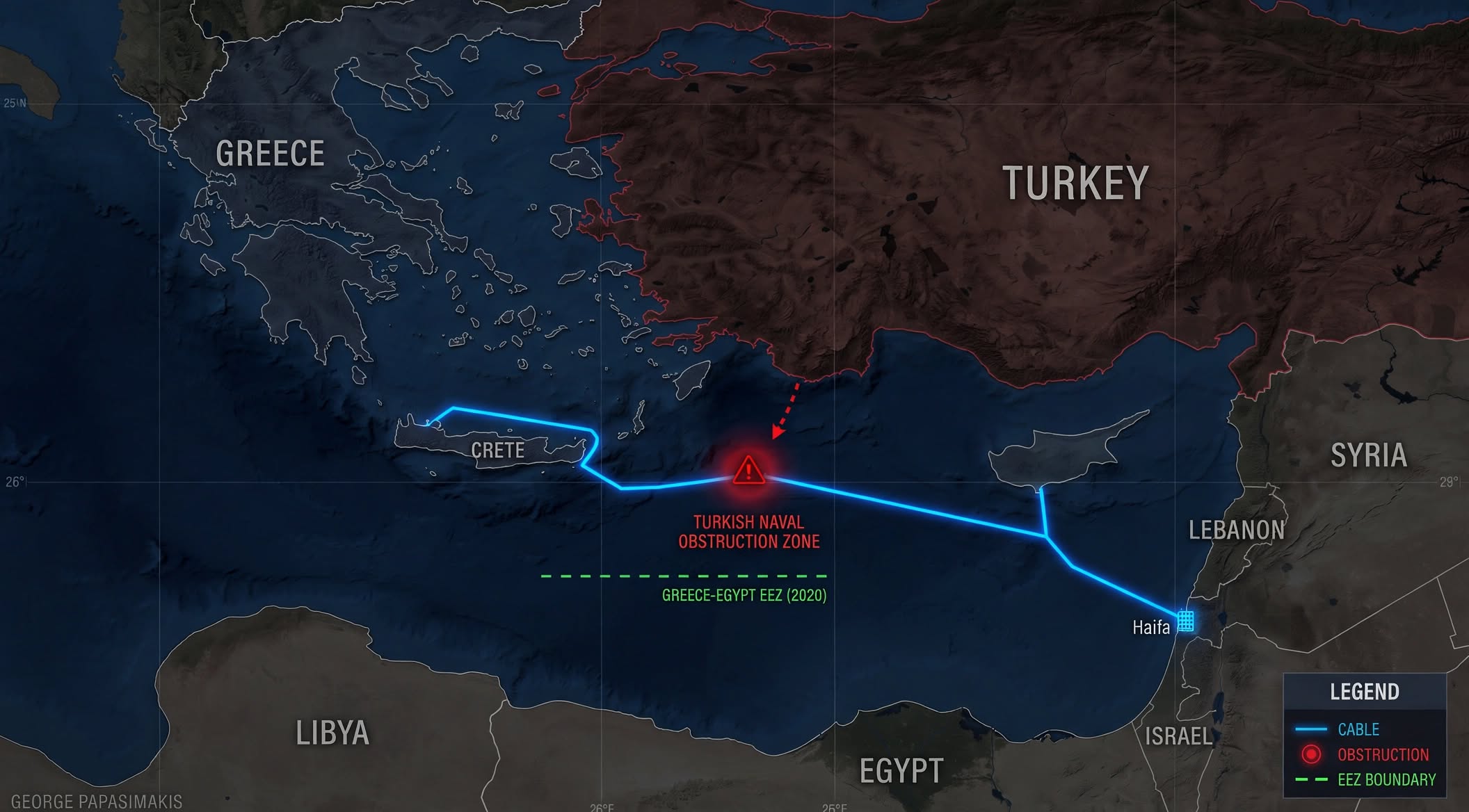
The Greece–Cyprus–Israel strategic triangle (Souda–Cyprus–Haifa) and the Great Sea Interconnector route. (AI-assisted visualization / George Papasimakis)
When Turkish warships intervened to halt seabed survey operations for the Crete–Cyprus electrical interconnector south of Kasos and Karpathos, many Western commentators dismissed the episode as routine Greek–Turkish friction. For defense planners in Jerusalem, reading this standoff through a narrow Aegean lens would be a serious mistake.
What is happening on the seabed between Crete and Cyprus goes far beyond a bilateral maritime dispute. It is a direct test of the energy and security architecture linking Israel, Cyprus, and Greece, and a calculated effort by Ankara to secure a de facto veto over Israel’s physical connection to Europe.
The Great Sea Interconnector: Breaking Israel’s Grid Isolation
The Great Sea Interconnector (GSI), formerly known as the EuroAsia Interconnector, is a 1,200-kilometer high-voltage direct current (HVDC) subsea cable designed to link the national power grids of Israel, Cyprus, and Greece. Once completed, it will connect Israel to the continental European electricity market for the first time.
For decades, Israel has functioned as an “energy island,” exposed to regional shocks and cut off from neighboring grids. Beyond its commercial value, the GSI is a core strategic asset. It ends Israel’s grid isolation, strengthens energy resilience, and anchors Jerusalem directly into Europe’s critical infrastructure.
By deploying naval vessels to intimidate European-flagged survey ships in international waters, Ankara is invoking its legally unfounded “Blue Homeland” (Mavi Vatan) doctrine and the 2019 Turkish–Libyan memorandum. Yet the waters south of Kasos and Karpathos lie squarely within the Exclusive Economic Zone lawfully delimited between Greece and Egypt in August 2020. If Turkey succeeds in stalling European contractors and freezing the Crete–Cyprus leg, the subsequent Cyprus–Israel section becomes commercially and operationally stranded. Without firing a shot, Ankara is attempting to hold Israel’s European energy corridor hostage.
Coercive Diplomacy and Maritime Law
Israeli strategists recognize this pattern immediately. Whenever Ankara senses hesitation from democratic alliances, it relies on gray-zone naval pressure and revisionist claims to alter realities at sea.
Under the United Nations Convention on the Law of the Sea (UNCLOS), specifically Articles 58, 79, and 112, the right to lay submarine cables within Exclusive Economic Zones and on the continental shelf is unambiguous. Coastal states cannot arbitrarily obstruct cable-laying operations, and third states holding unrecognized claims hundreds of miles from their own coastline have zero legal standing to interfere. Allowing Turkey to enforce an informal blockade against a European Union Project of Common Interest (PCI) sets a dangerous precedent across the Eastern Mediterranean: it signals that naval intimidation overrides international law.
Air Superiority and the Role of Greece’s F-16 Vipers
Diplomacy in the Eastern Mediterranean carries weight only when backed by credible military deterrence. While Athens maintains open diplomatic channels to preserve regional calm, it is simultaneously executing the largest qualitative upgrade of the Hellenic Air Force (HAF) in decades.
At the center of this effort is the modernization of 83 F-16 aircraft to the Block 70/72 Viper standard, equipped with the AN/APG-83 Scalable Agile Beam Radar (SABR), an active electronically scanned array (AESA) radar derived from fifth-generation fighters. Operating alongside Greece’s Rafale fleet, upgraded Mirage 2000-5 aircraft, and its path toward the F-35, the Viper program alters the balance of air power across the Aegean and the Eastern Mediterranean.
For Israel, a technologically advanced and militarily capable Greece provides vital strategic depth to its west. Over the past decade, cooperation between the Israel Defense Forces (IDF) and the Hellenic Armed Forces has matured into a genuine stabilizing factor, anchored by joint drills such as Iniochos and Noble Dina alongside major defense-industrial projects like the International Flight Training Center in Kalamata.
Securing the Trilateral Corridor
Regional history leaves little doubt about the cost of appeasing revisionism. If Ankara is allowed to dictate which subsea cables may be laid between EU member states and Israel, its next move will to challenge maritime transit, offshore energy exploration, and defense coordination across the entire Levantine basin.
Breaking this impasse requires coordinated, practical deterrence:
-
Visible Maritime Protection: Athens, Nicosia, and Jerusalem, supported by Washington and Brussels, should treat the uninterrupted completion of the Great Sea Interconnector as a strategic priority, ensuring a coordinated naval presence so survey and cable-laying vessels can work without interference.
-
Operational Infrastructure Security: The Greece–Cyprus–Israel trilateral framework must translate diplomatic alignment into concrete protection protocols, linking intelligence sharing, maritime surveillance, and air-defense coverage along critical subsea routes.
Protecting the subsea link between Israel, Cyprus, and Greece goes well beyond megawatts and power grids. Backed by credible air and naval deterrence, it is a test of whether the free nations of the Eastern Mediterranean will secure their own strategic autonomy.
References
-
United Nations Convention on the Law of the Sea (UNCLOS), Articles 58, 79, and 112.
-
Agreement between the Hellenic Republic and the Arab Republic of Egypt on the Delimitation of the Exclusive Economic Zone, August 6, 2020.
-
European Commission, Projects of Common Interest (PCI) & Connecting Europe Facility (CEF): Great Sea Interconnector.
-
U.S. Defense Security Cooperation Agency (DSCA), Hellenic Air Force F-16V (Block 70/72) Modernization Program.
-
Trilateral Summit Declarations (Greece–Cyprus–Israel), Joint Commitments on Energy Security and Critical Infrastructure Protection.
Related Topics
Related Posts