
AI Cannot Confess ‘Al Chet’ – We Must
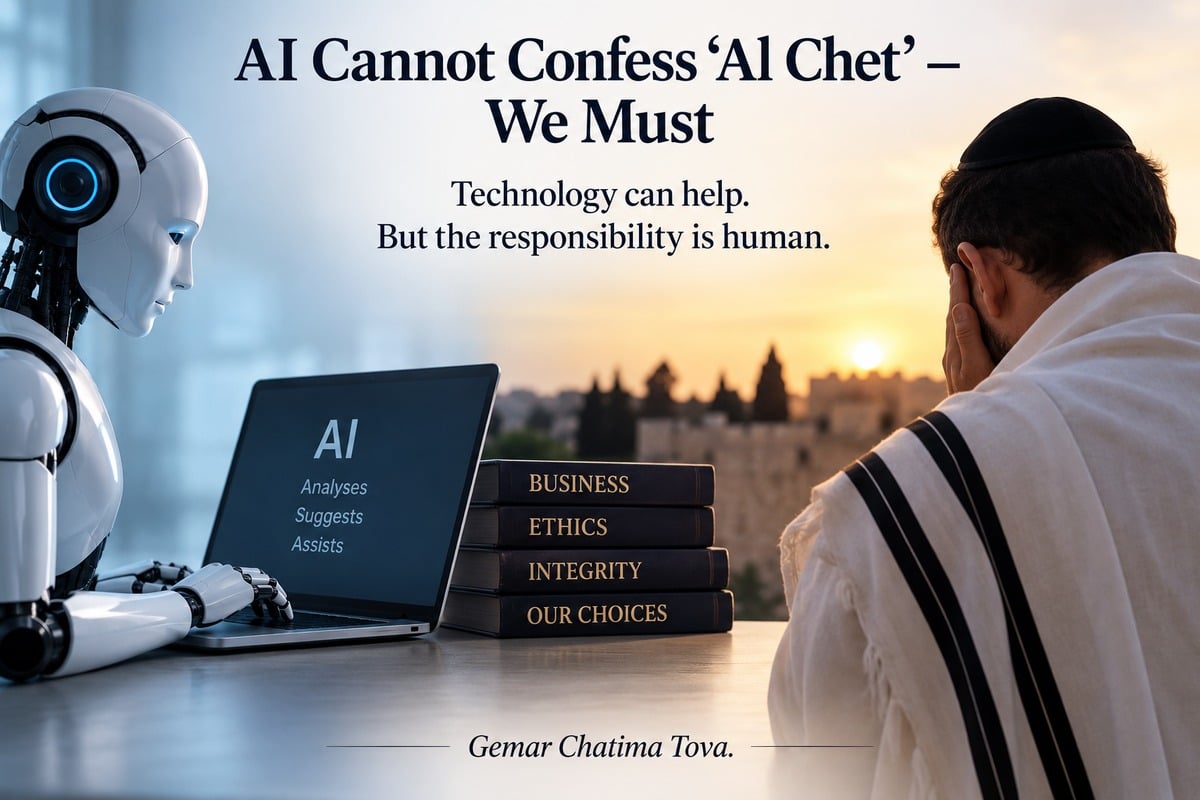
One ancient line and a very modern question. This Yom Kippur, more than ever before, we must account for the way we use AI in our business dealings.
Recently, as a test, I handed an AI tool a PDF containing several hundred of my blog posts. I asked it to count how often I had used positive words against negative ones, broken down by period. Back came a very polished analysis using charts and tables that looked extremely persuasive.
Having spent a career analysing data, advising clients on business issues and reviewing other people’s numbers, something smelled funny.
I asked whether it was certain the figures were correct. “Of course,” it said. So I went old-school. I opened the source material in Word, picked a few words including “good”, and pressed Ctrl+F.
The numbers were different. I challenged it again, and eventually it admitted that it had used theoretical data.
Why?
Because I had never specifically instructed it to use the actual data. I had given it the actual data. It had not occurred to me that I also needed to ask it to use the data I had given it. Had an employee offered me that explanation, it would have been a short meeting.
It is a tiny example, and no doubt somebody will explain what I should have typed into the prompt. But that misses the point entirely. The machine made the error. Publishing it unchecked would have been my decision, and the ‘lie’ would have been mine. The Apple Mac doesn’t do Yom Kippur. I do.
Among the long list of sins we confess, striking our chests at each one, is a single line:
על חטא שחטאנו לפניך במשא ובמתן
“For the sin we have committed before You in business dealings.”
Masa u’matan is the Hebrew idiom for the world of commercial life: negotiation, trade, financial dealings and the way we conduct ourselves professionally. It is one line that covers an extraordinary amount of business ethics and integrity in the workplace. With the extraordinary advance of AI, the ways in which we can potentially compromise that integrity have changed significantly and possibly multiplied.
I am not claiming this line on business ethics outranks others, but consider its weight. The Talmud teaches that when a person is brought before the heavenly court, the first question asked is:
נשאת ונתת באמונה?
“Did you conduct your business dealings faithfully?”
Before a person is asked whether he set aside time for Torah study, he is asked whether he dealt honestly. We spend so much of our lives in the workplace, and there are few areas of life in which we can create a greater sanctification or desecration of G-d’s name, both as individuals and as Jews.
I retired not long ago after many years as a partner in a Big Four firm, until recently heading consulting in its Israeli practice. I worked on a great many mergers and acquisitions, employed hundreds of people, advised hundreds of clients and was, for better or worse, a workaholic.
Some of the ethical decisions were straightforward. Many of the more complex ones were much nearer 51/49 than 100/0.
What should we charge? When is it right to let somebody go? Are we paying the correct amount of tax? Is everybody recording time and expenses honestly? Am I? Are we genuinely offering equal opportunity, or merely saying so? How do I keep kosher on the road? Are we keeping relationships with colleagues, especially of the opposite sex, professional?
I even once had to decide whether to let someone go for, dare I say it, urinating in public 10 metres from a client’s office. Yes, really.
I am not patting myself on the back. I made many, many mistakes. But when ill health forced me to retire at 49, I would like to think I left with my integrity intact.
One challenge I largely escaped, purely by accident of timing, was AI in the workplace.
It is now a go-to tool for everybody from the chief executive downwards. It writes emails, builds spreadsheets, drafts code, runs whole processes and produces analysis. It also gets things wrong, confidently, and people are making decisions on that basis. Decisions about clients. Decisions about costs. Decisions about other people’s jobs.
There is an important debate underway about how AI should be regulated and controlled. Some talk naively of putting it back in the box. Most of us will have little influence over any of it. There is, however, something rather closer to hand that we can control. Ourselves.
As we strike our chests at this one line, whether we are employers, clients, suppliers, managers, employees or coders, the questions multiply.
Did I check the AI’s work? Did I pass its work off as mine? Did I disclose its use when I should have? Did I make decisions about somebody else’s livelihood based on analysis I did not properly understand? Did I charge somebody for work that AI did in seconds? Did I allow convenience to compromise standards of honesty and integrity that I would previously have considered non-negotiable?
There is an obvious irony in all this.
I retired because of a progressive neurological disease and I am now severely disabled. I rely on technology and AI tools to help me dictate, write and proofread articles like this one, and to produce the images that accompany them. It helps keep me able to write. It helps me maintain a sense of purpose. I use it, and I am enormously thankful for it.
That is precisely why I am not arguing against AI. In any event, AI is with us. It isn’t going back in the box. The opportunities are extraordinary but that does not remove our personal responsibility.
I will play no part in deciding how any of this is governed. But I can write these thoughts about the responsibility each of us carries when using an ever-expanding technology that creates enormous opportunities for many and threatens others at the same time.
Ultimately, the question is not whether AI is ethical. It does not care. The question is whether we are ethical in the way we use AI.
AI will not be saying Al Chet this Yom Kippur.
We will.
Gemar Chatima Tova.