
Middle East Analyst
Are Americans Who Use the Term ‘Artificial Intelligence’ the Enemy?
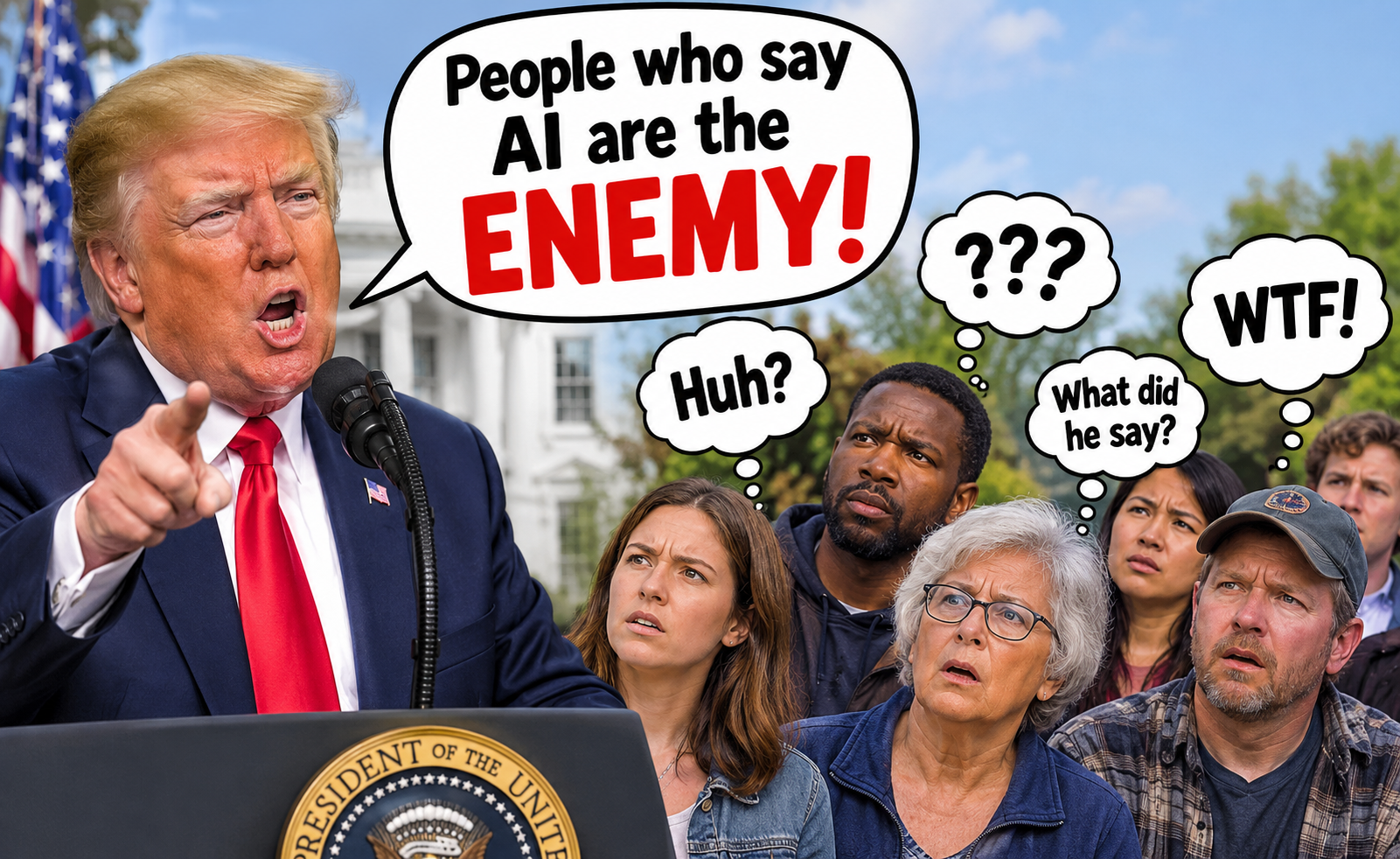
by author (AI)
Trump’s campaign to rename AI raises questions about scientific accuracy, free speech, political polarization, and the future of technology regulation.
On October 8, 2026, President Donald Trump escalated his campaign to replace the familiar term artificial intelligence with super intelligence. In a post on Truth Social, he declared:
“The White House considers anyone that uses the term, ‘Artificial Intelligence,’ as opposed to the highly accepted new and more accurate term, ‘Super Intelligence,’ THE ENEMY!”
The statement was not delivered at a rally or in a formal presidential address. It was a social-media declaration made against the backdrop of an administration effort to change how the federal government refers to AI. Less than two weeks earlier, Trump had discussed the proposed terminology at the United Nations General Assembly, arguing that the word artificial made intelligence sound fake. He wanted official American documents to use super intelligence instead.
There is a legitimate policy question here: Should a government establish standardized terminology for its own agencies? Of course. Governments routinely define terms for legislation, administrative procedures, and official communications. There is also a legitimate debate about whether the public’s understanding of emerging technologies is shaped by the words used to describe them.
But Trump’s latest statement raises a substantially different question. Is it appropriate for an American president to characterize people who continue using an established scientific term as enemies of his administration?
That question deserves serious consideration, independent of one’s political affiliation, opinion of Trump, or position on artificial intelligence.
The backlash: A dispute over more than a name
The president’s declaration prompted criticism from journalists and technology commentators who questioned both the terminology and the political message behind it. Axios highlighted the contradiction between Trump’s demand and the continued use of artificial intelligence in White House communications. The Independent characterized the statement as an escalation in the president’s broader campaign against established terminology. The Verge questioned the attempt to recast the technology in language that could obscure legitimate concerns about its capabilities and risks.
The scientific objection is straightforward. Artificial intelligence is an established umbrella term for a broad range of computational systems and techniques. It does not necessarily mean that a machine possesses human-like consciousness, genuine understanding, or intelligence equivalent to our own. Nor does the term imply that the technology is fake.
Superintelligence, meanwhile, has a more specific meaning in AI research and public debate: a hypothetical or prospective level of intelligence that surpasses human capabilities in important respects. It is not an interchangeable label for every existing AI system. Applying it indiscriminately to today’s chatbots, image generators, predictive systems, and other AI applications risks confusing rather than clarifying the discussion.
The distinction matters. A government can choose a preferred term for official communications, but it cannot settle a scientific question merely by changing a label. Nor does describing a technology more optimistically establish that its risks have been exaggerated.
Trump’s supporters might reasonably argue that super intelligence sounds more positive and better conveys the technology’s potential. But the president’s preference does not make the phrase scientifically more accurate across the entire field.
There is also an important distinction between the executive branch’s authority to standardize its own language and any claim that private citizens, researchers, journalists, universities, or companies should adopt the same terminology. The former is a normal function of government administration. The latter raises questions about scientific independence and freedom of expression.
Does the language of the president have a chilling effect?
The most consequential part of Trump’s statement may not be his proposed terminology. It is the word enemy.
American presidents have considerable influence over public discourse. Their words can legitimize positions, stigmatize opponents, and signal which views are welcome within the administration. When a president declares that people who use a familiar scientific term are enemies, he introduces a political test into what should remain an open intellectual debate.
There is a crucial difference between saying that a term is misleading and saying that the people who use it are enemies. The first invites argument. The second risks discouraging it.
The president has not, in the reporting available as of October 9, announced a specific penalty for private citizens, researchers, or companies that continue using artificial intelligence. The September executive order formalized the terminology change for federal agencies, but that is not the same as establishing a prohibition on private speech.
That distinction matters legally. Trump’s statement does not, by itself, establish that anyone’s First Amendment rights have been violated. Nor does the word enemy, however inflammatory, automatically constitute an enforceable threat. The legal analysis would depend on what the government actually did, whether it imposed penalties or conditioned benefits on speech, and the circumstances involved.
But the absence of an announced punishment does not eliminate the potential chilling effect.
A university researcher seeking federal grants, a technology company negotiating government contracts, or a scientist participating in an official advisory process might reasonably wonder whether using the disfavored terminology could attract unwanted scrutiny. A journalist might wonder whether the administration would treat critical coverage as evidence of hostility. A company might decide that avoiding controversy is more commercially prudent than defending its vocabulary.
These are plausible risks, not evidence that such retaliation has already occurred. That distinction should be preserved.
The broader principle is nevertheless important: Government pressure need not take the form of a formal ban to influence behavior. When the president attaches the label enemy to an otherwise ordinary expression, he can create incentives for people to remain silent, accommodate the administration, or avoid a legitimate controversy altogether.
The concern becomes especially serious when the subject is a technology whose capabilities, limitations, and risks remain contested.
The scientific debate that should remain open
The argument over terminology intersects with one of the most consequential unresolved questions in modern technology: How close are we to superintelligent AI, and what would reaching that threshold actually mean?
There is no universally accepted finding that today’s AI systems have achieved superintelligence. Researchers disagree about how intelligence should be measured, which capabilities matter most, how quickly systems may advance, and whether improvements in existing methods will be sufficient to reach human-level or beyond-human performance across a broad range of tasks.
The term singularity adds another layer. It is commonly used to describe a hypothetical point of technological development at which progress becomes so rapid or transformative that its consequences become difficult to predict. It is not a synonym for ordinary AI, and it is not an established milestone that researchers can confirm simply by adopting a preferred label.
Some researchers warn that increasingly capable systems could eventually create severe risks, including loss of human control over critical processes. Others argue that public discussion exaggerates speculative dangers, distracts from immediate problems, or mistakes impressive demonstrations for general intelligence. Still others focus on tangible concerns already emerging from the technology, including employment disruption, misinformation, cybersecurity, and concentration of economic power.
All these positions deserve scrutiny.
If artificial intelligence becomes politically disfavored because the president believes the word encourages fear, does that make the underlying questions less legitimate? Does describing the technology as super intelligence make concerns about safety less reasonable? And if a scientist believes that a particular system has not demonstrated superintelligence, should that scientist feel pressure to use a label that implies otherwise?
A change in terminology cannot resolve any of those questions.
Indeed, calling all AI super intelligence could make public discussion less precise by blurring the distinction between today’s systems and hypothetical future systems with capabilities substantially beyond human performance. Scientific terminology should help researchers distinguish between what exists, what has been demonstrated, what remains uncertain, and what is merely anticipated.
That is not an argument against optimism about AI. It is an argument for intellectual honesty.
The political context: AI has become an electoral issue
Trump’s declaration arrives at a particularly consequential moment. Artificial intelligence is no longer simply a technology-policy debate confined to Silicon Valley, research laboratories, and congressional committees. It has become a question about employment, household finances, energy prices, national competitiveness, and the distribution of economic power.
A Reuters/Ipsos poll published October 7 found that 57% of registered voters believed the Trump administration was not taking AI risks seriously enough, while 54% said the same of Congress. The survey also found substantial concern about potential job losses and the possibility that AI could threaten humanity’s future.
Those findings do not establish that AI is the top concern for every voter, or even that it ranks first in the electorate overall. They do establish that public concern is politically relevant and that many voters want more attention paid to the technology’s risks.
The partisan pattern is also changing. Pew Research Center reported in September that 56% of Democrats and Democratic-leaning independents were more concerned than excited about AI’s growing role in daily life, compared with 49% of Republicans and Republican-leaning independents. The gap reflects a shift toward greater concern among Democrats and declining concern among Republicans relative to earlier years.
This creates a potential political vulnerability for the administration. A president who characterizes critics of AI as enemies risks reinforcing the impression that his administration is more interested in promoting the technology than examining its consequences.
That impression may be particularly damaging among voters worried about their jobs, their children’s prospects, rising electricity bills, or the influence of wealthy technology companies over public policy.
There is also a distinction between supporting American leadership in AI and supporting every decision made by the companies developing it. Voters can want the United States to compete successfully with China while simultaneously demanding safeguards, accountability, and protections against economic disruption.
Those positions are not contradictory. They are compatible with a practical, national-interest approach to technology policy.
Did the AI industry help create the political problem?
The administration’s approach cannot be understood without considering the industry’s own political strategy.
AI companies and their financial backers have invested heavily in efforts to elect candidates who favor rapid development and relatively light regulation. Pro-industry political organizations have also targeted candidates who support stronger oversight.
Axios reported in July that the pro-AI super PAC Leading the Future held approximately $31 million in cash after transferring funds to affiliated groups. The broader political effort has involved substantial spending intended to influence congressional races and the future regulatory environment.
Some of that political activity has favored Republicans, particularly candidates who support a light regulatory touch. The pattern is real, although the industry should not be treated as a single political bloc: different companies, investors, and advocacy groups have backed competing approaches, including stronger safety oversight.
The industry nevertheless has a legitimate public-relations problem. When technology executives spend heavily to influence elections and oppose regulations, critics can reasonably ask whether their political investments are intended to protect innovation or to shield their businesses from accountability.
The distinction cannot be resolved simply by assuming bad faith. Campaign spending can reflect genuine beliefs about economic growth, national security, and competition with China. But it can also serve commercial interests. The relevant question is what policies the money supports and who bears the consequences.
Trump’s rhetoric risks making that problem worse. Rather than persuading skeptical voters that the industry deserves public trust, branding terminology critics as enemies may encourage the perception that the administration and influential technology executives want to control not only the direction of AI development but also the language in which its consequences can be discussed.
Yet responsibility does not rest entirely with the president. The industry’s campaign spending has already helped make AI policy a partisan electoral battleground. The president’s statement adds another layer to that polarization.
Data centers: The backlash is not exclusively Democratic
The politics of AI infrastructure illustrate why this is a dangerous strategy.
Large data centers require substantial electricity, land, cooling capacity, and supporting infrastructure. Communities have raised concerns about noise, water use, environmental effects, local development, and whether increased electricity demand will ultimately raise household bills.
It would be inaccurate to characterize opposition to data centers as primarily or exclusively a Democratic phenomenon.
A University of Pennsylvania Annenberg Public Policy Center survey released in September found that 61% of Americans opposed building new data centers in their local area. Opposition included 69% of Democrats, 54% of Republicans, and 53% of independents.
Democratic opposition has often been particularly visible in blue states and among environmental and consumer-protection advocates. But Republicans have also begun responding to constituents who worry about electricity costs, land use, and the benefits flowing to large corporations.
The Washington Post reported in August that President Trump continued defending data center development even as Republican officials in several states became more critical of projects that had angered local voters.
This is an important distinction: Opposition to a particular data center is not necessarily opposition to AI itself. Someone may support technological innovation while insisting that developers pay the full cost of the electricity they consume, that local communities have a voice, and that economic benefits are not concentrated among a handful of corporations.
Those are questions of public policy, not ideological disloyalty.
If the administration treats criticism of AI infrastructure as hostility toward technological progress, it risks alienating voters who are not opposed to innovation but want its costs and benefits distributed more fairly.
What happens if Democrats win Congress?
The November 2026 midterm elections could determine whether the next major phase of AI policy is shaped primarily by the current administration or by a more assertive Congress.
If Democrats win control of the House, and possibly the Senate, they are likely to have greater opportunities to investigate AI companies, scrutinize campaign spending, examine employment effects, and advance legislation addressing safety, transparency, data centers, and consumer protection.
The precise agenda would depend on the election results and the balance between moderates and progressives. Democrats do not agree on every regulatory question, and there are Republicans who support some forms of oversight as well. The result would not necessarily be a comprehensive regulatory regime, nor would congressional control guarantee that proposed legislation becomes law.
Nevertheless, the direction of the debate is clear enough to make regulation a plausible concern for an administration committed to accelerating AI development.
Recent reporting has documented divisions among Democrats over whether to pursue a broad regulatory framework or more targeted measures, while industry-backed political organizations have attempted to influence which candidates prevail.
Is this what Trump had in mind when he declared users of the term artificial intelligence to be enemies?
It is a plausible interpretation of the political context, but it is not an established fact. The president’s public explanation for the terminology change has centered on his belief that artificial makes the technology sound fake and that super intelligence is more accurate and positive. There is insufficient evidence to conclude that his specific statement was a calculated response to the prospect of a Democratic congressional majority.
The political effect, however, may be more important than the original motive.
By framing a terminology dispute in terms of enemies and allies, Trump risks encouraging the perception that support for his administration’s preferred AI policy is a test of political loyalty. That would be a mistake even if his underlying objective is to discourage excessive regulation or to promote American technological competitiveness.
A successful national AI strategy requires public confidence, credible scientific assessment, and political support that can survive changes in administration. It cannot depend indefinitely on one party’s control of the federal government.
The larger question is trust
Trump’s supporters may regard his declaration as rhetorical exaggeration or an attempt to promote a more optimistic view of a transformative technology. They may argue that the administration is simply trying to correct a misleading name and that no private speaker has been prohibited from using the traditional term.
Those arguments deserve consideration. The absence of a formal speech restriction is significant, and the government’s authority to determine its own terminology should not be confused with a general prohibition on alternative language.
But rhetoric from the president carries weight beyond its literal legal consequences. A declaration that people using a familiar scientific term are the enemy can undermine confidence that the administration welcomes independent scrutiny. It can also make a technically complex subject more difficult to discuss without partisan assumptions.
That is particularly counterproductive when the technology in question is changing rapidly and its economic and social effects remain uncertain.
The United States needs a serious debate about AI: what the technology can do today, what it might do tomorrow, how to preserve its benefits, how to manage risks, and how to ensure that the gains are not purchased at an unacceptable cost to workers, communities, or democratic institutions.
That debate requires more than enthusiasm, and it requires more than fear. It requires accurate terminology, open scientific inquiry, competing hypotheses, and the willingness to distinguish demonstrated capabilities from predictions.
The president is free to prefer super intelligence. Federal agencies can be directed to adopt that terminology within the scope of lawful executive authority. Private citizens, researchers, journalists, and companies should remain free to disagree.
The decisive question is not whether artificial intelligence is the perfect name for the technology. It is whether Americans can continue debating the technology honestly without being cast as political enemies for choosing different words.
A president should be able to advocate for a technology without demanding rhetorical loyalty to it. And an administration confident in the benefits of AI should have little reason to fear the people who insist on examining its risks.
Calling critics enemies does not settle the scientific debate, build public trust, or make the technology safer. It risks doing the opposite.
In a democracy, the people who question a policy are not necessarily enemies of progress. Often, they are the people asking whether that progress is being pursued wisely.
Related Topics
Related Posts