
The Fruit of Knowledge: AI, climate, and our children
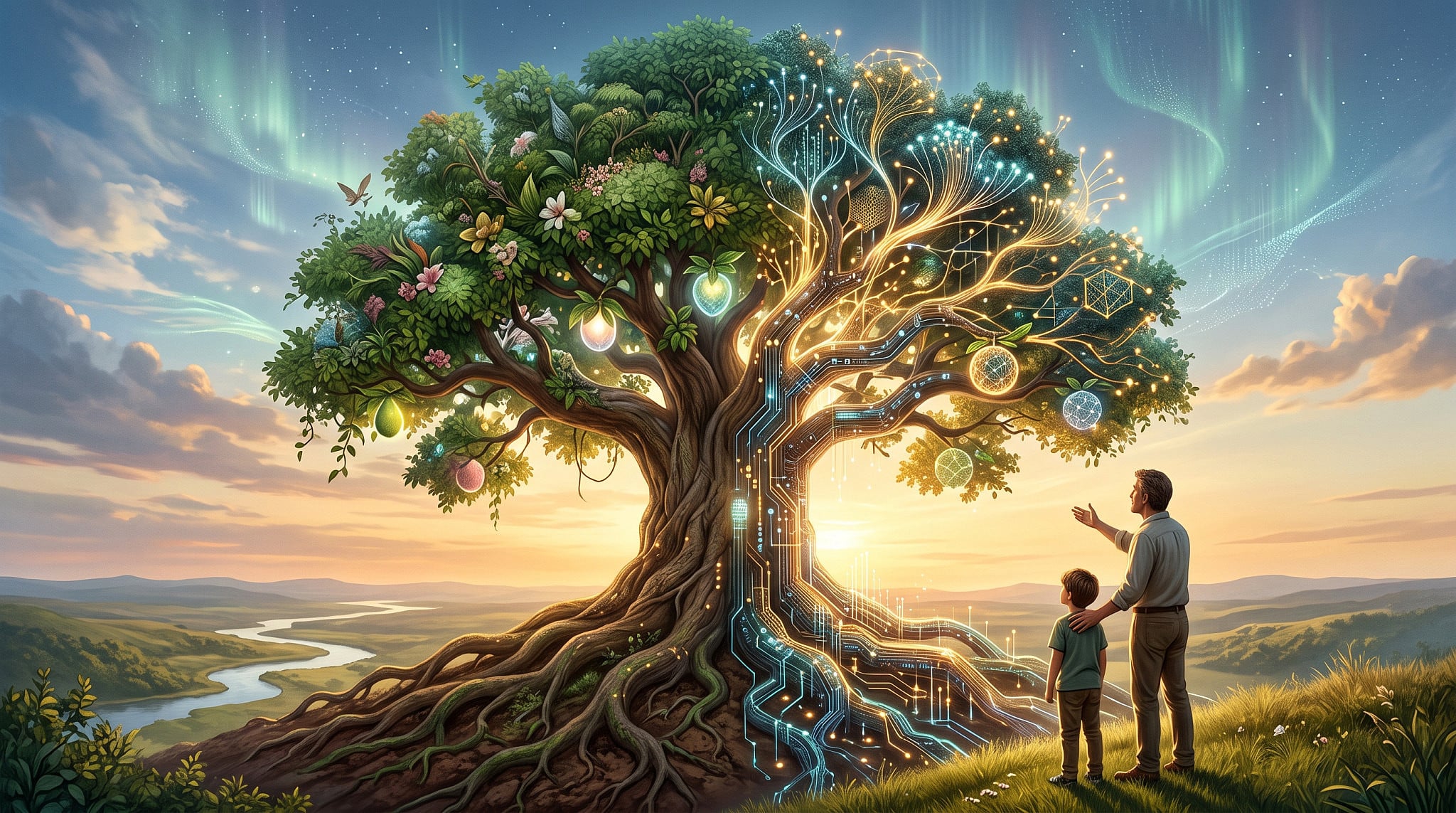
In the opening chapters of Bereishit (Genesis), humanity makes a choice that alters the trajectory of existence. Adam and Eve eat from the Etz HaDa’at Tov VaRa—the Tree of the Knowledge of Good and Evil. In an instant, their eyes are opened. They become acutely conscious of their nakedness, experience shame, and hide from God among the trees of the garden.
But what did they actually gain in that moment? It wasn’t merely a set of facts or a downloadable database. They acquired a fundamentally different way of knowing.
Philosophers have debated the mechanics of knowledge for centuries. René Descartes argued that knowledge begins with internal certainty (“I think, therefore I am”). Empiricists like John Locke and David Hume countered that true knowledge is born from observation and sensory experience. Rationalists like Baruch Spinoza suggested that human reason can transcend immediate experience altogether.
When Adam and Eve ate the fruit, they didn’t just learn new facts; they stepped into self-consciousness, moral agency, desire, and the heavy capacity to choose. Crucially, that moment also shifted their relationship with the Earth itself. In the biblical text, human choice instantly reverberates through the environment: the ground itself is affected by human action. To know, the Torah reminds us, is not a passive act. It is a threshold into power—and power always carries consequences for the world we inhabit.
Knowledge Means Actually Knowing Stuff
We live in a culture that often takes knowledge for granted—or dismisses it as obsolete.
When international PISA (Programme for International Student Assessment) educational results showed academic achievement in England rising significantly in reading, maths, and science—defying post-pandemic declines seen across many OECD nations—it answered a fierce, long-running debate about how we learn.
For years, the prevailing progressive educational view—famously articulated by Sir Ken Robinson in the most-watched TED talk of all time—argued that traditional schooling stifles creativity by focusing on rigid, memorized facts. Instead, Robinson advocated for teaching generic, transferable “skills” like critical thinking and problem-solving.
On the other side stood advocates like former UK Schools Minister Nick Gibb, who argued the exact opposite: critical thinking isn’t an abstract muscle you can train in a vacuum. You cannot think critically about a subject if you do not actually know anything about it. Knowledge is not the enemy of critical thinking; it is the raw material from which critical thought is built. It seems from the results, that Gibb was right.
The underlying fallacy of modern education is the idea that “knowing where to find an answer is the same as knowing it yourself.” If you have to look up every underlying concept, your brain lacks the cognitive working memory to synthesize big ideas, spot patterns, or challenge flawed assumptions.
The Dual Threshold: AI and Climate
The advent of AI, therefore, presents a tremendous challenge in an age of unmitigated access to knowledge. Whilst the internet made facts instantly retrievable, Artificial Intelligence changes the paradigm entirely. AI doesn’t just retrieve and share knowledge; it synthesizes, explains, applies, and creates. It increasingly executes tasks that once required human judgment and creative reasoning.
We are fast approaching a world where we can produce complex work without understanding it, generate essays without reading the sources, and render decisions without mastering the domain. Indeed, this article was written with the help of AI.
The paradox of our era is striking: human knowledge has never been more accessible, yet we can operate with unprecedented power while personally possessing less and less of it.
If AI represents a new Tree of Knowledge, we must ask: how are we handling its fruit?
This challenge does not exist in a vacuum. It mirrors the defining physical crisis of our time: climate change. The ecological crisis is itself the ultimate consequence of an earlier “Tree of Knowledge” moment—the Industrial Revolution. We unlocked the secrets of chemistry, physics, and resource extraction, achieving immense material power. Yet, because that technical mastery outpaced our ecological wisdom and moral restraint, we altered the delicate balance of the planet.
Both AI and the climate crisis represent twin manifestations of the exact same human vulnerability: our access to knowledge is expanding faster than our wisdom.
We cannot solve climate breakdown with superficial slogans or automated quick fixes; it demands deep, rigorous scientific understanding combined with a profound moral commitment to vulnerable people today and future generations tomorrow. Likewise, we cannot navigate the rise of thinking machines if we abdicate our own capacity to know, reason, and take responsibility. The more powerful our technology becomes—whether it is an algorithm or an energy grid—the more critical it becomes that we actually understand the world in which we deploy it.
Knowledge in Our Bones
Yet head-knowledge and technical mastery are still only part of the equation. There is another form of knowing altogether: knowledge absorbed so deeply through lived experience that it becomes instinct.
This is the gift of tradition. Jewish children don’t merely study the concept of Shabbat, the calendar of festivals, the imperatives of tzedakah (justice/charity), or the ethical mandates of shomrei adamah (guardians of the Earth) as theoretical subjects. They live them.
Through family rituals, weekly meals, community gatherings, and seasonal rhythms, these practices seep into their identities. Long before they can read a philosophical treatise on ethics or ecology, they learn how to share, how to pause, how to rest, and how to respect the natural limits of Creation. They don’t just know about their heritage; they learn how to be.
Tradition gives the next generation a head start. It embeds values, boundaries, and instincts into their bones before their minds are mature enough to analyze them intellectually. In an age of rapid climate disruption and hyper-accelerated technology, this embodied wisdom acts as a vital anchor.
What We Pass On
As we face an uncertain future shaped by synthetic intelligence and shifting planetary boundaries, our task is not to retreat from technology or reject progress. The answer is never to fear knowledge, but to cultivate the character required to carry it.
If we want to prepare the next generation for the world ahead, we must strive to give them three distinct gifts:
- Knowledge in their heads — the real, substantive facts and understanding required to think deeply and engage critically with complex systems.
- Judgment in their minds — the moral courage, critical capacity, and ecological awareness to use their power responsibly.
- Tradition in their bones — the lived values, habits, and community rhythms that remind them who they are and what truly matters.
Returning to the garden of Bereishit, the fundamental question was never whether humanity should seek to know. The question has always been what we choose to do with what we know—and what kind of world we choose to pass on to those who come after us.
Shabbat Shalom.