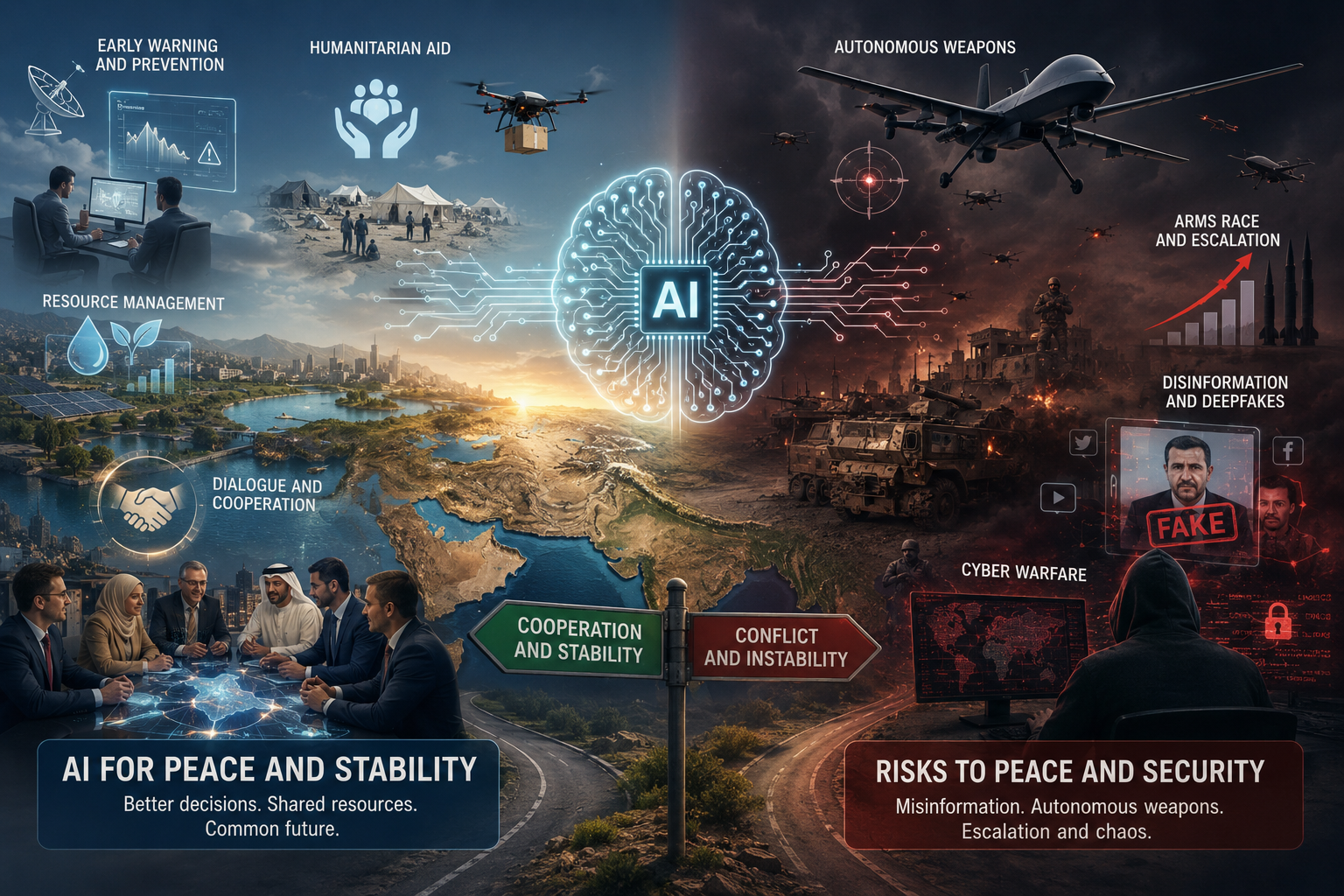
Artificial Intelligence (AI) is rapidly transforming the worlds of economics, science, and society. Yet its impact on international relations and regional conflicts may prove just as profound. In the Middle East, a region marked by security tensions, ideological rivalries, and geopolitical competition, AI has the potential to become both a tool for stability and a catalyst for greater conflict.
On the positive side, studies by organizations such as the RAND Corporation, the United Nations, and the Organization for Economic Co-operation and Development (OECD) highlight AI’s significant potential to improve decision-making. Advanced predictive systems can identify early warning signs of escalation, analyze vast amounts of intelligence data, and assist policymakers in preventing crises before they erupt. In the humanitarian sphere, AI is already being used to manage refugee crises, forecast water and food shortages, and coordinate aid efforts in conflict zones.
In the Middle East, where water scarcity and climate change increasingly contribute to tensions between states, AI could help manage shared resources more efficiently and reduce sources of friction. Furthermore, technological cooperation between rival countries could create mutual economic interests and strengthen channels of dialogue.
However, these opportunities are accompanied by substantial risks. Reports by the International Institute for Strategic Studies (IISS) and the Stockholm International Peace Research Institute (SIPRI) warn of a new arms race driven by autonomous systems. Intelligent drones, automated weapons platforms, and AI-powered cyber warfare tools could lower the threshold for the use of force and accelerate military escalation.
Another major concern lies in the information domain. Generative AI technologies, including deepfakes, enable the creation and dissemination of misinformation on an unprecedented scale. In a highly sensitive region such as the Middle East, a fabricated video of a political leader, religious figure, or military commander could trigger a diplomatic crisis, or even military confrontation, within hours. Researchers at leading universities in the United States and Europe have repeatedly warned that distinguishing truth from manipulation is becoming increasingly difficult.
There is also concern over delegating critical decisions to algorithms. AI systems may inherit biases from their training data or misinterpret complex situations. When security and military decisions are involved, such errors can have severe and potentially deadly consequences.
The question, therefore, is no longer whether AI will influence international conflicts, but how it will do so. If nations adopt effective mechanisms for oversight, transparency, and international cooperation, AI could become a powerful tool for reducing the risk of war and promoting regional stability. Without agreed-upon rules and safeguards, however, it could become a force multiplier for instability, disinformation, and a new generation of arms races.
In the Middle East, where history has been shaped by recurring crises and unexpected turning points, the choice between these two paths may prove decisive in determining the region’s future.