
Russian-American-Israeli Palestinian. Palestine is Israel.
AI Made People Equal
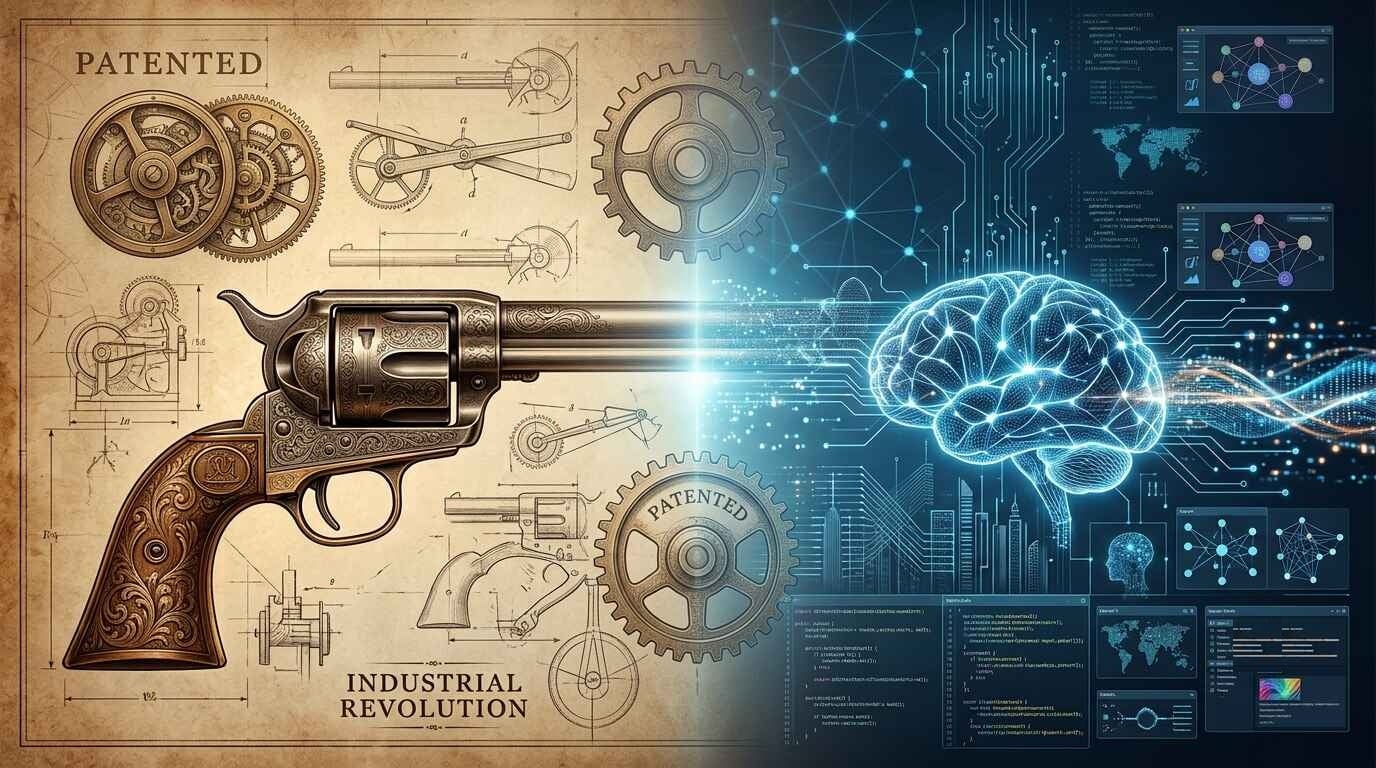
God created men, but Sam Colt made them equal. AI Did It Again. Image © Ivan Bassov, 2026. Licensed under CC BY 4.0.
Sam Colt Made People Equal. AI Did It Again.
We have all heard the famous saying:
God created men, but Sam Colt made them equal.
The saying captures a recurring pattern in human history.
Samuel Colt did not eliminate differences between people. He did something more subtle. His revolver dramatically reduced one of humanity’s oldest advantages: physical strength. A smaller person could now defend themselves against a larger one. A weaker person could challenge a stronger one.
Technology had redistributed power.
Today, we are witnessing another revolution. This time, it is not physical power that is being democratized. It is intellectual capability.
If Colt narrowed the gap between the strong and the weak, AI is narrowing the gap between the expert and the beginner.
Perhaps history will one day remember it differently:
God created men, but Sam Colt and AI made them equal.
In other words, Sam Colt made them physically equal, while AI made them intellectually equal.
That statement is no more literally true than the original quote. But like the original, it captures something profound.
Every Great Technology Democratizes Something
History is not just a sequence of inventions. It is a sequence of equalizers.
The printing press democratized knowledge. Public education democratized literacy. The Internet democratized information. AI democratizes expertise.
For centuries, expertise was accumulated slowly through years of education, practice, and mistakes. Today, a teenager can build software, compose orchestral music, design a logo, translate between languages, create illustrations, analyze legal documents, summarize research papers, write marketing campaigns, or draft business plans—often within minutes.
Not because the teenager suddenly became an expert.
Because expert-level capabilities have become widely accessible.
The barrier to entry has collapsed.
AI Does Not Make Everyone Smart
Critics immediately object: “AI doesn’t make stupid people smart.”
They’re right—but that isn’t what happened.
Colt didn’t make weak people strong. It made strength less decisive. Likewise, AI does not eliminate differences in intelligence, creativity, or judgment. It makes many forms of specialized knowledge less decisive.
Knowing every programming language is less valuable when AI writes code. Perfect grammar matters less when AI edits prose. Memorizing syntax matters less when AI remembers it for you. Translation becomes less about vocabulary and more about intent.
Expertise has not disappeared.
Its role has changed.
Does AI Democratize Talent?
At first glance, the answer seems obvious.
If AI allows anyone to compose music, paint pictures, write software, or design buildings, hasn’t it democratized talent as well?
Not quite.
Talent and expertise are not the same thing.
Expertise is largely accumulated through education, practice, and experience. Talent is something different. It is the ability to see what others do not see, to ask unusual questions, to recognize beauty, patterns, opportunities, or solutions that escape most people.
AI dramatically democratizes expertise. It gives millions of people access to capabilities that once required years of training.
Talent is a different kind of advantage.
AI Doesn’t Create Talent. It Reveals It.
Imagine two people using the same AI music generator.
One produces forgettable background music.
The other creates a composition that genuinely moves people.
They had access to the same technology.
The difference was not the AI.
The difference was taste, imagination, and vision.
For centuries, technical skill was often the gatekeeper of creative expression. A brilliant storyteller with poor writing skills might never publish a novel. Someone with extraordinary musical imagination but no formal training might never compose a symphony. A visionary designer who could not draw might never communicate an idea.
AI removes many of those barriers.
It does not give everyone talent.
It gives talent a chance to become visible.
In that sense, AI may not democratize talent at all.
It democratizes the ability to express it.
For much of history, craftsmanship determined whether talent could be seen. AI increasingly separates the two.
The question is no longer, “Can you make it?”
Increasingly, the question becomes, “Do you have something worth making?”
As AI lowers the barriers to execution, the bottleneck shifts elsewhere.
The New Scarcity
When knowledge becomes abundant, something else becomes scarce.
Information is abundant.
Expertise is increasingly accessible.
Talent is increasingly visible.
The scarce resource is becoming something else: judgment.
The important questions become different.
Not: “What do you know?”
But: “What are you trying to accomplish?”
Not: “Can you write code?”
But: “Can you describe the system that should exist?”
Not: “Can you draw?”
But: “Do you know what should be drawn?”
AI answers questions.
Humans decide which questions matter.
That difference may become the defining skill of the coming decades.
Everyone Can Become a Creator
For most of history, creating something valuable required specialists. You needed programmers, designers, editors, translators, composers, illustrators, and researchers.
Now, one determined individual can coordinate all of these capabilities.
A novelist can create illustrations. An engineer can compose background music. A physician can build software. A historian can produce documentaries. A teacher can create interactive simulations.
The boundaries between professions begin to dissolve.
Perhaps we are returning to an older ideal. Not the narrow specialist, but the polymath.
Except this time, the polymath has AI assistants.
The Rise of the One-Person Company
This may become AI’s largest economic impact.
For centuries, companies grew because no individual possessed every necessary skill. Building a product required teams. Marketing required specialists. Accounting required specialists. Legal work required specialists. Programming required specialists. Design required specialists.
Now imagine a founder working alongside dozens of AI agents.
One agent researches competitors. Another writes software. Another designs interfaces. Another prepares financial projections. Another drafts contracts. Another creates advertising campaigns.
The founder no longer performs every task.
The founder orchestrates them.
The company becomes smaller.
Its capability becomes larger.
The bottleneck shifts from labor to leadership.
Managing AI Is Not Managing People
This creates an unexpected consequence.
Management itself changes.
Traditional management is deeply human. You motivate. You persuade. You negotiate. You resolve conflicts. You conduct performance reviews. You build trust.
AI agents require a completely different kind of management.
They do not need encouragement. They do not become jealous. They do not argue over promotions. They do not resign.
Instead, managing AI resembles directing an orchestra whose musicians never tire.
Success depends on defining objectives clearly, breaking large problems into smaller ones, verifying outputs, coordinating parallel work, and improving prompts.
The future manager may need fewer people skills and more systems thinking.
Ironically, “managing” AI may look less like management and more like architecture.
Why Hire Employees At All?
This uncomfortable question is already emerging.
If AI performs much of the intellectual work, why employ people?
The answer reveals what remains uniquely human.
People are still needed where trust matters. Where accountability matters. Where relationships matter. Where physical presence matters. Where moral responsibility matters. Where lived experience matters.
AI may produce an advertisement.
Only humans decide whether it should exist.
AI may recommend a medical treatment.
Only humans bear responsibility for the patient’s life.
The human role shifts upward—from execution toward responsibility.
Every Equalizer Has Two Sides
The Colt revolver empowered ordinary citizens.
It also empowered criminals.
Technology does not choose its users.
AI follows the same pattern.
It helps researchers discover medicines. It also helps fraudsters write convincing scams. It enables artists. It enables propagandists. It accelerates scientific discovery. It accelerates misinformation.
Every technology that distributes power distributes both its benefits and its dangers.
The question has never been whether technology is good or bad.
The question is whether society can adapt faster than the technology evolves.
The Greatest Shift May Be Psychological
Perhaps the deepest change is not technological at all.
For generations, people defined themselves by what they could do.
“I am a programmer.”
“I am a translator.”
“I am a designer.”
Increasingly, value lies not in performing a task but in deciding which task is worth performing.
Identity shifts from specialist to orchestrator. From craftsman to conductor. From worker to director.
The most valuable person may no longer be the one with the most knowledge.
It may be the one with the clearest vision.
The New Meaning of Equality
AI didn’t make everyone equal — not in the way we once imagined.
People still differ in intelligence, curiosity, discipline, imagination, ethics, wisdom, and courage. Those differences may become even more important.
But AI has done something remarkable.
It has reduced the importance of many advantages that once separated professionals from amateurs.
Just as Colt reduced the importance of physical strength, AI reduces the importance of accumulated technical expertise.
The real revolution is not that everyone becomes equally capable.
It is that capability itself has become widely accessible.
History occasionally produces inventions that permanently change the distribution of power.
The revolver changed who could defend themselves. The printing press changed who could learn. The Internet changed who could publish.
AI changes who can create.
And that may prove to be the most profound equalizer of them all.
—
See Also
Related Topics