
Cohost of "Physics to God" podcast
AI’s More Subtle Existential Threat
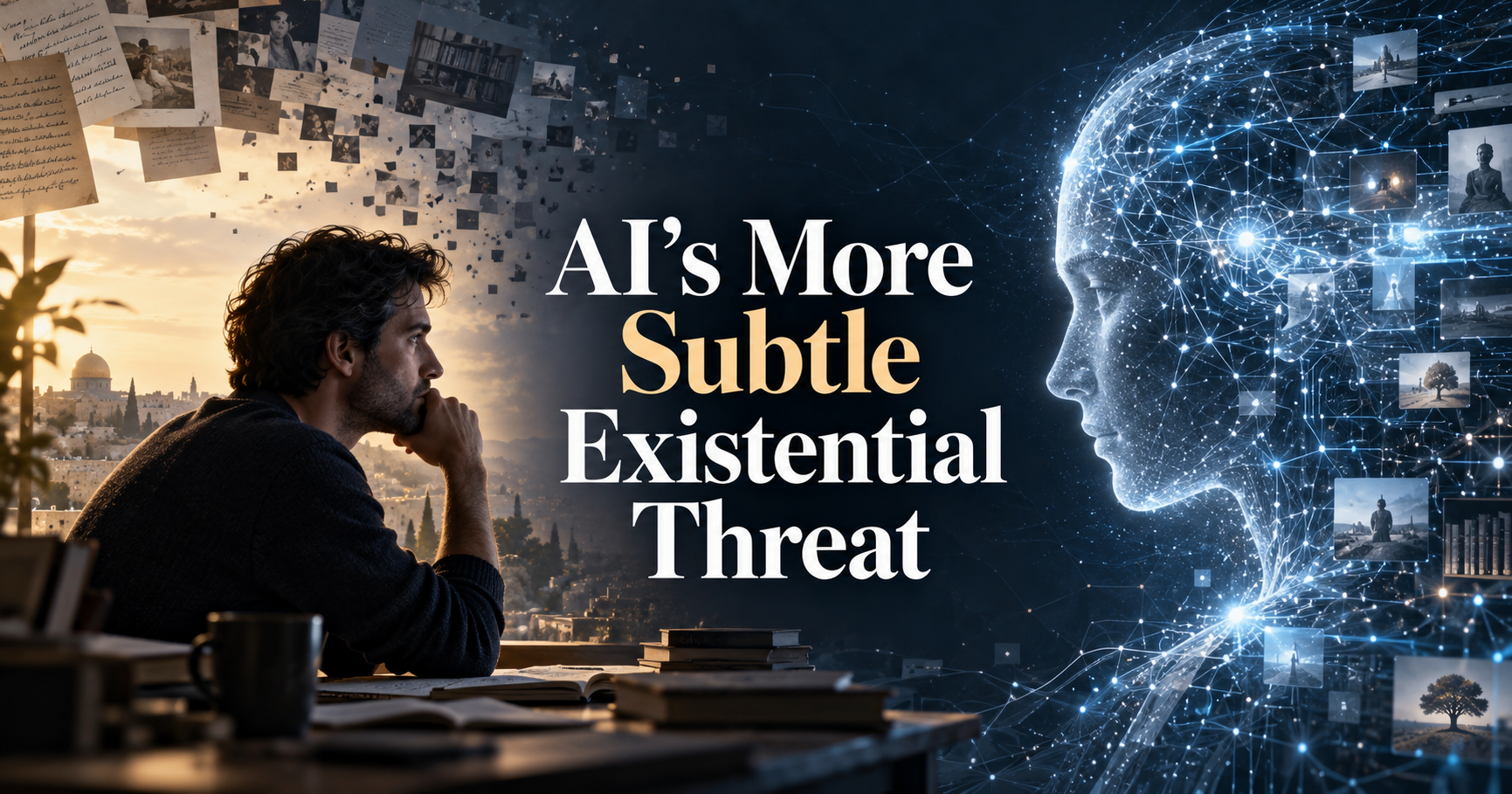
What happens to our sense of purpose, intelligence and human value when AI can do more and more of our thinking for us?
When people call AI an existential threat, they usually mean the dramatic version: we build something smarter than ourselves, lose control of it, and it turns against us.
But there is a subtler possibility. AI also threatens our essential capacities, and even our sense of who we are. Even if everything goes right on the external front, we will still face three difficult questions: what we will do, what we will become, and what we are worth.
Start with work. For most of history, people worked because they had to. But work is much more than a way to survive. It gives shape to our days and provides the sense that someone needs us. If AI and robots can eventually do much of that work better than we can, the optimistic result is enormous abundance. The less pleasant issue is that society in which many people have enough to live on but little to do is not obviously a happy one.
Still, I suspect this is the most manageable of the three problems. Prosperity tends to generate new wants. Yesterday’s luxuries become today’s necessities, and new kinds of work grow up around them. AI may also end up replacing tasks rather than people. Machines multiplied our physical strength without making human labor obsolete, and AI will probably do something similar for intellectual work.
The second problem worries far more. Even if we keep working, what happens to our minds when machines can do so much of our thinking?
We develop abilities by using them. We learn to reason by reasoning, to think critically by evaluating, to solve problems by struggling with them. And what we stop using, we tend to lose. We have already seen a mild version of this. Most of us no longer remember phone numbers, navigate without GPS, or do much arithmetic in our heads. Each convenience was worth it, but each also removed a reason to develop a particular skill.
AI could take this much further. Why work out an argument when one can be produced instantly? Why labor over a paragraph, a proof, or a hard question when the answer is seconds away?
A person working with AI will almost certainly be far more capable than a person working alone. My concern is the human half of that partnership. Picture someone who, with a powerful assistant, can do remarkable intellectual work. Now take the assistant away. What’s left? Think about what phones have already done to us. With AI, the effect will be far broader and more pervasive.
Rejecting the technology isn’t the answer. But we will have to be deliberate about what we hand over. If you want to keep the ability to write, you will have to keep writing. Use it or lose it. If we want to develop our own minds, we will need to distinguish between using AI for busy work we don’t care to do and using it to replace essential thinking. Some people will take this seriously. I am less sure about society as a whole. Convenience, speed, and better results are hard to resist. Will wide swaths of humanity gradually lose their intellectual edge?
The third question goes deeper. We are not the strongest or fastest animals. What has set us apart is our minds. As far as we know, we are the only beings capable of understanding the universe.
Suppose AI eventually surpasses us across the board, reasoning more deeply and solving problems we can’t even follow. We would knowingly share the world with an intelligence greater than our own for the first time. For someone whose picture of humanity places us at the top of the intellectual hierarchy, that could be genuinely disorienting. One of our last claims to cosmic exceptionalism would be gone. This problem will be especially poignant for someone who never recognized any being greater than themselves.
Knowledge of God changes the picture. For a believer, human beings were never the greatest intelligence in existence. An intelligence immeasurably beyond ours was always fundamental to reality. AI could introduce a new level of intelligence above our own, but it would not overturn the basic picture in the same way.
More importantly, belief in God gives us a basis for human value that does not depend on intellectual supremacy. If our worth rests on being the smartest thing around, a superintelligent machine poses a profound challenge. But if human worth rests on knowing God, understanding His universe, and emulating His ways, then being outthought does not make us obsolete.
So we should keep asking whether AI will quite literally destroy humanity. But we should also recognize that humanity can be threatened in subtler ways. Ultimately, the choices we make as individuals, as communities, and as a species will determine how we meet that internal threat.
Related Topics
Related Posts