
CEO of Time to Stand Up for Israel
When Religion Becomes an Obstacle to Peace
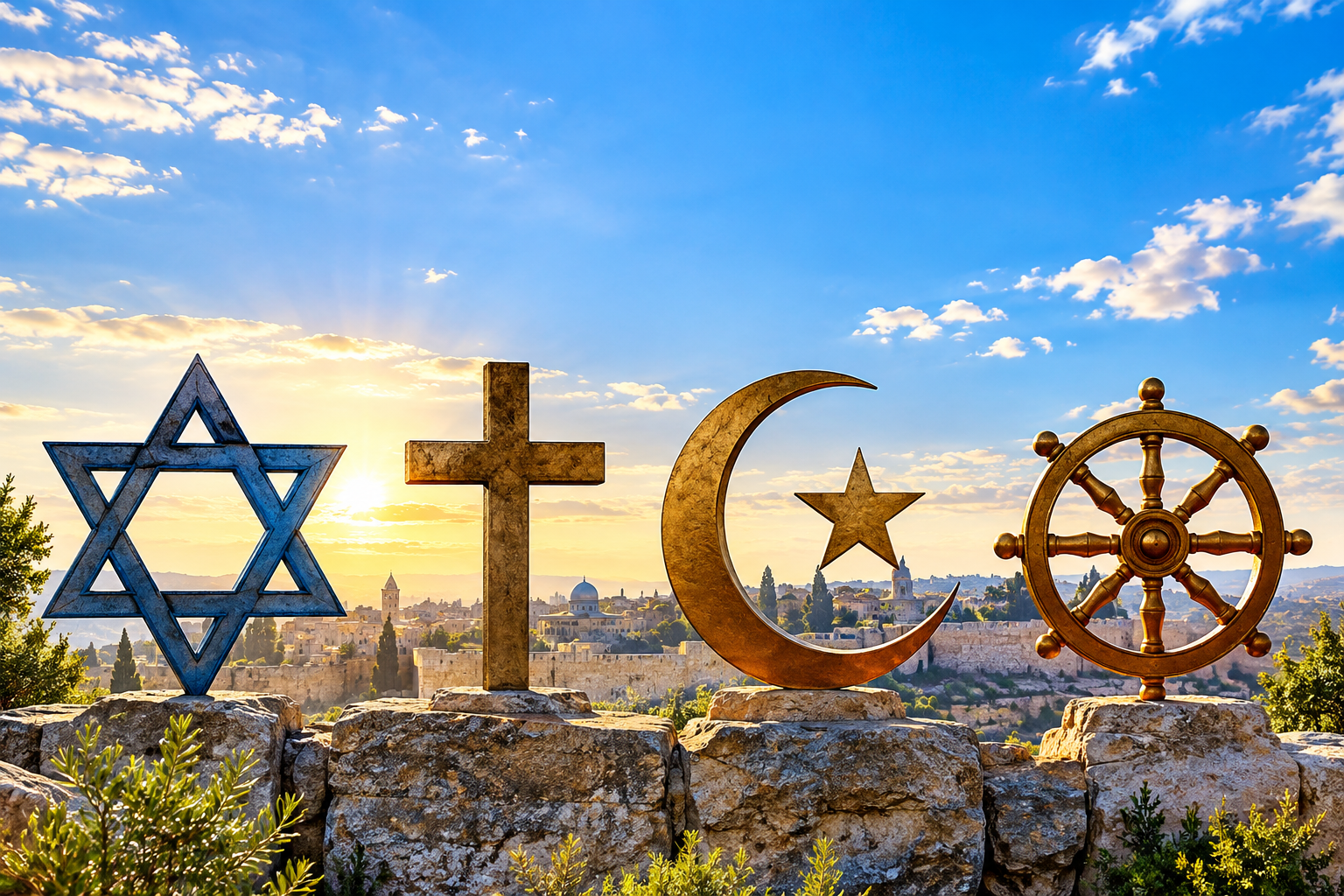
Photo Credits: Sabine Sterk (AI)
When Religion Becomes an Obstacle to Peace: Why Israel’s Existence Is Not Negotiable
The Middle East Will Never Achieve Lasting Peace While Religious Extremism Denies Jewish Self Determination
Religion has shaped the Middle East for thousands of years. It has inspired civilizations, created extraordinary cultural traditions and provided millions with spiritual meaning. Yet it has also been used to justify persecution, territorial conquest, discrimination and violence.
The Israeli Palestinian conflict demonstrates how dangerous religion becomes when political disputes are transformed into struggles over divine authority.
There is a fundamental difference between defending religious beliefs and claiming that those beliefs grant the right to eliminate another people’s national existence.
Israel’s legitimacy does not depend on religious approval from its neighbors. The Jewish people’s historical connection to the land is not a theological proposition that another religion can simply reject.
It is a matter of history, national identity and political self determination.
The existence of Israel is an established reality. Its security and future borders remain subjects of legitimate political debate, but the right of its people to live in peace should not be.
Jewish History Did Not Begin in 1948
One of the most persistent misconceptions surrounding Israel is that Jewish national identity began with the establishment of the modern state in 1948.
Jewish history in the land stretches back thousands of years. Jerusalem was central to Jewish religious, cultural and political life long before the emergence of Christianity or Islam.
The Hebrew language, Jewish traditions, historical kingdoms and generations of Jewish communities testify to a connection that cannot reasonably be dismissed as a modern political invention.
This history does not erase the longstanding presence, heritage or national aspirations of Palestinian Arabs.
But neither can Palestinian national aspirations erase Jewish history.
Both peoples have historical connections and contemporary rights that require recognition.
Attempts to deny the Jewish connection to Jerusalem or portray Jewish nationhood as inherently illegitimate do not advance peace. They make reconciliation harder by demanding that one people surrender its historical identity.
Israel Must Not Be Held to a Standard of Legitimacy Denied to No Other Nation
The Middle East contains states whose political identities are closely connected to religion, ethnicity, language or historical traditions.
Israel identifies as the nation state of the Jewish people, while also being home to citizens of different religions and backgrounds.
That national identity can be examined critically, particularly where questions of equality and minority rights arise. But criticism of particular laws or government policies is fundamentally different from asserting that Jewish national self determination is uniquely unacceptable.
Israel has democratic institutions, competitive elections, an independent judiciary and an active civil society. Its Muslim, Christian and Druze citizens participate in political and public life, although inequalities and discrimination remain serious concerns.
The appropriate standard is therefore consistent scrutiny of rights and responsibilities.
Israel’s actions should be subject to international law, including its obligations toward Palestinian civilians. Palestinian political organizations and neighboring states should likewise be judged by their conduct, their protection of civilians and their willingness to recognize the rights of others.
A standard applied selectively cannot provide a credible foundation for coexistence.
The Religious Rejection of Israel Is a Barrier to Peace
The conflict is not solely religious. It involves territory, displacement, security, competing national movements and generations of suffering.
Nevertheless, religious absolutism adds an especially difficult obstacle.
When political leaders or armed movements describe Israel’s existence as a religious offense, they move the conflict beyond questions that diplomacy can readily address.
Borders can be negotiated. Security guarantees can be designed. Political institutions can be reformed.
But a demand that a nation disappear because its existence contradicts a religious interpretation leaves little room for peaceful compromise.
Hamas’s founding charter of 1988 included explicitly antisemitic language and framed the struggle in religious terms. Its 2017 political document changed aspects of that language while maintaining its refusal to recognize Israel.
The October 7, 2023 attacks, in which Hamas and other armed groups killed and abducted civilians, exposed the human cost of violence directed at people because of their national identity.
Such attacks cannot be justified by religion, historical grievance or political objectives.
Equally, the suffering of Palestinian civilians cannot be dismissed because Hamas operates within Palestinian society.
A principled defense of Israel’s right to exist must remain consistent with the protection of innocent life.
Recognition Is Not Surrender
One of the most damaging assumptions in the region is that recognizing Israel requires abandoning Palestinian identity, Islam or Arab history.
It does not.
Recognition means accepting that Jewish national existence is a permanent part of the political landscape.
Likewise, recognizing Palestinian rights does not require Israelis to abandon their own history or legitimate security concerns.
This is the distinction that religious absolutism too often refuses to make.
Jerusalem can hold profound meaning for Jews, Muslims and Christians simultaneously. One community’s sacred attachment does not automatically invalidate another’s.
A religious claim becomes dangerous when it is used to argue that only one community may exercise political rights or maintain a legitimate presence.
No durable settlement can emerge from such a principle.
Israel’s Security Is Not an Optional Consideration
Jewish history includes repeated experiences of exclusion, persecution, expulsion and mass murder. The Holocaust remains the most devastating modern example of the consequences of antisemitic ideology combined with state power.
Israel’s establishment in 1948 followed decades of Zionist political organization, international diplomacy, conflict and the aftermath of the Holocaust.
For many Jews, sovereignty represents not only national fulfillment but also the capacity for collective self defense.
This helps explain why demands that Israel accept threats to its civilian population in the name of political compromise encounter such profound resistance.
No state can reasonably be expected to treat deliberate attacks on its civilians as an acceptable condition of coexistence.
At the same time, security cannot be achieved solely through military power. Long term security also depends on political arrangements that address Palestinian rights, accountable governance and the prevention of further violence.
The strongest case for Israel’s security is one that recognizes security as a right shared by civilians on both sides.
Religious Extremism Must Be Challenged Wherever It Appears
Islamist movements that reject Jewish national existence present a significant obstacle to coexistence. Their ideology deserves serious scrutiny, especially where religious language is used to justify attacks against civilians.
But religious extremism is not exclusive to one community.
Jewish extremists who invoke divine entitlement to justify attacks on Palestinians, forced displacement or permanent inequality also undermine the possibility of peace.
The existence of extremists within a religious tradition does not define all its believers.
Many Muslims support peaceful coexistence with Israel. Many Jews oppose extremist nationalism. Christians and other communities across the region have contributed to interfaith dialogue and reconciliation.
The necessary distinction is between religious conviction and religious coercion.
People must remain free to believe deeply without being entitled to impose those beliefs through violence or the denial of another community’s rights.
Peace Requires Accepting Israel as a Permanent Reality
The Abraham Accords showed that Israel and Arab states can establish diplomatic relations despite profound religious, cultural and political differences.
Those agreements did not resolve the Israeli Palestinian conflict, but they demonstrated that recognition and cooperation do not require agreement on every historical grievance.
This is an important lesson.
Israel cannot be expected to disappear as the price of regional peace. Nor can Palestinians be expected to abandon their national identity or basic rights.
The political challenge is to develop arrangements that make those realities compatible.
Religious leaders have a responsibility to reject teachings that dehumanize other communities. Governments have a responsibility to protect minorities and civilians. Political movements have a responsibility to distinguish legitimate national aspirations from the elimination of another people.
Conclusion: Israel’s Existence Is Not Subject to Religious Permission
The central issue is not whether Judaism, Christianity or Islam contains the correct interpretation of sacred history.
It is whether people can live alongside others whose identities and beliefs they do not share.
Israel’s right to exist in security does not require theological endorsement from the Muslim world, the Christian world or anyone else.
The Jewish people have a historical connection to their homeland and a legitimate claim to national self determination. That claim deserves recognition alongside the rights and aspirations of Palestinians.
There is nothing peaceful about demanding the disappearance of a country because its national identity conflicts with religious doctrine.
And there is nothing contradictory about defending Israel’s existence while insisting that its government respect human rights and international law.
The Middle East will move closer to peace when religious identity is no longer used as a veto over another people’s existence. Israel’s future should be shaped through diplomacy, security and the rule of law, not by demands that Jews surrender their national identity.
Israel’s existence is not a theological debate. Coexistence begins by accepting that reality while extending the same fundamental human dignity to everyone who shares the land.
Related Topics
Related Posts