
Algeria’s Top Spy Chief (in Israel)
Algeria has long ranked among the most antisemitic countries in the world—hardly unusual for a nation whose very existence was midwifed by France and whose independence was secured by pan-Arabists. Permit me, if you will, a brief journey down memory lane.
During the anti-Jewish riots in the Algerian town of Constantine in 1934, twenty-five Jews were murdered in mob violence. The assaults on the community did not cease there: in May 1956, a bomb exploded in a Jewish café, continuing a tragic pattern of attacks against the city’s Jews. In 1963, with the proclamation of the National Code of Algeria—a year after independence from French colonial rule—the few Jews who had not already been forced out by nationalist riots, assaults, and looting were formally stripped of Algerian nationality on the sole basis of being non-Muslims. Algeria’s “solution” to its self-manufactured Jewish dilemma stands as one of the most successful—and most overlooked—acts of ethnic cleansing in the twentieth century: from 140,000 Jews in 1948 to, quite literally, none today.
Of course, only a society steeped in antisemitism and saturated with Al Jazeera talking points could elect—and then re-elect—a man like Abdelmadjid Tebboune: a president who has eroded human rights, trampled on indigenous Amazigh rights, denied religious plurality by shuttering 46 of 47 Protestant churches through judicial harassment, turned a blind eye to torture allegations against his security forces, failed to curb spiralling inflation, and continued to bankroll the Polisario Front—selling out the Algerian people to the interests of the Islamic Republic of Iran.
Funnily enough, one of the most successful diaspora Algerians in today’s Middle East isn’t that pro-intifada singer Saint Levant—who, let’s be honest, is only a quarter Algerian and a quarter Palestinian, with the rest European—but rather a military chief… in Israel.
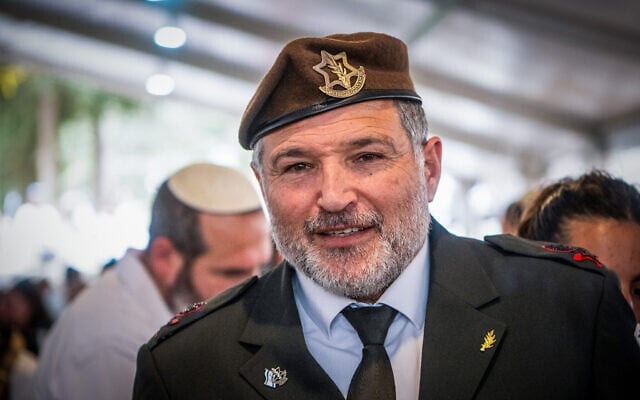
That’s right. As of 25 September, Israel’s Senior Appointments Advisory Committee has approved the candidacy of Maj. Gen. David Zini as director of the Shin Bet security agency. Netanyahu first named Zini as his choice in May, following months of legal and political disputes over his effort to dismiss the agency’s former director, Ronen Bar.
Born in Jerusalem, Zini hails from a prominent Algerian Sephardic family. His grandfather, Rabbi Meir Zini, served communities in Algeria, France, and Israel, and was among the last great Sephardic rabbis of North Africa as well as a leading Zionist voice of Algerian Jewry. Rabbi Meir was born in 1921 in the town of Mascara and enlisted in the French army at the outbreak of WWII. Under the pro-Nazi Vichy regime he was stripped of his citizenship and sent to a forced labor camp near Sidi-bel-Abbes—an ordeal he survived, making him one of Algeria’s many Holocaust survivors. Like most of Algeria’s Jews, his family was forced to flee to France in 1962 following the War of Independence, where he dedicated himself to uniting Algerian Jews and preserving their faith and traditions.
Whatever one makes of Zini’s appointment—and he has indeed faced sharp criticism from the Hostages Families Forum for opposing all negotiations with Hamas, while even Netanyahu once dismissed him as “too messianic,” making the choice all the more curious—there can be no doubt about his ancestors’ contributions to Algeria’s unique cultural landscape. That landscape was ultimately erased by a toxic combination of Arab nationalist policy and street-level Islamist extremism.
The real irony is that in late May—precisely when Netanyahu nominated Zini to head the Shin Bet—reports emerged that the Algerian government was scrambling to restructure its own intelligence services amid glaring operational weaknesses and national security concerns. The repeated failures of General Abdelkader Haddad, head of internal security, led to his abrupt dismissal after barely a year in office, replaced by General Abdelkader Ait Ourabi. Haddad’s ousting is widely believed to be linked to serious irregularities in his handling of sensitive cases, both political and human rights–related.
In another version of history—one in which Algerian society had not relentlessly abused its Jews and erased its Jewish character—Zini’s family might never have left. With Rabbi Meir’s military background, his grandson David could easily have followed a similar path in Algeria itself. In that alternate life, David Zini might well have been the very intelligence chief Algeria is now so desperately searching for, without any of the complications over his views on the Gaza war or the annexation of Judea and Samaria.
But alas, one cannot expect excellence from a nation where Yahud (“Jew”) remains a playground insult; where Hitler is still hailed as a model of European intellectual prowess; where every political setback is blamed on “the Jews” or “the Zionists”; and where the Jews who once enriched every facet of Algerian culture—its music, its clothing, its language—have been ousted in the pursuit of a pan-Arabist wasteland.
Perhaps one day Algeria will reckon with its mistakes. Perhaps it will even seek reconciliation. But that day lies far in the distance—and for Algerian Jews, the rear-view mirror holds no nostalgia.