London based entrepreneur, cybersecurity analyst doing a PhD in AI
Allegory of the Black Ant – Shirk/Shituf
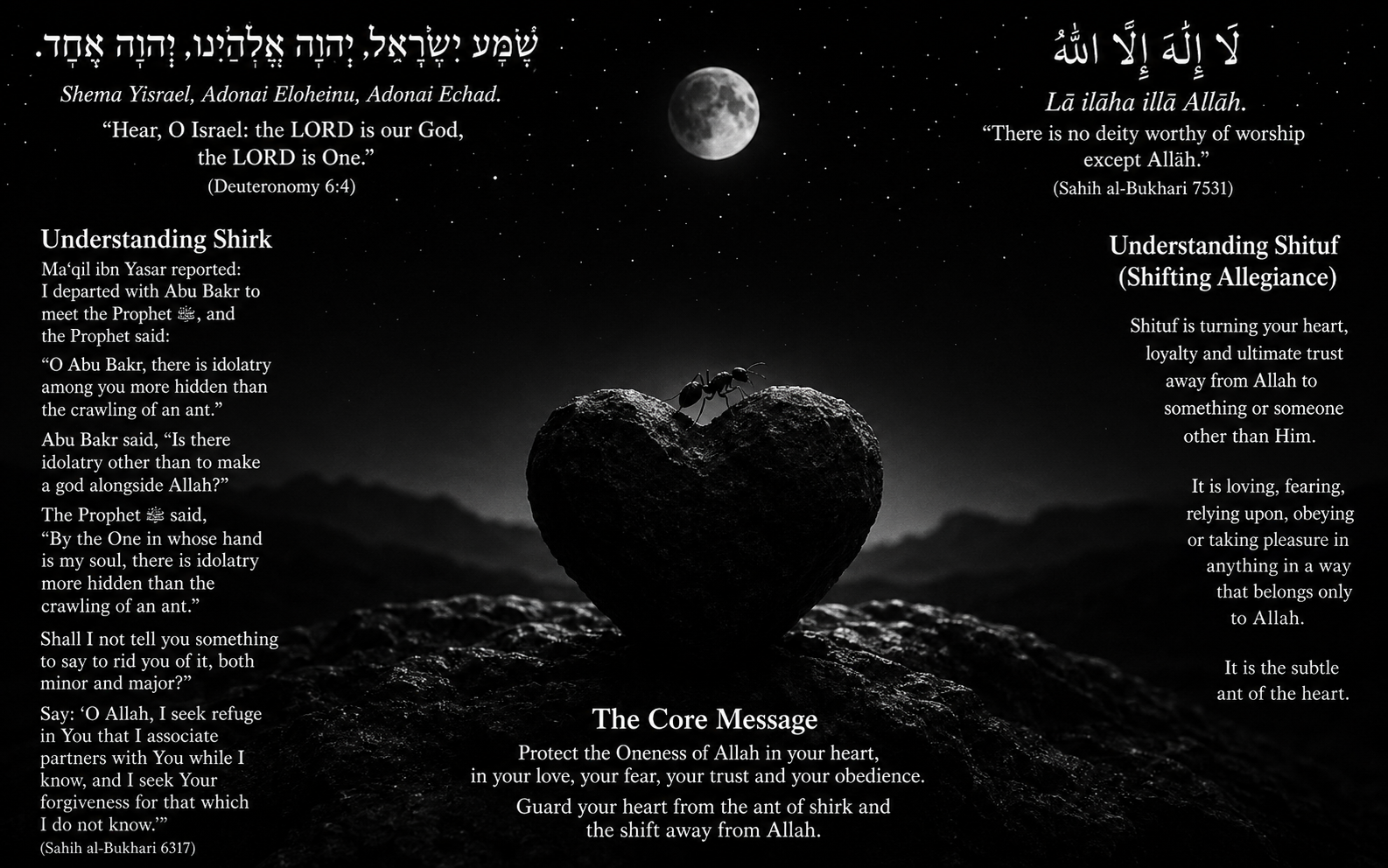
The Black Ant
A Call Beyond Sectarianism, Back to God
The Shema:
שְׁמַע יִשְׂרָאֵל יְהוָה אֱלֹהֵינוּ יְהוָה אֶחָד
Shema Yisrael, Adonai Eloheinu, Adonai Echad.
“Hear, O Israel: the LORD is our God, the LORD is One.”
Deuteronomy 6:4
The verse sits at the heart of Jewish confession. Rabbinic tradition made its recitation central to Jewish religious life, morning and evening. (Sefaria). Having studied under 2 Rabbis intermittently, I understand that both Muslims and Jews worship the same God of Abraham whereas Christian Theology is a bit more convoluted due to the trinity.
One question the reader must ask here is if both Muslims and Jews worship the same God of Abraham, and God is the All Knowing and the Guide, then why is there a difference and strife and bloodshed? Don’t we trust God as the final arbiter?
Fourteen centuries ago, the Qur’an reinforced the same message from God:
قُلْ هُوَ ٱللَّهُ أَحَدٌ
Qul huwa Allāhu Aḥad.
“Say: He is Allah, One.”
Qur’an 112:1
The linguistic resemblance is not accidental.
Hebrew אֱלוֹהַּ — Eloah and Arabic إِلٰه — ilāh belong to the same ancient Semitic family of words for deity. Elohim is the familiar Hebrew form, while Allāh is the Arabic name by which Muslims refer to the One God.
Likewise, Hebrew אֶחָד — eḥad and Arabic أَحَد — aḥad are cognate Semitic words expressing oneness.
Not identical in every grammatical nuance.
But unmistakably related.
And the theology underneath them is even clearer:
God is One.
That is where I would begin.
Not Sunni.
Not Shia.
Not Salafi.
Not Sufi.
Not Islamic Brotherhood.
Not Jew.
Not Christian.
Not Evangelical.
Not the Haredim.
Not Zionist.
Not politics.
Not Arab.
Not Israel.
Not Palestine.
Not Mexicans.
Not immigrants.
Not the countless other labels that have crept up.
Not the accumulated wounds of communities.
God.
Because perhaps the great tragedy of religion is that we begin by worshipping God and eventually become capable of worshipping the things and language we have built around Him. The labels we ascribe.
Our sect.
Our scholar.
Our nation.
Our family.
Our reputation.
Our own certainty.
And sometimes we do not even notice it happening.
The Black Ant
Maʿqil ibn Yasār (raḍiyallāhu ʿanhu) reported that he went with Abū Bakr al-Ṣiddīq (raḍiyallāhu ʿanhu) to meet the Prophet Muhammad ﷺ.
The Prophet Muhammad ﷺ said:
“O Abū Bakr, shirk among you is more hidden than the crawling of an ant.”
Abū Bakr al-Ṣiddīq (raḍiyallāhu ʿanhu) asked:
“Is there shirk other than making another god alongside Allah?”
The Prophet Muhammad ﷺ replied, by the One in Whose hand was his soul, that shirk could be more concealed than the movement of ants.
Then he taught him the cure:
“O Allah, I seek refuge in You from associating anything with You knowingly, and I seek Your forgiveness for what I do not know.”
Al-Adab al-Mufrad 716 in the commonly indexed edition; graded ṣaḥīḥ by al-Albānī. (Sunnah)
I find that image terrifying.
Not a giant idol.
Not a golden calf.
An ant.
Something almost silent.
Something small enough to escape attention.
Shirk can enter the heart without announcing itself.
That is why sectarianism should concern all of us.
This is one of the worst evils of society, and in many ways the precursor to violence. This could be along many lines but religion and ethnicity are two we are dealing with as a society today on a massive scale. ICE is an example of this.
One of the great tragedies of this “type of sectarianism” is the effect it has on the psychological safety of citizens and their mental health.
A person may proclaim lā ilāha illa Allāh while allowing something else to acquire an authority in the heart that belongs only to Allah.
“My scholar cannot be wrong.”
“My sect cannot be wrong.”
“My people cannot be wrong.”
“My country cannot be wrong.”
“I cannot be wrong.”
The black ant moves.
The Warning About Sects
The Prophet Muhammad ﷺ warned that fragmentation would not belong only to previous religious communities.
Abū Hurayrah (raḍiyallāhu ʿanhu) narrated that the Prophet Muhammad ﷺ said:
“The Jews split into seventy-one or seventy-two sects, and the Christians similarly, and my Ummah will split into seventy-three sects.”
Jāmiʿ al-Tirmidhī 2640. (Sunnah)
Read that slowly.
My Ummah.
The natural human response is to read the hadith and immediately identify the other seventy-two.
I think the more frightening response is:
What if I am wrong?
What if the label I inherited has become more important than the revelation by which that label itself must be judged?
The Qur’an says:
“Hold firmly together to the rope of Allah and do not become divided.”
Qur’an 3:103
And:
“Indeed, those who divided their religion and became sects—you have nothing to do with them.”
Qur’an 6:159
The centre is not the sect.
The centre is Allah.
The God of Moses (ʿalayhi ṣ-ṣalātu wa-s-salām)
Mūsā (Moses) (ʿalayhi ṣ-ṣalātu wa-s-salām) is one of the towering figures of the Qur’an.
As a Muslim, I believe Allah spoke to him.
I believe Pharaoh oppressed the Children of Israel.
I believe Mūsā (ʿalayhi ṣ-ṣalātu wa-s-salām) confronted tyranny.
I believe the sea was parted.
I believe revelation was given to him.
A Muslim cannot dismiss Mūsā (ʿalayhi ṣ-ṣalātu wa-s-salām) and remain faithful to the Qur’an.
Islam does not ask me to exchange Mūsā (ʿalayhi ṣ-ṣalātu wa-s-salām) for Muhammad ﷺ.
That would misunderstand both of them.
It asks me to recognise that they called to the same Creator.
Muhammad ﷺ does not replace the God of Mūsā (ʿalayhi ṣ-ṣalātu wa-s-salām).
He calls me back to Him.
The God of Small Things
Arundhati Roy gave her famous novel the beautiful title The God of Small Things.
Borrow the phrase for a moment.
Because when I read the story of Mūsā (ʿalayhi ṣ-ṣalātu wa-s-salām), I am struck by how little of it begins with grandeur.
He is travelling.
He sees a fire.
Perhaps some information for his family he can bring back from there.
Perhaps a burning branch he can carry back.
A valley.
A tree.
A voice.
His sandals.
And the staff already in his hand.
Then Allah asks:
“What is that in your right hand, O Moses?”
Qur’an 20:17
Allah knows what is in his hand.
Of course He knows.
Yet Mūsā (ʿalayhi ṣ-ṣalātu wa-s-salām) answers.
His staff.
Something he leans upon.
Something with which he tends his sheep.
A piece of wood.
Then the ordinary becomes extraordinary.
I sometimes think this is why we miss God.
We look for Him only in the spectacular.
Yet His signs have become so familiar that we no longer see them.
Water.
My heart beating while I write this.
Sleep.
A hand.
A child smiling.
A seed breaking open beneath soil.
Morning returning after darkness.
The conscience that hurts when I betray it.
The inexplicable fact that anything exists at all.
The God who split the sea is also the God who made the drop of water.
The God of great things is necessarily the God of small things.
Before the Labels, Abraham (ʿalayhi ṣ-ṣalātu wa-s-salām)
Before Mūsā (ʿalayhi ṣ-ṣalātu wa-s-salām) stood Ibrāhīm (Abraham) (ʿalayhi ṣ-ṣalātu wa-s-salām).
Judaism, Christianity and Islam all reach toward him.
But the Qur’an makes a provocative claim:
“Abraham was neither a Jew nor a Christian, but he was upright, submitting to Allah, and he was not among the polytheists.”
Qur’an 3:67
The point here is the core principle. It is chronological and theological.
Ibrāhīm (ʿalayhi ṣ-ṣalātu wa-s-salām) existed before those later communal labels.
The Qur’an calls him ḥanīf.
A man turned away from false gods toward the One God.
And this is where his story becomes uncomfortably relevant to sectarianism.
He asks his people:
“What are these statues to which you are so devoted?”
Qur’an 21:52
The problem is not merely stone.
It is inherited devotion that has ceased asking whether the object deserves devotion.
Modern idols rarely look like statues.
Sometimes they have television channels.
Sometimes academic titles.
Sometimes political offices.
Sometimes religious clothing.
Sometimes millions of followers.
Sometimes a lot of money.
Sometimes a “bag of tricks”.
Sometimes institutional backing.
Sometimes they are simply the opinions of our parents lodged so deeply inside us that we mistake inheritance for revelation.
The Qur’an repeatedly challenges the argument:
“We found our fathers doing this.” Quran, Surah Al-A’raf (7:28)
That sentence frightens me because almost all of us could say it.
Then Look at Muhammad ﷺ
So I would ask the seeker of truth to examine Muhammad ﷺ in exactly the same way.
Not because a Muslim told you to.
Not because somebody who hates Islam told you not to.
Read him (saws).
Examine his (saws) claim as a jeweller examines a diamond beneath magnification.
What did he (saws) actually call people toward?
The Qur’an says:
“Say: I am only a human being like you, to whom it has been revealed that your God is One God.”
Qur’an 41:6
That is perhaps the most important sentence to remember about Muhammad ﷺ.
I am human.
Your God is One.
He does not invite humanity to worship Muhammad ﷺ.
He points away from himself.
Toward Allah.
When his letter inviting Heraclius to Islam was transmitted, it contained the Qur’anic invitation:
“O People of the Scripture, come to a common word between us and you: that we worship none but Allah…”
Qur’an 3:64
The invitation begins there.
God.
Revelation as Criterion
Islam makes another claim which should not be softened.
The Qur’an says of itself:
“We have revealed to you the Book in truth, confirming what came before it of Scripture and as a criterion over it.”
Qur’an 5:48
The word is muhayminan.
From the mainstream Islamic perspective, the Qur’an confirms the original Divine revelations sent before it while functioning as the final authoritative criterion over them.
Islam therefore does not teach that every later religious development is equally valid.
It teaches continuity and finality.
The Qur’an also says:
“Indeed, We have sent down the Reminder, and surely We will preserve it.”
Qur’an 15:9
I would phrase its preservation carefully.
The Qur’an has an exceptionally stable manuscript, oral and recitational transmission from the earliest Islamic centuries. Its canonical qirāʾāt are themselves part of that transmitted tradition rather than evidence that Muslims possessed unrelated Qur’ans. In its time since revelation till today, there has been no change in as much as a letter or a phonetic symbol. Historical records prove this. No other text in human history can claim such extraordinary preservation. For example the first 5 books of the Bible are supposed to be written by Moses (Musa a.s.) but there is debate regarding authorship as it contains the death and burial of Moses (Musa a.s.).
The other evidence include hints of scientific details, and most importantly prophecies of things to come before the event such as the Roman victory over Persians.
For the Muslim believer, this preservation fulfils the promise of Qur’an 15:9.
The Stakes
Islam’s theological claim is not merely that Muhammad ﷺ was one interesting prophet among many whom humanity may choose to ignore.
Abū Hurayrah (raḍiyallāhu ʿanhu) narrated that the Prophet Muhammad ﷺ said that whoever among the Jews or Christians hears of his mission and dies without believing in what he was sent with will be among the people of the Fire.
Ṣaḥīḥ Muslim 153.
I do not think honesty permits me to hide that from a Jewish or Christian reader.
Nor do I think respect requires pretending Islam says something it does not.
Islam honours Mūsā (ʿalayhi ṣ-ṣalātu wa-s-salām).
It honours ʿĪsā (Jesus) (ʿalayhi ṣ-ṣalātu wa-s-salām).
And it claims Muhammad ﷺ is the final Messenger.
That is the proposition.
Examine it.
The Hypothesis
This is where my invitation becomes personal.
Scientists begin with questions.
They form hypotheses.
Then they test them.
So take a hypothesis about God:
If the God of Ibrāhīm (ʿalayhi ṣ-ṣalātu wa-s-salām) exists, and I sincerely ask Him for guidance, He can guide me.
Test it.
You do not need to announce it.
You do not need to win an argument.
Go somewhere quiet.
And say, in whatever language belongs to your heart:
God of Abraham (ʿalayhi ṣ-ṣalātu wa-s-salām), God of Moses (ʿalayhi ṣ-ṣalātu wa-s-salām), Creator of me and everything I know: guide me to Your truth. If Muhammad ﷺ was truly Your Messenger, help me recognise it. If the Qur’an is from You, guide me to understand it. And where my assumptions are wrong, correct me. I want Your truth more than I want to remain comfortable.
Then see what happens.
Not for five minutes.
Not as a trick.
Sincerely.
A practising Muslim does not stand before Allah five times daily and announce:
I am guided. Everyone else has the problem.
In every obligatory rakʿah we recite:
“Guide us to the straight path.”
Qur’an 1:6
Across the obligatory prayers, that means at least seventeen repetitions every day.
I am Muslim.
And I am still asking:
Guide me.
Why?
Because guidance is not a badge.
It is dependence.
Al-Fātiḥah places the entire relationship beautifully:
Praise belongs to You.
You alone we worship.
You alone we ask for help.
Guide us.
Sectarian arrogance says:
I have arrived.
Islam says:
O Allah, keep guiding me.
A Call to the Jamāʿah
This does not mean that theology no longer matters.
It matters enormously.
Nor does it mean Sunni and Shia differences can simply be wished away.
They cannot.
Nor does it mean that every interpretation is equally valid.
It is precisely because truth matters that we must return disputes to revelation.
The Qur’an says:
“If you disagree over anything, refer it to Allah and the Messenger…”
Qur’an 4:59
That is where mainstream Islam begins.
Allah alone is worshipped.
The Qur’an is His final revelation.
Muhammad ﷺ is His final Messenger.
His authentic Sunnah is followed.
The Companions (raḍiyallāhu ʿanhum) are honoured as the foundational generation through whom the religion was transmitted.
The inherited mainstream scholarly tradition is respected.
And no scholar after Muhammad ﷺ becomes infallible.
The four Sunni madhhabs themselves prove that legitimate disagreement does not have to become sectarian hatred.
Difference can exist beneath unity.
The disease begins when the school becomes the god.
When loyalty becomes stronger than evidence.
When identity matters more than truth.
There the black ant appears again.
Come Back Before the Labels
So my invitation is now not only to Jews.
It is to me.
To Sunni and Shia.
To Jew and Christian.
To the person who stopped believing years ago.
To the person who has never questioned the religion written on his birth certificate.
Go back before the labels.
Before the politics.
Before inherited grievances.
Before denominations.
Before sects.
Go back to Ibrāhīm (ʿalayhi ṣ-ṣalātu wa-s-salām) before the idols.
Go back to Mūsā (ʿalayhi ṣ-ṣalātu wa-s-salām) removing his sandals.
Go back to the simplest proposition:
God is One.
The Shema says:
Adonai Echad.
The Qur’an says:
Allāhu Aḥad.
Islam says:
Lā ilāha illa Allāh.
No deity worthy of worship except Allah.
Not me.
Not you.
Not the rabbi.
Not the imam.
Not the ayatollah.
Not the shaykh.
Not the politician.
Not the nation.
Not the sect.
Allah.
Then ask what He revealed.
Ask whom He sent.
Ask where the evidence leads.
And follow it.
Watch for the Ant
The greatest idol may not be one we recognise.
It may be the one so small that we never thought to inspect it.
The black ant.
My tribe.
My scholar.
My anger.
My reputation.
My ideology.
My certainty.
Myself.
That is why I keep returning to the supplication taught by the Prophet Muhammad ﷺ:
اللَّهُمَّ إِنِّي أَعُوذُ بِكَ أَنْ أُشْرِكَ بِكَ وَأَنَا أَعْلَمُ وَأَسْتَغْفِرُكَ لِمَا لَا أَعْلَمُ
Allāhumma innī aʿūdhu bika an ushrika bika wa-anā aʿlam, wa-astaghfiruka limā lā aʿlam.
O Allah, I seek refuge in You from knowingly associating anything with You, and I seek Your forgiveness for what I do unknowingly.
The prayer does not say:
Expose their shirk. Go after the “other sects”.
It says:
Protect me from mine.
This is also extremely important as the believer must rectify himself properly before “throwing stones” at Glass Houses. A sign of spiritual illness is unnecessary external violence I would say. A soul at rest would not go around “sniffing for trouble” every few days like our “great politicians” do. There is no need to “humiliate others” if you are at peace – you would likely look for a “win win” solution for all – rather than see the world as a “zero sum game”. This is my observation of current geopolitics- and not necessarily theology. The more violent, the more demented. The farther away from core qualities like truth, beauty, good character.
Perhaps that is where the cure for sectarianism begins.
Not by pretending differences are unreal.
Not by pretending every religion is equally true.
Not by abandoning doctrine.
But by making sure that every doctrine, scholar, sect and identity remains beneath the One for whose sake religion exists at all.
God.
The Shema calls to Him.
Ibrāhīm (ʿalayhi ṣ-ṣalātu wa-s-salām) broke idols for Him.
Mūsā (ʿalayhi ṣ-ṣalātu wa-s-salām) walked toward a small fire and found His revelation.
Muhammad ﷺ called humanity back to Him.
And every Muslim still asks Him every day:
Guide us to the straight path.
The black ant is difficult to see.
So look carefully.
Theological position: This article is written from a mainstream Sunni Islamic theological perspective, within the understanding of the Jamāʿah, affirming tawḥīd: Allah alone is the Creator, Sustainer, Lawgiver and ultimate object of worship. It recognises Mūsā (ʿalayhi ṣ-ṣalātu wa-s-salām), ʿĪsā (ʿalayhi ṣ-ṣalātu wa-s-salām), Ibrāhīm (ʿalayhi ṣ-ṣalātu wa-s-salām) and all the Prophets sent by Allah, while affirming that Muhammad ﷺ is the final Messenger and that the Qur’an is the final, preserved and universally binding revelation. Earlier revelations are understood as originally from Allah, while the Qur’an functions as the final criterion over what preceded it (Qur’an 5:48). The article therefore compares the Shema and Islamic tawḥīd not to imply theological equivalence between Judaism and Islam in their present forms, but to highlight their shared insistence on the Oneness of God and to invite the reader back to uncompromising monotheism.*
This position also recognises that shirk may be subtle as well as explicit. Maʿqil ibn Yasār (raḍiyallāhu ʿanhu) reported that the Prophet Muhammad ﷺ warned Abū Bakr al-Ṣiddīq (raḍiyallāhu ʿanhu) that shirk can be “more hidden than the crawling of an ant,” and taught the supplication: “O Allah, I seek refuge in You from associating anything with You knowingly, and I seek Your forgiveness for what I do not know.” Al-Adab al-Mufrad 715/716, graded ṣaḥīḥ by al-Albānī in the commonly cited edition.
The article also understands sectarianism through the Prophetic warning that the earlier religious communities divided and that the Muslim Ummah would likewise split into seventy-three sects (Jāmiʿ al-Tirmidhī 2640; Sunan Abī Dāwūd 4596). The purpose of citing this is not sectarian triumphalism, but self-examination: every inherited label, school, movement, scholar, nation and loyalty remains subordinate to Allah and His Messenger ﷺ. Where disagreement occurs, the Qur’anic instruction is to “refer it to Allah and the Messenger” (Qur’an 4:59).
Finally, from this theological standpoint, accepting the final Messenger is not optional once his message has genuinely reached a person. Abū Hurayrah (raḍiyallāhu ʿanhu) narrated that the Prophet Muhammad ﷺ said that any Jew or Christian who hears of him and dies without believing in that with which he was sent will be among the people of the Fire (Ṣaḥīḥ Muslim 153). Thus the invitation made here is respectful but not relativistic: worship Allah alone, reject all partners and rivals, and follow His final Messenger ﷺ. Allah knows best. Any good in this article is from Allah, and any mistakes are my own.
A good litmus test for this is are we able to challenge any “assumptions” that our society already holds as “correct” – of-course politely and through the right channels without resorting to violence.
Related Posts