
CFO | Empower Society for Good I Author
America at 250: What Makes a Good Society?
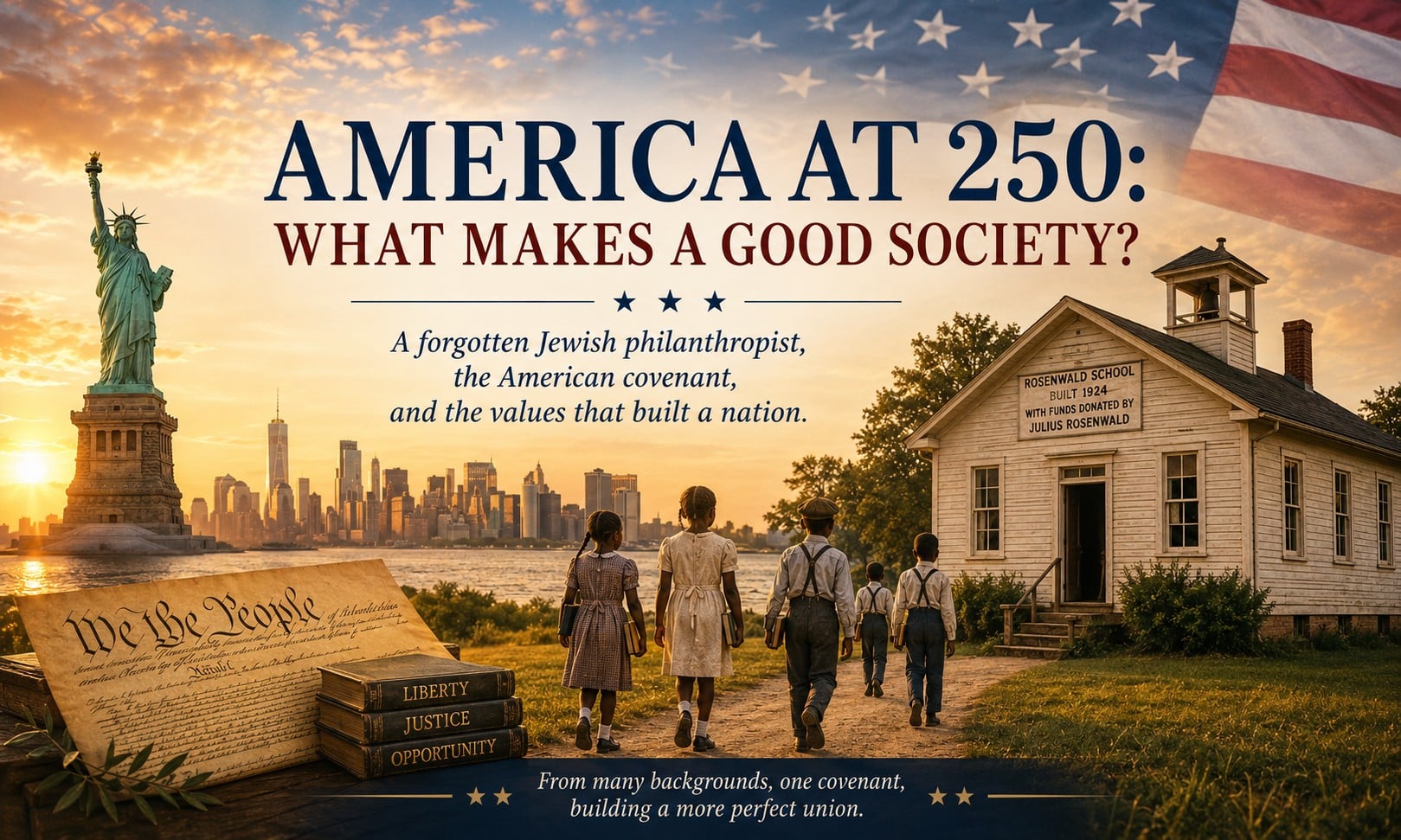
As the United States approaches its 250th anniversary on July 4, 2026, perhaps the most important question is not whether America has been great, but what has made it a good society?
As an Israeli looking at America from afar, I have long admired its remarkable experiment. No nation is perfect, and America’s history is certainly no exception. Yet few countries have done more to shape the modern world or to offer hope to millions seeking freedom, opportunity and a new beginning.
Today, however, America faces profound challenges. Political polarization has deepened. Trust in institutions has declined. Identity politics increasingly competes with a shared national story. Antisemitism has re-emerged in places where it should never be tolerated, and hostility towards Israel has, in some circles, become a marker of social or political identity.
Against that backdrop, I want to share the story of a remarkable American.
The Billionaire Who Wanted No Monument
This is the story of Julius Rosenwald, which deserves to be retold as an example of how one man can make a difference.
The Jewish president of Sears, Roebuck & Co. quietly helped fund more than 5,000 schools for African American children across the segregated South. Working alongside Booker T. Washington, his philanthropy transformed educational opportunity for generations. By the 1930s, around one-third of Black children in the South had attended a Rosenwald School.
He gave away the equivalent of more than a billion dollars in today’s money.
He refused to have buildings named after him.
He believed wealth had value only if it created opportunity for others.
Yet today, relatively few Americans know his name.
His story made me ask a broader question.
What kind of people build a good society?
It also reminded me of something else.
America’s Jewish community has never been large. Throughout most of the nation’s history, Jews have represented only a small percentage of the population. Yet their contribution to American society has been extraordinary.
From the American Revolution to the Civil Rights Movement; from science and medicine to law, education, philanthropy, business and the arts, Jewish Americans have consistently helped shape the nation.
This is not a story of privilege or power.
It is a story of contribution.
It reflects a tradition that places enormous emphasis on education, justice, responsibility, repairing the world (Tikkun Olam), and caring for the stranger because “you were strangers in the land of Egypt.”
Of course, Jewish Americans were far from alone. America was built by people of every race, religion and background. But as America marks its 250th anniversary, it is worth remembering that a remarkably small community made an enduring contribution to the common good.
America’s Greatness Was Never Perfection
America was born with extraordinary ideals—and profound contradictions.
It declared that “all men are created equal,” while tolerating slavery.
It championed liberty while excluding many from its promise.
Its greatness has never been that it got everything right.
Its greatness has been its willingness—however imperfectly—to confront injustice and move closer to its founding ideals.
The abolition of slavery.
The preservation of the Union.
The Civil Rights Movement.
The expansion of opportunity.
Each generation was challenged to build a better America than the one it inherited.
That is the mark of a healthy society—not perfection, but the courage to improve.
A Nation Built by Many Hands
America’s story was never written by one people alone.
It was shaped by founders like George Washington and Benjamin Franklin, who established democratic institutions and civic responsibility.
By reformers such as Frederick Douglass, Harriet Tubman and Martin Luther King Jr., who challenged America to live up to its own ideals of liberty and equality.
By educators like Booker T. Washington, and philanthropists like Julius Rosenwald, who believed education was the surest path to dignity and opportunity.
By immigrants and refugees, including Albert Einstein, who found in America the freedom to think, discover and contribute.
By scientists like Jonas Salk, the son of Jewish immigrants, who developed the first successful polio vaccine and refused to patent it because he believed it belonged to humanity.
By moral voices such as Abraham Joshua Heschel, who marched arm in arm with Martin Luther King Jr. in Selma, saying, “When I marched in Selma, my feet were praying.”
By Elie Wiesel, who reminded America that “the opposite of love is not hate, but indifference.”
Long before them, Jewish Americans were already helping shape the new republic.
Haym Salomon, a Jewish financier, helped fund the American Revolution.
Gershom Mendes Seixas, America’s Patriot Rabbi, defended religious liberty.
Jonas Phillips argued that citizenship should never depend on religious belief.
Rebecca Gratz built schools, orphanages and charitable institutions that strengthened American society.
Emma Lazarus gave the Statue of Liberty its enduring voice:
“Give me your tired, your poor,
Your huddled masses yearning to breathe free…”
These names are not always remembered.
But their contributions helped build the nation.
The Jewish Contribution
The story of Jewish America is not simply one of finding refuge.
It is also one of repaying that refuge through contribution.
Generation after generation, Jewish Americans helped finance a revolution, defend religious liberty, educate disadvantaged children, discover life-saving medicines, advance science, strengthen the rule of law, enrich American culture, support civil rights and build institutions that benefited society as a whole.
Never a large community, they nevertheless made an enduring contribution to the American experiment—not because they sought privilege, but because they embraced responsibility.
Their lives reflected values deeply rooted in Jewish tradition.
That every human being is created in the image of God.
That education is the greatest inheritance we can leave our children.
That justice is a sacred obligation.
That wealth carries responsibility.
And that we are commanded to care for the stranger because we ourselves were once strangers.
These are not only Jewish values.
They are the foundations of every good society.
Hope: America’s Greatest Export
America’s greatest export was never Hollywood.
Nor Silicon Valley.
Nor Wall Street.
It was hope.
The belief that your past need not determine your future.
The belief that people from different nations, races and religions could become one people without surrendering their distinct identities.
Rabbi Jonathan Sacks observed that societies are held together not merely by contracts but by covenant—shared responsibilities that bind people together in pursuit of the common good.
That insight feels especially relevant today.
When societies become defined only by competing identities…
When rights become detached from responsibilities…
When trust gives way to suspicion…
When outrage replaces dialogue…
The covenant begins to weaken.
America’s Next 250 Years
America’s first 250 years demonstrate something profound.
A nation’s greatness is not measured only by its wealth.
Nor by its military.
Nor by its technological achievements.
It is measured by the character of its people.
By the institutions they build.
By whether they expand opportunity.
By whether they protect the vulnerable.
By whether they choose hope over fear.
The American experiment has never been guaranteed.
Every generation must choose it again.
Julius Rosenwald never sought recognition.
Haym Salomon sacrificed his fortune to help finance a revolution.
Jonas Salk refused to profit from a vaccine that saved millions.
Abraham Joshua Heschel marched for justice because he believed faith demanded action.
Elie Wiesel reminded us that indifference is the beginning of moral failure.
Their lives point to a simple truth.
Good societies are not built by people asking what their country owes them. They are built by citizens asking what they owe one another.
As America celebrates its 250th birthday, perhaps the question is not simply whether it will remain prosperous or powerful.
The question is whether it will continue to renew the covenant that enabled people of every background to build something greater together.
Because ultimately, that is what makes not only America—but any nation—a good society.
Questions to Ponder
- What values transformed America from a young republic into a beacon of hope for millions?
- Why are figures like Julius Rosenwald, Haym Salomon and Rebecca Gratz so little known despite their extraordinary contributions?
- What can today’s generation learn from the partnership between Booker T. Washington and Julius Rosenwald?
- How can a diverse society preserve a shared sense of purpose without demanding uniformity?
- Have we become too focused on our rights and forgotten our responsibilities to one another?
- As America enters its next 250 years, what covenant will bind its citizens together?
- What legacy are we leaving for the next generation—not only in wealth or technology, but in values?
This reflection is, at its heart, not about America alone. It is about the enduring question that Rabbi Jonathan Sacks asked throughout his life: What makes a good society? America’s story suggests that the answer lies not in perfection, but in the continual renewal of freedom through responsibility, diversity through covenant, and success through service to others.
Related Topics