
Stand for Jewish life. Fight antisemitism.
America may be ready for a Jewish president. Is the Democratic Party?
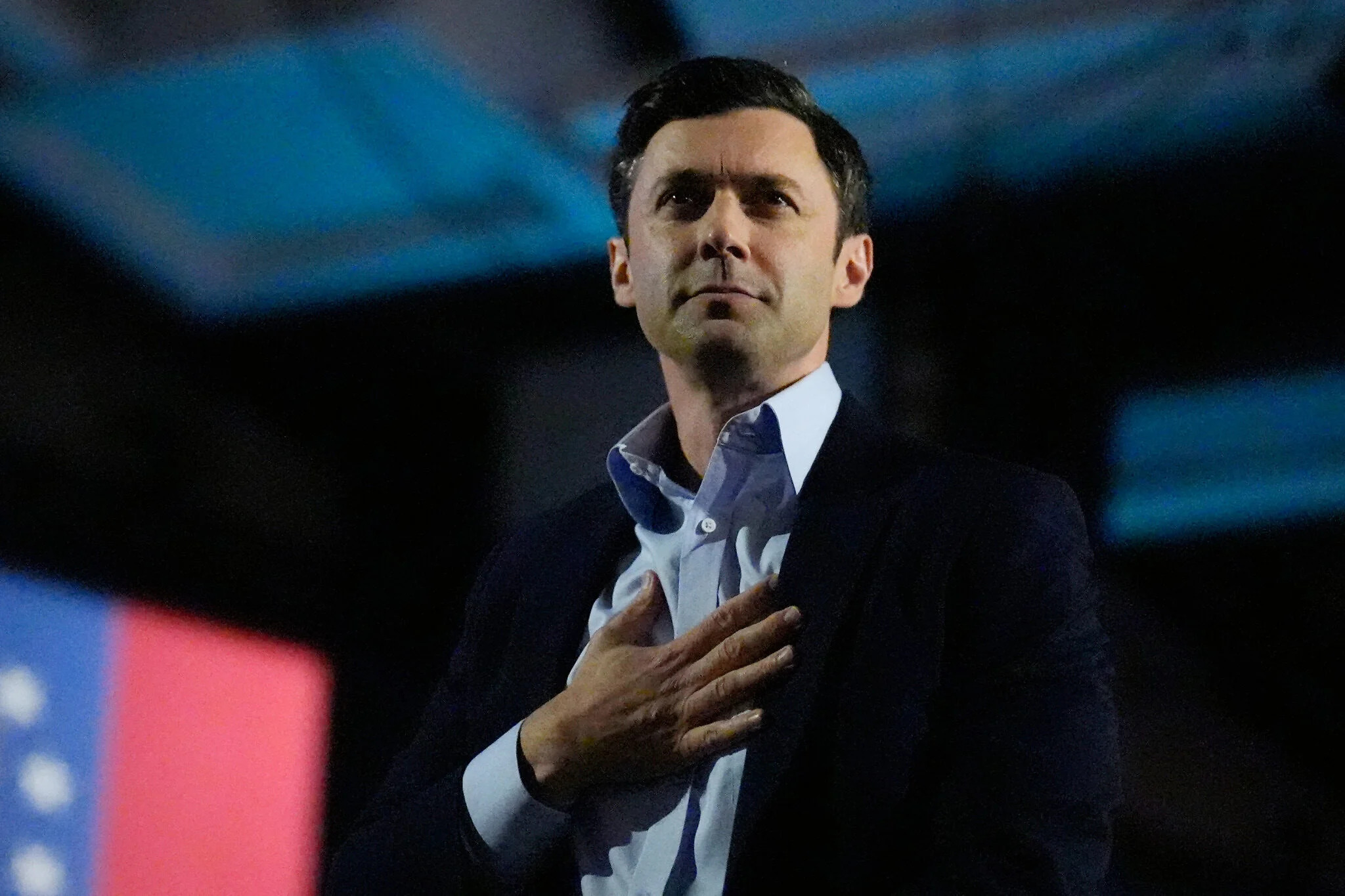
Victorious Georgia Democratic Senate candidate Sen. Jon Ossoff, D-Ga., during an election night event, November 3, 2026, in Atlanta. (AP Photo/Mike Stewart)
Jon Ossoff’s political rise raises a question that reaches far beyond his own ambitions. Anti-Zionism is gaining ground within the Democratic Party, while antisemitism casts a dark shadow over Jewish life across America. In this climate, can a Jewish politician who openly supports Israel ever become the party’s presidential nominee?
On November 3, Jon Ossoff had the kind of election night that can change a politician’s future. The 39-year-old Democrat won reelection to the United States Senate in Georgia by an impressive 18-point margin, defeating Republican Mike Collins by 59 to 41 percent. For Democrats, it was a major victory in a crucial swing state. For Ossoff, it was another step toward becoming one of the most recognizable faces of his party.
Almost immediately, speculation about his political future intensified: Could Jon Ossoff become a presidential candidate in 2028?
There is another detail that makes this prospect particularly interesting: Jon Ossoff is Jewish.
At first glance, this should be an entirely ordinary idea. American Jews have been part of the country’s political, cultural, and economic life for generations. They have served in Congress, held cabinet positions, and helped shape national politics on both sides of the aisle.
America may well be ready for a Jewish president. But within the Democratic Party, the political ground is shifting.
The Democrats’ anti-Zionism problem
For generations, the Democratic Party has been an important political home for American Jews. Jewish voters have traditionally supported Democratic candidates in large numbers, and Jewish Americans have played a major role in building the party.
But since October 7, 2023, Israel has become one of the most divisive issues within the Democratic Party. Anti-Zionist positions have become increasingly visible within its progressive wing. Some politicians and activists go far beyond criticizing Israeli government policy: they question Israel’s legitimacy as a Jewish state or reject the very idea of Jewish self-determination.
We already saw how intense this dynamic has become in the summer of 2024, when Pennsylvania Governor Josh Shapiro was considered as Kamala Harris’s running mate. Progressive activists quickly targeted him with the label “Genocide Josh,” even though his positions on Israel were virtually identical to those of non-Jewish contenders like Tim Walz. Shapiro faced a public loyalty test simply because he was an outspoken Jewish politician who supports Israel.
There is a clear distinction between legitimate criticism of Israeli policy and antisemitism. When criticism turns into denying the Jewish people’s right to self-determination, erasing Jewish historical ties to the land of Israel, or demanding that Jewish politicians distance themselves from Israel to prove their progressive credentials, it crosses into pure antisemitism.

What does Jon Ossoff stand for?
This is what makes Jon Ossoff such an interesting figure.
His Jewish background is an important part of his personal story. His father’s family traces its roots to Jewish immigrants from Lithuania and Russia. His mother is an Australian immigrant and is not Jewish. Ossoff has spoken about entering the mikveh before his bar mitzvah to formalize his Jewish identity. He grew up in a Jewish household and had his bar mitzvah at a Reform synagogue in Atlanta. He has described his Jewish heritage as a defining part of his identity.
His positions on Israel reflect the difficult balancing act facing many liberal Jewish Democrats. Ossoff supports a two-state solution and opposes the BDS movement. At the same time, he has become increasingly critical of Benjamin Netanyahu’s government and its conduct of the war in Gaza. In July 2025, he voted to advance a resolution aimed at blocking a proposed sale of rifles to the Israeli National Police, explaining that he was concerned the weapons could end up under the control of National Security Minister Itamar Ben-Gvir. But he also voted against a separate resolution to block the sale of air-to-ground munitions to Israel, arguing that Israel must retain the military capacity to defend its population against missile attacks.
Ossoff supports Israel’s security and its right to exist as the Jewish homeland, while remaining critical of its current leadership. But in today’s climate, that kind of nuanced position satisfies neither side.
Political representation vs. genuine acceptance?
All of this is happening while antisemitism in the United States has reached levels that leave many Jewish Americans feeling increasingly unsafe. The consequences are visible in everyday life: Jewish students facing hostility on college campuses, attacks on Jewish institutions, threats against communities, and armed security outside synagogues.
For decades, the success of Jewish Americans in public life was seen as evidence of America’s openness and pluralism. A Jewish senator from Georgia is part of that story.
But political representation and genuine acceptance are two different things. If Jewish politicians are only welcome as long as they downplay their heritage or cut their ties to Israel, that is not real acceptance. The real question is whether Jewish Americans can participate fully in political life while expressing their identity openly, including their connection to Israel.
Where do Democrats go from here?
Jon Ossoff may never run for president. His political future remains his own decision. Yet his extraordinary success in Georgia proves that a moderate, proudly Jewish Democrat can build a winning coalition in a tough state.
The question is whether that same profile can succeed in a national Democratic primary. If the Democratic Party’s activist wing continues to treat support for Israel as a disqualifier, it risks alienating its most loyal historical supporters and dividing its own coalition.
America may be ready for a Jewish president. The question is whether the Democratic Party is ready to nominate one.
Related Topics
Related Posts