
Is Congress Going to Become the Next United Nations When It Comes to Israel?
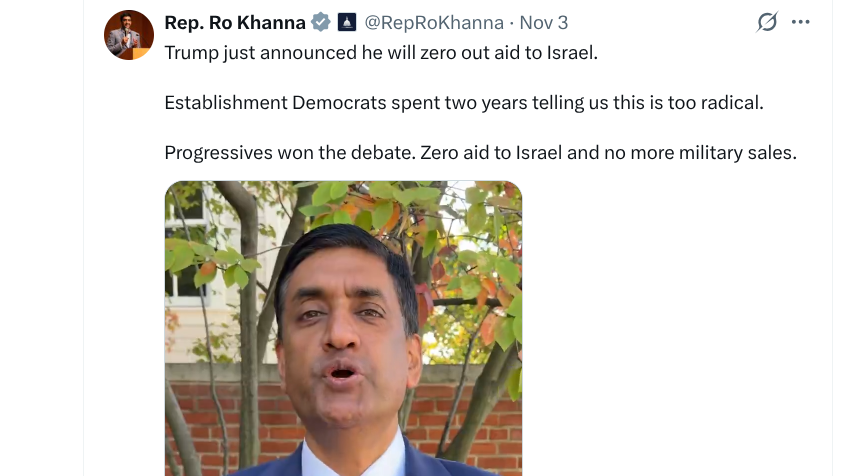
On Tuesday morning, as Americans headed to the polls, President Trump told Fox & Friends that the roughly $4 billion in annual military aid the United States sends Israel would end at the close of this year, an agreement he said he made with Israeli Prime Minister Benjamin.
Within hours of Trump’s announcement, Rep. Ro Khanna of California posted his victory lap on X, crediting progressives with winning the argument and then adding the line that tells you exactly where this is going: “Zero aid to Israel and no more military sales.”
The end of Khanna’s statement deserves attention, because it is his real announcement.
The decision regarding the cessation of aid itself is a sound one, and Israelis were making the case for it first. Netanyahu told The Economist in January that he wanted to taper off American military aid within a decade. In May, he told CBS he wanted to “draw down to zero” the financial side of the relationship, and in June he wrote to Rep. Marlin Stutzman that the time had come for Israel to move from aid recipient to partner. Other conservative voices in the US establishment echoed these sentiments. Senator Lindsey Graham, who no one can claim was a progressive liberal, also said in January that he would be creating a proposal to end US foreign aid to Israel and present it to both the Trump administration and Israel.
The current arrangement was built for a country that no longer exists. After the Yom Kippur War, when the IDF had to be rebuilt, American aid equaled about a fifth of Israel’s GDP and covered roughly half its defense budget, according to former defense minister Moshe Arens. The Carter administration expanded military aid dramatically in 1979 as part of the peace treaty with Egypt, and in 1985 Congress turned it entirely into grants while rescuing an Israeli economy in crisis. Today Israel’s economy tops $600 billion, its GDP per capita is above $60,000, and Israel’s own Institute for National Security Studies puts American aid at about half of one percent of GDP and around 15% of the defense budget. A nation that wealthy can pay its own way.
If anyone comes out behind in this deal, it is the United States. Israel has been required to spend its aid money at American plants, and under the current agreement nearly every dollar goes to American suppliers by 2028. Raytheon builds Iron Dome interceptors with Rafael, Boeing has produced Arrow components with Israel Aerospace Industries for decades, and the U.S. Army bought two Iron Dome batteries of its own. Once Israel is paying with its own credit card, it will have every reason to build more at home and shop wherever it finds the best deal, and American workers and Pentagon planners will feel that long before anyone in Jerusalem does.
Khanna arrived in Congress in 2017 as a progressive who backed the alliance and military aid. As recently as October 2025, he told a Bay Area Jewish paper that he supported Zionism and believed the people at AIPAC were acting in what they saw as America’s best interest. By June 2026, he had become the first member of Congress to sign the TrackAIPAC pledge, which commits signers to accept the genocide charge against Israel and oppose American military support for it. In July, he spent 72 hours touring West Bank villages, inciting violence from Israeli residents of the area, without coordinating with Israeli authorities or security personnel, and passed on meeting October 7 survivors and hostage families.
Khanna changes positions the way other politicians change ties, yet he has an uncanny sense of where his party’s activist base is headed next. With aid ending, the next fight will be over whether Israel may buy American weapons at all, with its own money, or whether it will face an embargo on arms, like what was recently suggested by the newly elected Darializa Avila Chevalier, another DSA politician from New York.
Europe has already shown us the playbook. In June, France barred Israel’s Defense Ministry from the Eurosatory arms exhibition outside Paris and allowed Israeli companies to display only air defense systems. This very week France reimposed restrictions on Israeli firms at Euronaval. That is the boycott, divestment and sanctions movement wearing a business suit, and Khanna and others want to bring it to Washington.
On Tuesday night Democrats won both the House and the Senate. Most Democrats do not share Khanna’s obsession, but the members who do will hold committee seats, draft amendments, and use every close vote as leverage. We already know what happens when a determined bloc inside an institution fixates on one small country. In 2025, the UN General Assembly adopted 15 resolutions on Israel and 11 on the rest of the world, according to UN Watch. From 2015 through 2024, the tally was 173 to 80. The UN, to its own detriment, has been fixated on Israel for decades and has turned a deaf ear to other conflict zones, where actual human atrocities are occurring.
With people like Khanna empowered by the victories of several new Democratic Socialist candidates, all of whom have an anti-Israel agenda, can we expect a similar ratio on Capitol Hill? Are we to see every appropriations bill become an excuse for an anti-Israel amendment, or every hearing detouring to discuss the situation in Gaza? Will Israel now see condemnations from Congress arriving at a pace once reserved for Turtle Bay? Only time will tell. But one thing is for certain: while the guns in Gaza have largely gone quiet, all we have seen is that the anti-Israel rhetoric has only grown louder, and in many cases has become a pathway to power for Democratic Socialist candidates and others.
For people who despise Israel, no concession will ever be enough. Ending aid makes sense for both countries, but they will treat it as blood in the water and claim it as their trophy. If history has taught us anything, the DSA rhetoric against Israel will likely not even stop at Israel, and will eventually come home to affect American Jews and many other minority groups, because, as Dennis Prager and Joseph Telushkin wrote in 2003 in their coauthored book “Why the Jews?”, “Antisemites begin with Jews, but they never end with Jews”.
American Jews have enjoyed 250 years in the greatest democracy our people have ever called home. We need to look honestly at what it means when those who single out the Jewish state for condemnation start winning elected office, and we need allies in both parties ready to say plainly that a friend of America should be free to buy what it needs, with its own money, from the country it stands beside. Otherwise, we run the risk of Congress becoming the next political body, hyper-focused on a single foreign issue to the detriment of all others, like the United Nations.