
President of Shahvand Think Tank
America’s Iran Debate Is Based on a False Choice
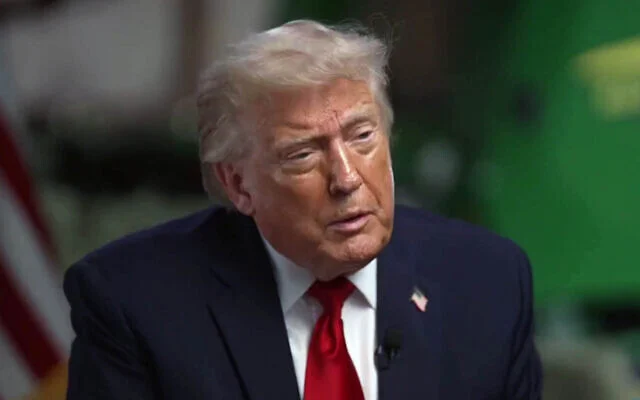
US President Donald Trump in an interview with NBC's 'Meet the Press,' aired on June 7, 2026. (NBC screenshot)
America’s Iran debate continues to revolve around a familiar binary: engagement or confrontation. Across administrations, congressional hearings, and think tank circles, these poles define the limits of policy thinking. Yet this framework no longer reflects either Iran’s internal trajectory or the strategic realities of the Middle East.
The problem is not that the United States has chosen the wrong approach. It is that the debate rests on a flawed assumption—that Iran can be meaningfully shaped through external pressure or diplomatic integration alone. Both approaches treat Iran primarily as a policy target, rather than a society undergoing long-term internal change that external tools only partially influence.
This produces a persistent mismatch: US policy oscillates between engagement and coercion, while Iran evolves along a separate timeline shaped by generational change, institutional rigidity, economic adaptation, and shifting social expectations.
The engagement model assumes that integration into the international system can gradually moderate Iran’s behavior. The confrontation model assumes that sustained pressure will force compliance or weaken the state’s external capacity. Both contain partial truths. Diplomacy can reduce escalation risks; pressure can constrain certain activities. But neither accounts for how Iran changes internally over time.
Iran today is defined by deep structural tensions: an aging political system governing a young, digitally connected population; centralized ideological authority alongside increasingly decentralized social behavior; and persistent economic constraints colliding with rising expectations for mobility and dignity. These tensions do not respond predictably to sanctions relief or diplomatic breakthroughs, nor do they collapse under pressure in linear ways. They evolve internally, often in forms only partially visible from outside the country.
What is missing from Washington’s debate is sustained attention to Iran as a society in motion. Over the past decade, Iranian society has undergone significant shifts in norms, behavior, and political expression.
At the same time, citizens have adapted to state constraints through technological workarounds. Despite extensive restrictions on digital access, widespread use of VPNs and decentralized communication platforms has created a parallel informational sphere. This does not amount to political liberalization, but it does weaken the state’s monopoly over information and accelerates the circulation of alternative narratives. These changes accumulate over time and gradually reshape the environment in which political authority operates.
The persistence of the engagement–confrontation divide reflects political convenience more than analytical accuracy. It offers clarity in a domain defined by uncertainty, but that clarity is increasingly artificial. Both approaches assume that external policy inputs are the primary drivers of Iranian behavior. In reality, Iran’s external actions are deeply entangled with domestic dynamics operating on different time horizons.
This helps explain why US policy often oscillates without producing lasting strategic effect. Each shift responds to immediate behavior rather than underlying trajectory.
A more complete framework must account for how internal political conditions shape external conduct. States under sustained internal pressure often externalize instability through regional behavior. In Iran’s case, regional activity through aligned networks and non-state partners serves multiple functions: deterrence signaling, strategic leverage, and domestic political consolidation. External behavior, in this sense, is not separate from internal conditions but intertwined with them.
If the current debate rests on a false choice, the alternative is not a third policy option but a different question: how should U.S. policy account for Iran’s internal evolution over time while managing immediate regional risks?
This reframing does not eliminate deterrence or diplomacy. It situates them within a longer strategic horizon. In practice, this means prioritizing the regional environment in which Iran operates through deterrence, energy stability, and security coordination, while also investing in sustained analysis of Iran’s internal dynamics, from generational change to information flows and legitimacy pressures. It also requires recognizing the limits of external influence: engagement and pressure can shape conditions, but they do not determine Iran’s internal trajectory in a linear or controllable way.
The central limitation in Washington’s Iran debate is not disagreement over tactics but confinement of perspective. Engagement and confrontation are not opposites; they are variations within a framework that overestimates the power of external policy tools.
Iran is a society in motion, shaped by internal forces that interact with but are not reducible to external pressure or diplomacy. In my ‘Onion State’ thesis, I explain why Iran’s power is layered and resilient.
The real choice is not between engagement and confrontation. It is between a static view of Iran and a dynamic one that accounts for evolving social expectations, including growing demands for political accountability and secular governance. These trends are increasingly visible both within Iran and across its diaspora, where opposition leader Reza Pahlavi, in the Iranian community have advanced alternative political visions for a post–Islamic Republic order.
Only this broader, society-centered perspective offers a foundation for a more realistic and durable US policy.
Related Topics
Related Posts