Media and Presentation Skills Trainer
Featured Post
An oasis of unity and comfort in Hostages Square
Amidst the post-October 7th discord and divisiveness, the Masorti Movement’s daily singing and prayer circle was a safe place of comfort and unity for all
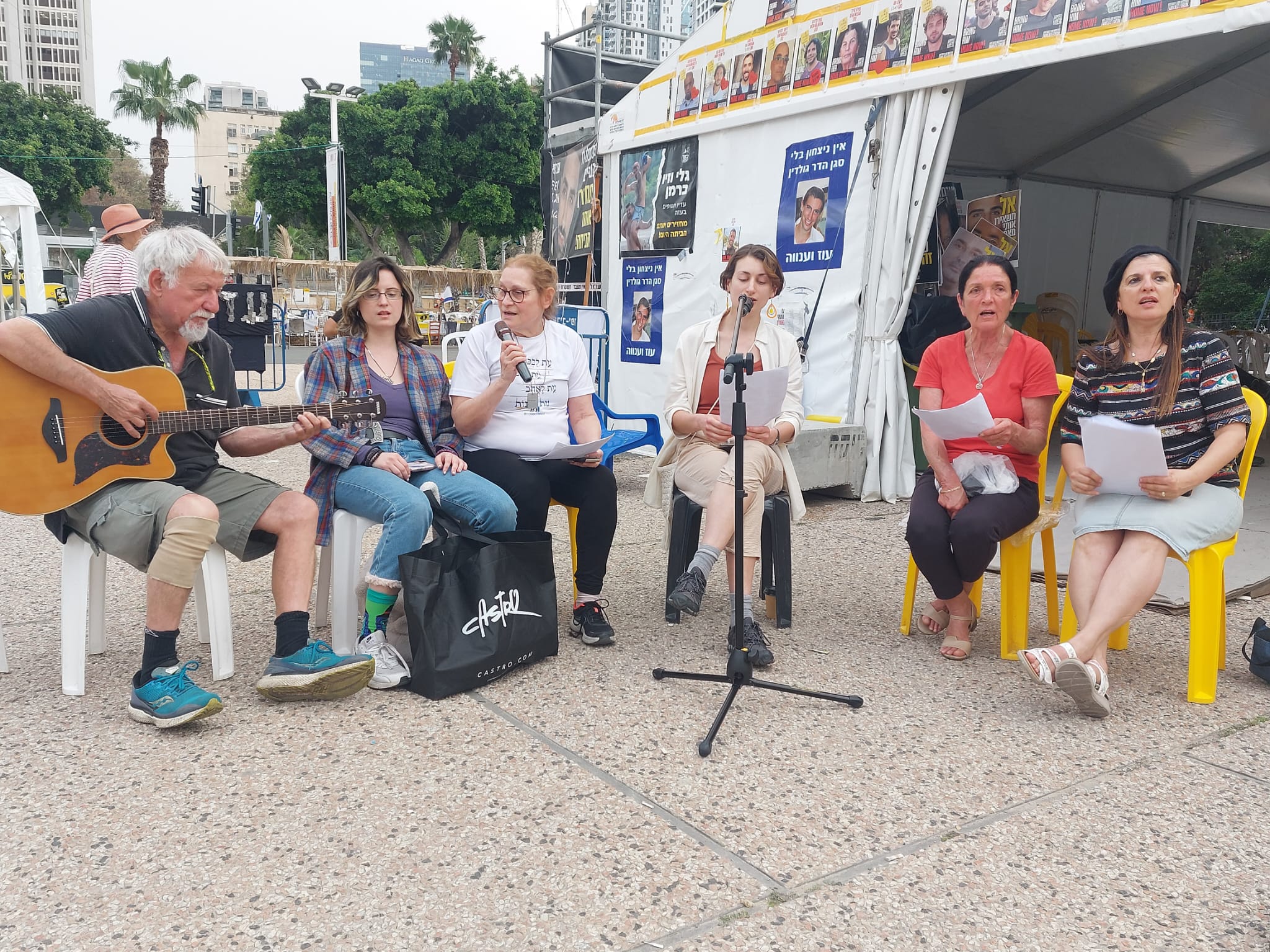
The singing and prayer circle of the Masorti Movement in Hostages Square. (Courtesy)
Every evening in Hostages Square in Tel Aviv, as the sun set and the city hummed around us, something extraordinary took place — a circle of song, prayer, and presence. For more than two years, this gathering became a quiet heartbeat amid grief and uncertainty.
Together, Eddie Landau and I had the privilege of helping to hold this space.
This circle began through the initiative of the Masorti Movement and under the remarkable leadership of Elisheva Barak. From the first days of the war, someone from the movement came to lead every single day, at the exact same time. A regular community gradually formed around it — a committed, ongoing minyan devoted to this gathering. Rabbis from across the Jewish spectrum, facilitators, and musicians all came to help lead.
The week after October 7th, I saw an announcement by the Masorti Movement (the Israeli branch of Conservative Judaism) about a prayer and singing circle on Kaplan Street in Tel Aviv where the families of the hostages were congregating; I thought – that I can do. I’m not a psychologist, not a doctor, nor a social worker. I can sing and lead tefillot/prayers. I can use my voice.
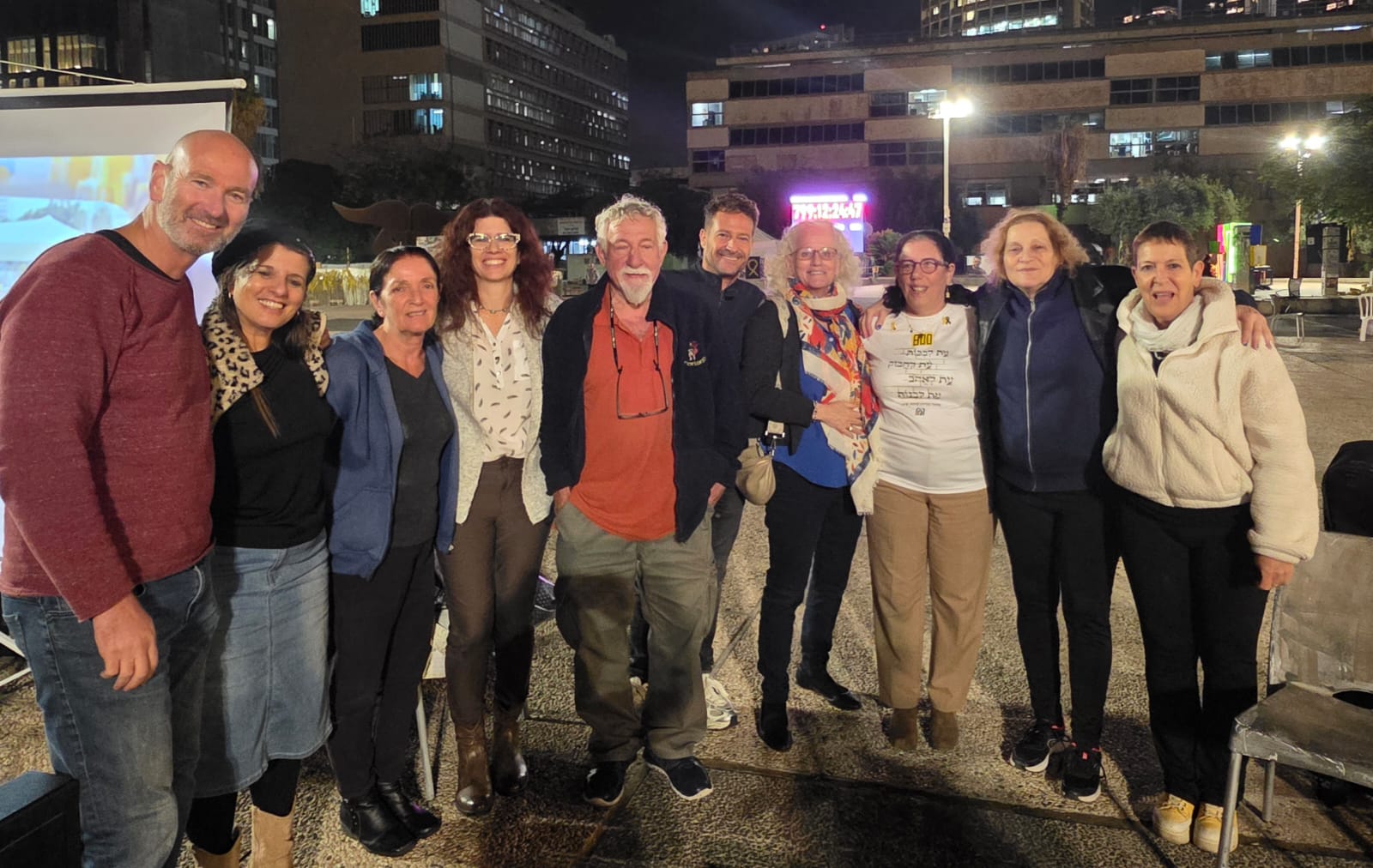
Soon after, the circle was moved to the newly named Hostages Square in front of the Tel Aviv Museum. I was asked to help facilitate the daily circle and ended up coming to Hostages Square at least three times a week.
Eddie came as a member of the egalitarian Masorti minyan, Havurat Tel Aviv, and as a clinical psychologist, bringing the practice of showing up, holding space, and listening.
Together, we became part of the team that opened the chairs, passed out the song sheets, and stayed until the last voice faded.
For us, this daily rhythm carried profound meaning. It reminded us how Jewish tradition finds strength in continuity — how sacred rituals and regular practices create a sense of belonging and stability. It also brought to mind the psychoanalyst Donald Winnicott’s concept of the “holding environment” — a space where a person feels sufficiently supported to express themselves freely, without fear or judgment.
For more than two years, every day at 5 p.m., people from all walks of life gathered in this circle. Religious and secular, ultra-Orthodox and Reform, secular humanist Jews, Christians from Africa, Europe, and Scandinavia, even news teams from abroad — everyone was welcomed. We sat in chairs with well-worn pages of songs and prayers for the return of the hostages, the recovery of the injured, and the safety of our soldiers.
The true magic was that this circle remained apolitical. All around us were demonstrations, burning tires, blocked highways, anger. But inside our circle, we made a different rule: here, we listen. The square was covered with posters of the hostages and installations like the tunnel — a symbol of where our loved ones were held. It would have been easy to be overwhelmed. People arrived dazed, not knowing what to do with their sorrow, their trauma. They cried with us, laughed with us, and shared their stories. They were not alone.
It became a space of deep listening, where politics and labels stayed outside, and every voice was welcomed. In a Jewish sense, it grew into a kind of minyan of the heart — a circle of song, tears, and hope, where something sacred entered our shared pain and our collective refusal to stop holding on to life.
So many powerful moments were born there.
A bereaved mother whose daughter was murdered at the Nova music festival stood with us and shared her story. We played a recording of her daughter singing, and her voice filled the square, transforming grief into light.
A mother and her teenage daughter from Ramat Gan spoke about the helplessness they had felt since October 7th, and how joining the circle made them feel part of something larger than themselves.
Guy Illuz’s father came with Guy’s big dog and told us about his son’s love for music. Guy was kidnapped from the Nova Festival and was later murdered in Gaza.
Eden Alexander’s grandmother, Varda, was a fixture in the square — elegant, always in a beautiful hat and always holding the poster of her grandson. When anyone asked to take a picture with her, she insisted that the poster of Eden be in the photo. “The important thing is not to forget Eden and the other hostages.”
We remember one evening leading the circle together with Rabbi Sara Cohen next to hostage Alon Ohel’s piano. We started with a small group. Suddenly, a large group of yeshiva students with long peot (sidecurls) and tzitziot flying in the wind ran up to us and joined in singing Shir LeMaalot and Gesher Tzar Meod. They didn’t ask who was leading. They sang at the top of their lungs, jumping high in the air or swaying to the slow songs.
The response from families of the hostages was especially meaningful. Many told us that knowing we were there every day — praying and standing in solidarity for the return of their loved ones — became an essential source of strength. Some of the hostages who returned came to thank us in person. With several families, the relationships continued beyond the circle itself.
Jews from abroad who came to volunteer also joined us. They told us of the rising antisemitism in their own countries, crying with us and sharing their trauma. We told them that we were all carrying trauma. This was the time to strengthen our connection. We need each other. Together we sang Acheinu: “Our brothers, the whole house of Israel, who are in distress and captivity… may God have mercy on them, and bring them from distress to comfort, from darkness to light…”
At a concert soon after his release, Alon Ohel spoke about how often we stop ourselves from reaching out to someone who is hurting. We tell ourselves, “I shouldn’t interfere,” or “They won’t want to hear from me.” But this circle proved the opposite. It became a place where human connection happened naturally, where people both led and were led.
These are only a few of countless moments in which the circle opened its arms to anyone carrying loss, fear, or hope. In that shared space, people from Israel and around the world joined their hearts together. In doing so, they gave life to the Jewish teaching that Kol Yisrael arevim zeh bazeh — that all Israel is responsible for one another.
In these days of increasing bitterness and divisiveness, we hope we can learn the lesson of the circle. We are all part of the whole house of Israel. We seem to forget that all too often.
But in Hostages Square, for one hour every evening, we remembered.
––
The above was co-written with Eddie Landau. Eddie Landau, PhD, is a clinical and medical psychologist. She has a private psychotherapy practice for adults, adolescents and children. She also works at the lung clinic at Schneider Children’s Hospital, where she specializes in working with adults and children with Cystic Fibrosis. Eddie lectures and presents widely in Israel and abroad. She is also a qualified Aruna yoga teacher. She lives in Tel Aviv with her husband and two children.
Related Topics