An Ophthalmologist, a Spy Psychiatrist, and the CIA Officer Who Broke A.Q. Khan
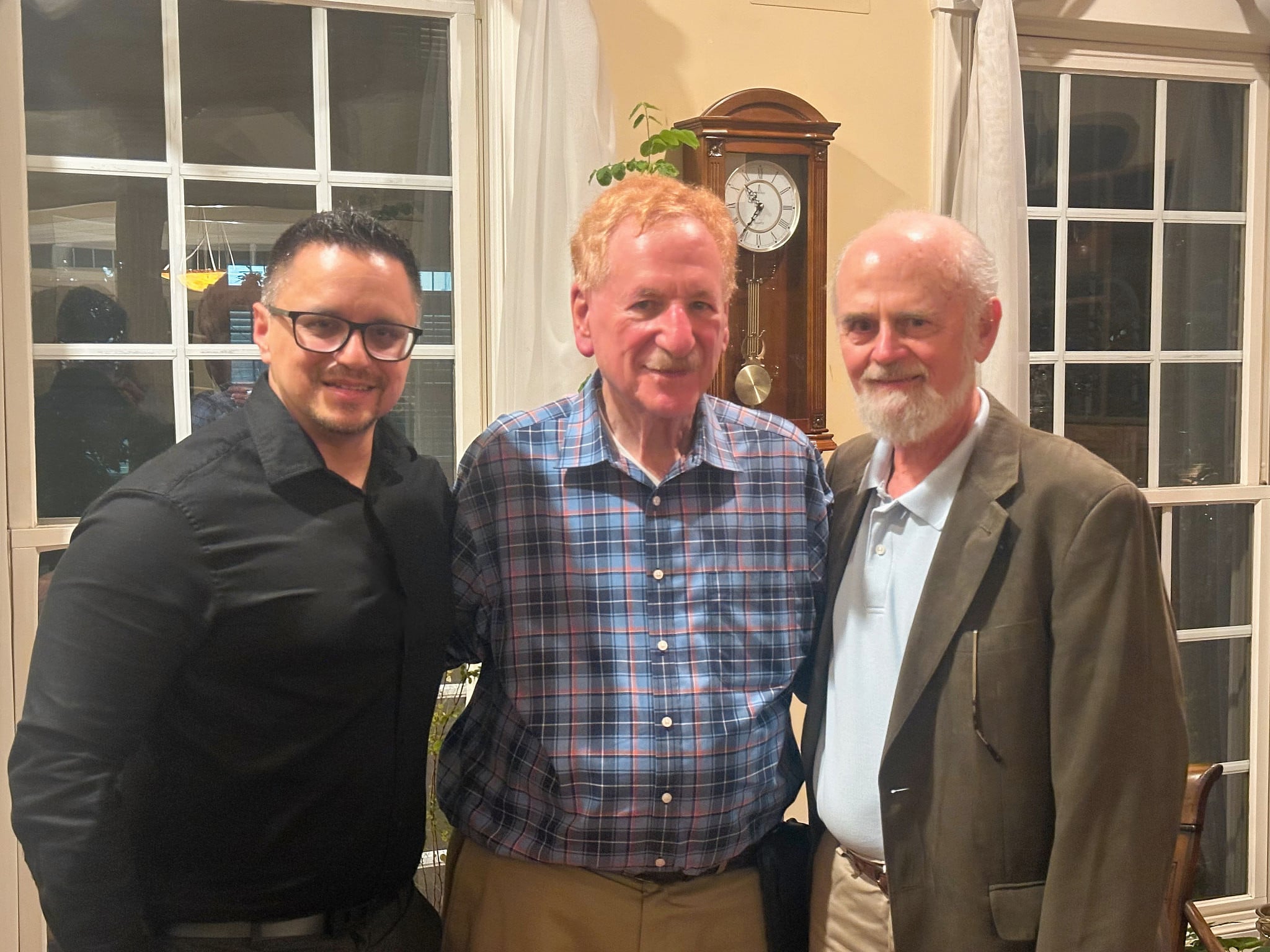
And there we were: a Honduran ophthalmologist who writes for The Times of Israel; the world’s leading authority on the psychology of insider spies; and the CIA officer who broke A.Q. Khan’s nuclear proliferation network.
The gathering was hardly accidental. I had traveled to Washington, D.C., with my family primarily for this meeting, which had been planned for months. That evening, our three families were having dinner at the home of Dr. David Charney. My path to that table had begun with nuclear weapons.
Writing about nuclear risk for The Times of Israel had put me in contact with Charney, a psychiatrist whose work has focused on the psychology of insider spies. What began as an exchange between two writers developed into a close friendship. Despite coming from very different professional worlds, we discovered that we saw many of the same problems in remarkably similar ways.
But the work that had made David Charney an unusual figure in the world of counterintelligence began somewhere very different: sitting in a room, week after week, listening to three Americans responsible for betraying some of their country’s most closely guarded secrets.
Charney served as a psychiatric consultant to the defense in three major espionage cases: Earl Pitts, an FBI agent who spied for the Soviet Union and Russia; Brian Regan, an Air Force and National Reconnaissance Office employee; and Robert Hanssen, the FBI counterintelligence agent whose espionage for Moscow continued for more than two decades. While the three were incarcerated, Charney was able to meet with each for as much as two hours a week for approximately a year.
At dinner, David explained how deliberate he had been about creating continuity in those encounters. The day, the hour and the way he approached each man remained consistent. Even his clothing and the colors he wore did not change from one session to the next. The message, reinforced week after week, was simple: the Dr. Charney entering that room was the same Dr. Charney they had seen the previous week. They could continue to trust him.
That mattered. These were convicted spies, reviled by the public and by the institutions they had betrayed. With Charney, however, they could speak without being judged anew for what they had done. Over time, they opened up.
Charney began to recognize a pattern. Different histories and circumstances had brought the three to espionage, but important elements of their psychological journeys repeated themselves: the personal crises preceding the betrayal, what happened after they crossed the line, the remorse, the feeling of being trapped and eventually the desire for a way out.
Those conversations led Charney to a conclusion central to his work: insider spies are not born. They are made.
Earlier intelligence studies had examined convicted spies through formal instruments and shorter interviews. Charney considered that research useful but incomplete. Months of conversations with the same three men allowed him to see things those methods could miss.
He eventually organized what he had observed into a ten-stage psychological trajectory. At its center was what he called an “intolerable sense of personal failure,” defined not by outward measures of success, but by a person’s private judgment of himself. Accumulating pressures could produce what Charney called a “Psychological Perfect Storm,” until betrayal began to appear, from inside that private psychological world, like a solution.
Crossing the line did not end the crisis. Remorse could follow, leaving the spy trapped between a foreign intelligence service he could not simply abandon and his own government, where confession meant the prospect of prosecution and prison. Whatever the original motivation, Charney found that their experiences increasingly converged around fear, uncertainty, hopelessness and the desire to get out.
That insight led to his three White Papers and eventually to his proposal for the National Office for Intelligence Reconciliation, or NOIR: an independent mechanism through which an active insider spy could surrender, disclose the damage done and accept severe consequences while avoiding prison. His later work also addressed intervention before an intelligence officer crossed the line in the first place.
It was through that world that David Charney came to know James “Jim” Lawler.
By then, Lawler had completed a twenty-five-year career as a CIA operations officer, more than half of it devoted to countering the proliferation of weapons of mass destruction. He had also become a specialist in recruiting foreign spies and had served as chief of the A.Q. Khan Nuclear Takedown Team.
The achievement that would define the final decade of his career did not begin with A.Q. Khan.
Lawler’s team had originally been assigned to penetrate the nuclear program of another country, one he still does not publicly identify. His strategy rested on an unusual premise. To defeat proliferators, he concluded, he had to become a proliferator himself.
His team created an operation capable of functioning credibly within that clandestine world. Instead of merely watching proliferators from outside, they created a way in. Eventually, elements of a proliferation network they had not originally set out to find came to them.
It was the network of Abdul Qadeer Khan.
Khan, revered in Pakistan as the father of the country’s atomic bomb, had turned nuclear proliferation into a private international enterprise, connecting suppliers and intermediaries with governments seeking nuclear capabilities. His network dealt with Libya and also had connections to the nuclear programs of Iran and North Korea.
Penetrating such a network ultimately required people on the inside. Human recruitment was one of Lawler’s specialties. Over his CIA career, he has said publicly that he personally made recruitment pitches to roughly fifty or sixty potential intelligence sources. Against the proliferation network, he recruited sources capable of providing access that technical intelligence alone could not.
At dinner, Jim told me that the effort consumed almost ten years of his career and, at its height, roughly 95 percent of his time. Yet whenever he spoke about it, he was careful about the pronoun. It was never simply what he had accomplished. It was what he and his team had accomplished. He repeatedly described them to me as a fabulous team.
George Tenet, then director of the CIA, apparently shared that assessment. In a 2004 note to Lawler, Tenet wrote that what “you and your team” had achieved would rank among the most spectacular intelligence accomplishments in CIA history. Former CIA Deputy Director John McLaughlin went further, describing it as “the closest thing I’ve ever seen to a perfect intelligence operation.”
By 2003, years of intelligence work allowed the United States and its partners to follow one of the network’s most consequential shipments toward Libya.
The ship was the BBC China.
On October 3, 2003, it was diverted to the Italian port of Taranto, where five containers holding thousands of components destined for Libya’s clandestine uranium-enrichment program were removed. Two months later, on December 19, Libya announced that it would abandon its nuclear and other weapons-of-mass-destruction programs and open them to international inspection.
What investigators subsequently found showed why the operation mattered. Libya had pursued a clandestine uranium-conversion and enrichment program that it acknowledged was intended for the production of nuclear weapons, and material related to nuclear weapon design had been supplied through Khan’s network. Its enrichment effort had not reached an industrial scale. But Khan had been providing Libya with a clandestine path toward nuclear weapons capability.
Lawler and his team had helped close it.
Sitting to his left at the round dining table, I asked Jim why he had retired while still relatively young, after twenty-five years in the CIA and at such a point in his career. He told me that after almost a decade consumed by that mission, he wanted to go out winning.
But I had another question. After spending a career doing work meant to remain secret, why had he decided that this particular achievement should become public?
Jim thought about it for a few seconds.
“Ego,” he said. “The same as you and David when you publish what you publish.”
I could hardly disagree. There is ego in putting your name on something and wanting your work to be known. But I told him that there can also be an ego directed beyond oneself: the desire to leave something useful behind, something that may survive us and perhaps benefit future generations.
That conversation led the three of us somewhere else. Looking back at the very different roads that had brought us to that dining room, none of us could describe them as the execution of some grand plan. One thing had simply led to another, then another, often in directions we had neither planned nor particularly sought. Only afterward could we look back and see the chain of events that had brought each of us to where we were—and, on that particular evening, had brought all three of us to the same table.
Speaking only for myself, it is something for which I thank God.
And none of us had arrived there alone.
Our families had shared the evening with us. By the time we said goodbye, the admiration around that table extended well beyond the three men whose stories had dominated so much of the conversation. Each of the women beside us had been fundamental to the lives and work that had brought us there. Whatever accomplishments we might discuss over dinner had been built with years of support that rarely appears in biographies, intelligence histories or bylines.
I would never compare my accomplishments with those of David Charney or Jim Lawler. What they achieved belongs to an entirely different scale. But I will allow myself one small boast.
Some of my articles scared a man who had spent twenty-five years in the CIA.
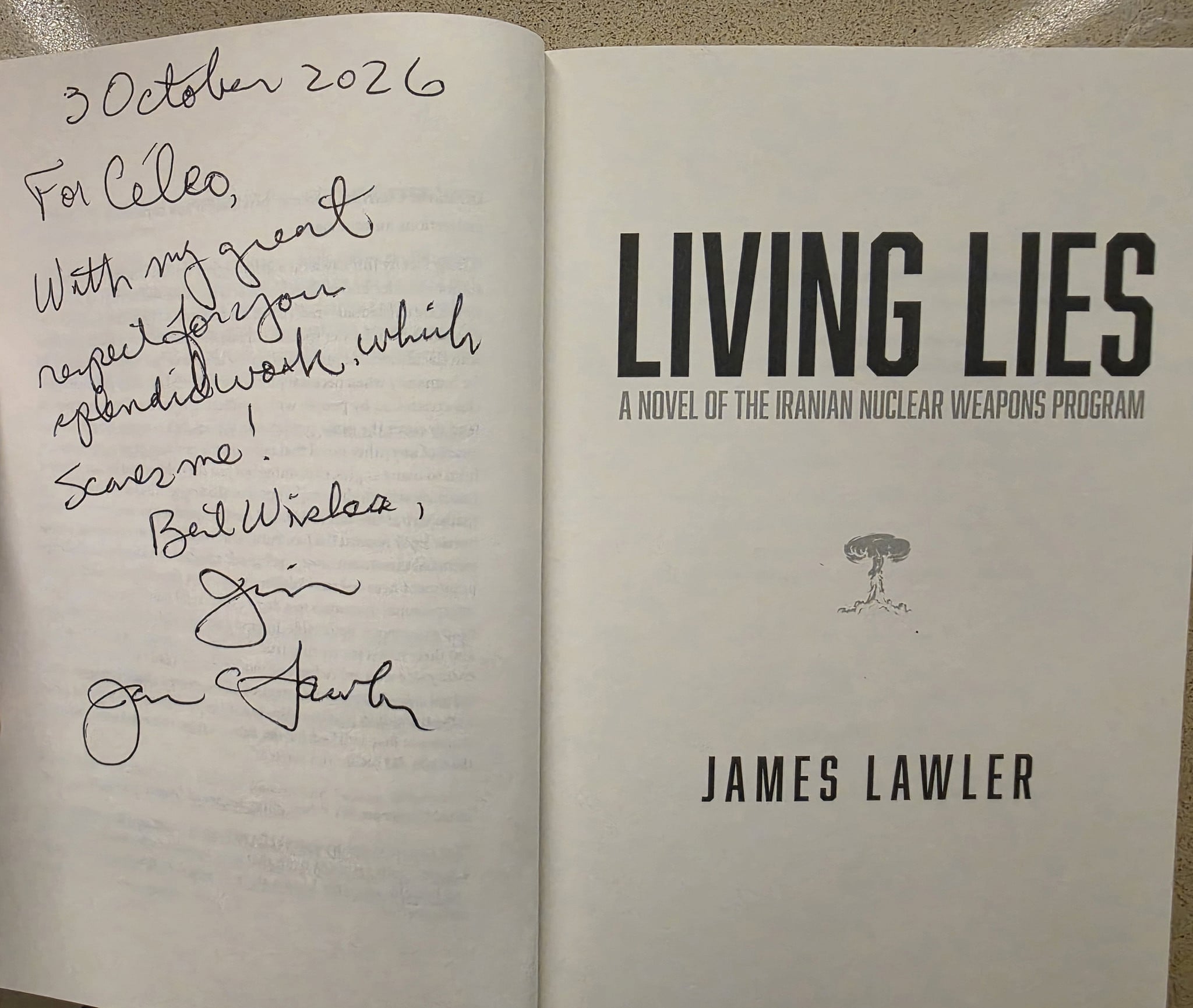
Jim told me so himself that evening. Before we left, he gave me a copy of his novel, Living Lies: A Novel of the Iranian Nuclear Weapons Program. On the first page, dated October 3, 2026, he had written:
“For Céleo, with my great respect for your splendid work, which scares me. Best wishes, Jim.”
We left David’s home that night with the doors wide open. There would be another gathering. Jim had already volunteered his house and promised that next time he would make us barbecue.
I hope he keeps that promise.