
An Aging Jewish Feminist
And The Nobel Prize Goes To… Pinchas the Zealot
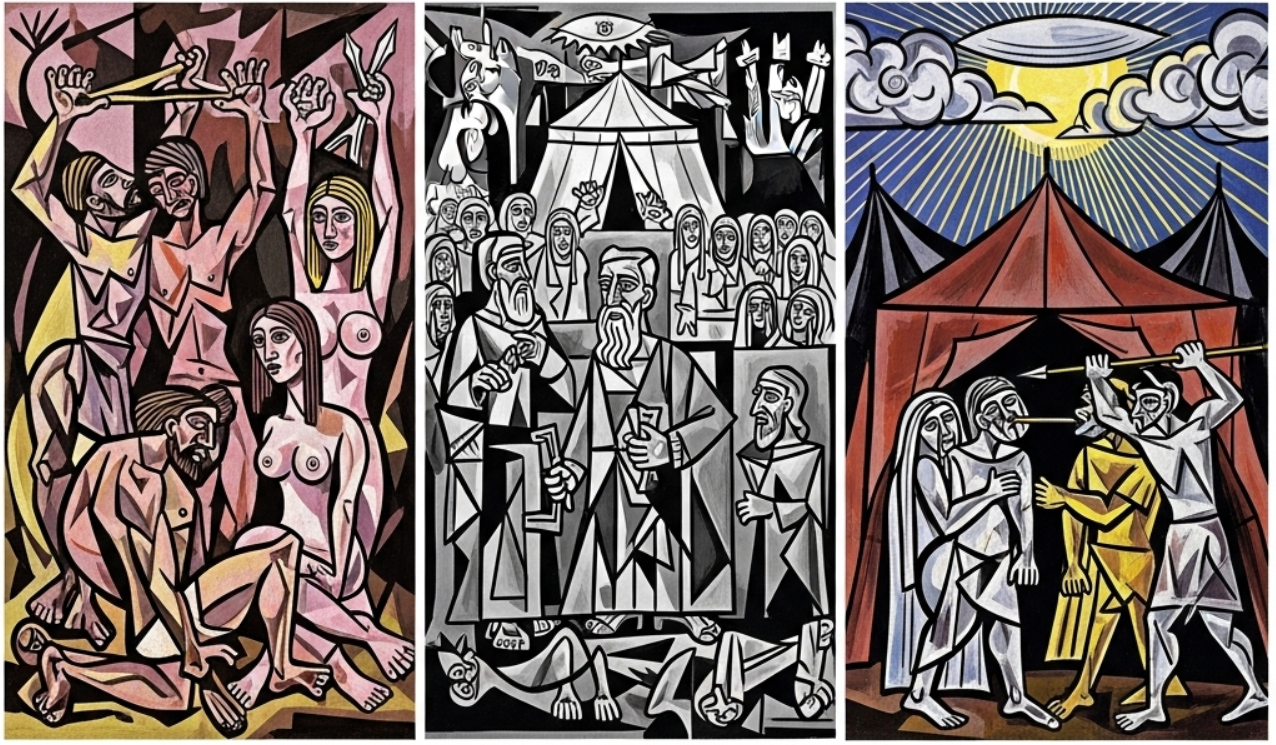
How do you explain to your children the story of a man who spears a couple mid-coitus, halts a divine plague, and gets rewarded with an “eternal covenant of peace”? Good luck! You could call it a deeply disturbing biblical paradox. Or you could take the easy way out: tell them he was a righteous priest restoring order.
WELCOME TO PARSHAT PINCHAS
At Shittim, the Israelites are described as “whoring” with Moabite women—a term that raises eyebrows before any theological analysis even begins. These women, we’re told, invited Israelite men to participate in sacrifices for their god, Baal-Peor. The men, apparently unable to resist the meat-and-maiden combo, gave in. God’s reaction? Wrath. A deadly plague breaks out, and Moses is told to publicly impale the offenders.
Then comes a plot twist. We’re given names: the Israelite man was Zimri son of Salu, a Simeonite chieftain. The Midianite woman? Cozbi daughter of Zur, tribal head of a Midianite clan. This wasn’t just any couple. Zimri had the audacity to bring Cozbi into the camp in front of the Tent of Meeting. Doing what, exactly? Was he raping her? Was it consensual? Did she tempt him? The text doesn’t say.
In response, Pinchas—grandson of Aaron, future High Priest—grabs a spear and goes full vigilante, impaling them both mid-act. The plague stops. Divine applause follows. And God grants him an “eternal covenant of peace.” You’ve just witnessed a double homicide… and a priesthood awarded. Welcome to the Bible’s version of the Nobel Peace Prize.
Yes, you read that correctly. Pinchas is rewarded with shalom—peace—for a spectacular act of violence. How does that work? How does bloodshed become sacred? How does a zealot earn a covenant of peace?
It’s the kind of twist that would be baffling—unless you remember how history tends to operate. As the saying goes, history is written by the victors. Or in this case, by the priests. The story is less about objective truth and more about legitimizing power. Pinchas restores priestly order through one act of sexualized violence—and God grants him a dynasty. You can almost hear the divine tweet: “Huge win for Law & Order! Pinchas = HERO! #PriesthoodForLife.”
And while we’re talking tweets and peace prizes, the whole episode starts to feel oddly modern. Imagine a world where a leader authorizes a bombing campaign, escalates regional tensions, then declares that he brought peace to the Middle East—and gets nominated for the Nobel Prize. Oh wait, no need to imagine. That happened. If preemptive strikes can earn you accolades today, maybe it’s not so shocking that a priestly hit job was considered sacred in ancient Israel. The line between zealotry and leadership has always been perilously thin—especially when you control the narrative.
READING THE TEXT WITH A HERMENEUTICS OF SUSPICION
What if the Moabite and Midianite women were not seductresses, but victims? The narrative is eager to blame them: they “lured” the men, they “invited” them. But Cozbi is identified as a chieftain’s daughter—an elite in a patriarchal system. Do we really think she had agency here? Or was she a pawn, a political offering, a spoil of war?
There is a long and tragic tradition of using women’s bodies as battlegrounds. We’re told the men “profaned themselves” with the Moabite women—but did anyone ask if the women consented? Could this be a case not of consensual seduction but of systemic sexual violence reframed as idolatry? If so, the sin here is not just theological—it is ethical. Perhaps Cozbi, a victim of rape, was not just violated by Zimri, but by the biblical tradition itself, which preserves her only as a scapegoat for divine wrath.
Then there’s Pinchas. The hero. The man whose name headlines an entire Torah portion. What kind of person responds to sexual transgression with a spear?
It’s worth pausing on the Hebrew word for spear: romach. Rearranged, its letters spell rechem—womb. The spear, a phallic symbol, replaces compassion (rachamim) with violence. One could ask whether Pinchas was aroused by what he saw. Did he enter the tent trembling with rage—or with something else? Was this the sublimation of erotic desire into sacred execution? Unable to bear his own forbidden stirrings, Pinchas impales the couple, transforming his internal turmoil into ritual bloodshed.
The spear is not just phallic. It becomes a symbol of control—over bodies, over boundaries, over power. The act of killing Zimri and Cozbi is framed not just as necessary, but redemptive. Intertribal sex, especially with Midianite women, threatens the community’s purity. What better way to enforce tribal loyalty than to demonize intermarriage and mythologize its punishment?
This is not just a story about idolatry. It is about power—sexual, political, religious—and the violence used to maintain it.
And remember: Pinchas wasn’t just anyone. He was Aaron’s grandson. He had priestly pedigree. But by acting before Moses, without sanction, he didn’t just wield a spear—he seized authority. He performed an unsanctioned execution and was retroactively rewarded. This is the founding myth of a priesthood built not on mercy or wisdom, but on spontaneous bloodshed. You could call it a priestly coup—with God’s rubber stamp.
RABBINIC DISCOMFORT
To be fair, not all ancient voices accepted this story at face value. Rabbinic sources contain notable criticism and ambivalence toward Pinhas for his violent act against Zimri and Cozbi. Rabbinic sources reveal deep ambivalence:
There is a textual tradition which preserved the broken vav, in the word “shalom” (peace). In Numbers 25:12, the covenant is sealed with a “shalom” whose vav is split. This rare vav ketu’ah openly questions the validity of the brit shalom given to Pinchas for his violent act. This scribal tradition is a form of implicit commentary and criticism, forcing us to ask questions about God’s reward for zealousness (Kedushin 66b).

Another source explicitly states that Pinhas acted “not with the approval of the Sages.” Rabbi Yudah bar Pazi says the Sages even considered excommunicating Pinhas for his act, and only refrained because the Holy Spirit intervened, declaring that Pinhas and his descendants would receive the covenant of priesthood. This source comes as close as possible to outright condemnation, emphasizing that Pinhas’s behavior should not serve as a precedent or role model, and that his case was an anomaly due to unique circumstances and divine approval (Jerusalem Talmud, Sanhedrin 9:7).
There is even a Halakhic tradition that rules that if Zimri had killed Pinhas in self-defense, Zimri would have been innocent. Furthermore, if Pinhas had acted before or after the illicit act, he would have been guilty of murder. The halakha is “halakhah ve-ein morin kein”—“It is the law, but we do not teach people to act this way.” Vigilante justice, the rabbis understood, is a dangerous business (Sanhedrin 82a).
Now fast-forward to today. Imagine a soldier disobeying orders, murdering a couple he believes are traitors, and receiving a national medal. The message? Take bold, violent action in the name of honor—and you’ll be rewarded, even if you circumvent proper authority.
THE HEART OF THE PROBLEM
The story of Pinchas is not just disturbing. It is a theological endorsement of violence masquerading as virtue. It’s a tale that sanctifies zealotry, channels erotic panic into righteous fury, blames women for male desire, and silences dissent with divine approval. It teaches that peace can be achieved by purging impurity, that order is restored by force, and that those who kill most decisively may inherit the priesthood.
And that lesson has never gone out of style. We still live in a world where religious violence masquerades as righteousness. Where purity politics lead to bloodshed. Where women are blamed for men’s urges. Where zealots believe they are the agents of salvation. Where zealots still believe that peace can be forged through destruction. The story of Pinchas is not just ancient history. It is a mirror. It is also, chillingly, a masterpiece of theological propaganda.
We never hear Cozbi’s voice. We don’t know Zimri’s version. There is no trial, no deliberation, no due process. Just spear, blood, and divine reward. It’s disturbingly efficient. And disturbingly effective. And if we accept its righteousness without question, we risk becoming its next victim—or worse, its next Pinchas.
PINCHAS ON HIS DEATHBED: CONFESSION OR JUSTIFICATION?
I come from a lineage torn in two.
My grandfather Aharon was a man of peace—he loved and pursued shalom with every breath. My great-uncle Moshe, chosen by God, often ruled through anger. He killed an Egyptian when no one else acted; I did the same. When I saw the people paralyzed, weeping, and doing nothing, I acted. He shattered the tablets in rage. He commanded the Levites to slaughter their own kin after the Golden Calf. That was my first taste of blood, too.
And yet, my grandfather Aharon—who helped create the Golden Calf—escaped punishment and is forever remembered as a peacemaker. Maybe that’s why God gave me the peace prize: to keep it in the priestly family.
But let’s not forget: Moshe too was flawed. He struck the rock instead of speaking to it. From both of them, I inherited a divided legacy. I had to choose who to follow.
To be honest, I was also frustrated—and jealous. As a priest, I couldn’t marry just anyone. I had to remain pure. She had to be from the right family. Meanwhile, the rest of Israel’s men had no such restrictions. They slept with whomever they pleased—Moabites, Midianites—without consequence.
And then I saw them: the Israelite man and the Midianite woman together, publicly, defiantly. In that moment, I chose Moshe’s path. I lifted my spear—romach—and drove it through both of them.
It felt like righteousness. But sometimes I wonder: should I have spared Cozbi? Was she just collateral damage? I acted in zeal, in the name of justice. And for that, I was given a covenant of peace.
But was it really peace—or was it silence?
Some called it divine justice. Sometimes I think it was more like giving someone the Nobel Peace Prize for ending a war they themselves escalated.
That spear—romach—still haunts me. Its letters can be rearranged to spell rechem, womb. From the same root comes rachum—merciful. As I pierced her womb, I rejected mercy. I chose a weapon over compassion. I turned life’s origin into death’s final act.
Years later, when Jephthah made his reckless vow—to sacrifice the first thing he saw—I had the power to intervene. A priest can annul a vow. But he asked, “Shall a general humble himself before a priest?” And I replied, “Shall a priest humble himself before a man of war?” So between our pride, a girl was sacrificed.
Was I truly zealous for God? Or just another man who mistook violence for holiness?
I lifted a spear once. But I’ve spent a lifetime wondering what else I killed that day. Maybe it wasn’t just two bodies. Maybe I killed the path of peace.
And maybe following Moshe—flawed, passionate, righteous, but often ruled by fury—was itself a mistake.
And if that’s true… I have to rethink everything I’ve ever done.
Note: The midrash that describes Jephthah’s refusal to seek annulment of his vow from the High Priest Phinehas—and Phinehas’s refusal to approach Jephthah—originates in Midrash Tanhuma, specifically in the section Tanhuma (Buber), Parashat Bechukotai 7 . This midrash elaborates on the biblical account found in Judges 11 by adding that Jephthah, out of pride, would not go to Phinehas to annul the vow, and Phinehas, out of his own pride, would not go to Jephthah. As a result, Jephthah’s daughter was sacrificed, and both men were held responsible for the tragedy.
Related Topics
Related Posts