POST-HARMONY Special Project
Anselm Kiefer and Post-Nazism, Today
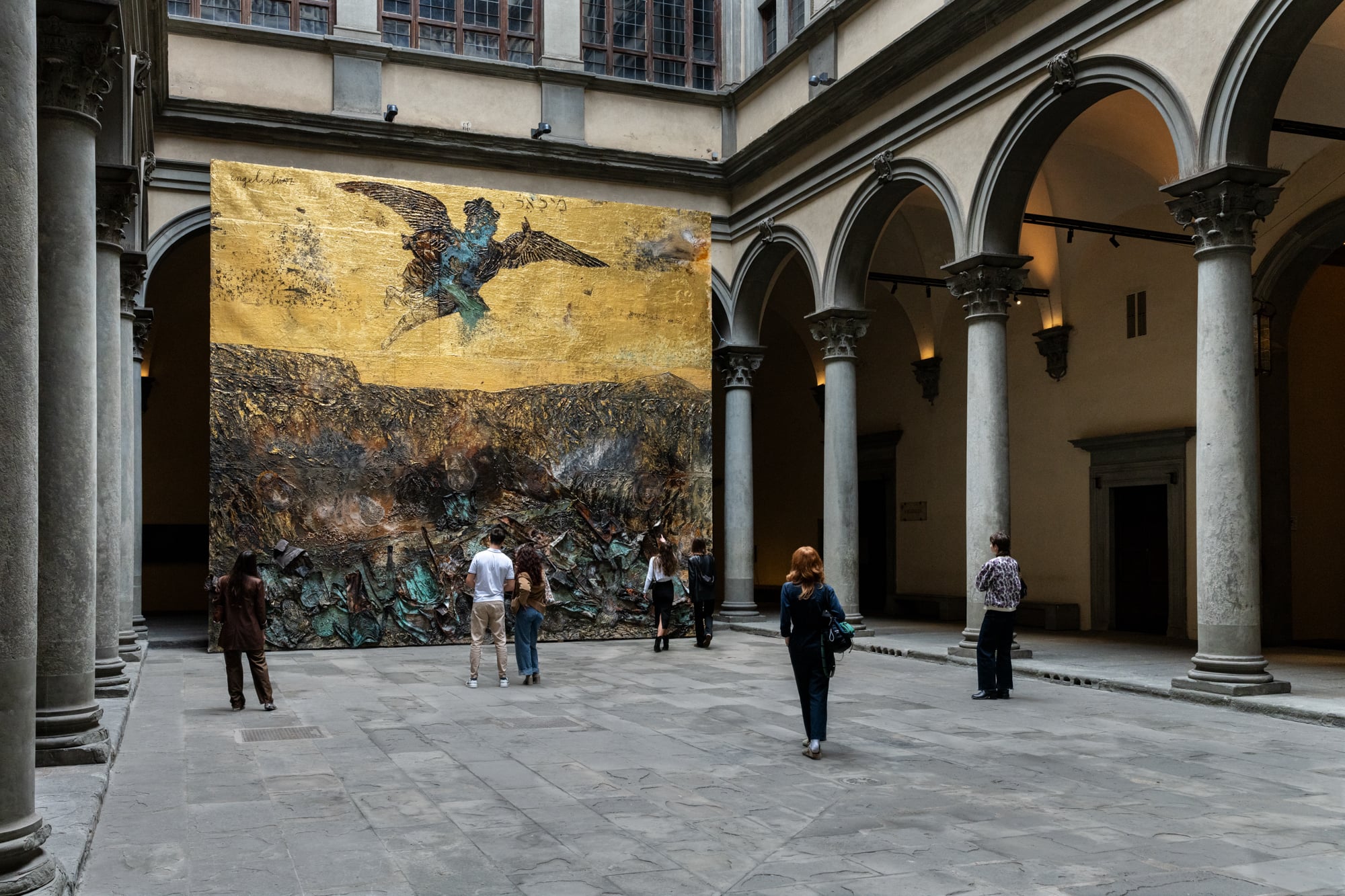
Anselm Kiefer's Fallen Angels exhibition in Florence
FALLEN ANGELS EXHIBITION AT PALAZZO STROZZI IN FLORENCE
Re-Visiting Kiefer in Florence
Anselm Kiefer, who is 79, is a mighty artist. He sees with ‘a wide-shuttered camera’ in his eye, and he creates accordingly. He has an original and impressive voice of his creations which impresses once and deeply. His aesthetic is interesting, modern and powerful. During the decades of his work as a visual artist, which has been over a half of a century by now, Kiefer spoke loudly and in his own way, which is heavily philosophical , due to the objective circumstances of his and his generation’s life, and the place in which they were born and lived. And our history.

As my dear friend, a great reader of modern art and literature Michael de Saint-Cheron, who currently works on his new book on Kiefer, says, ‘ Along with Baselitz and Soulages, Kiefer is one of the last major artists since World War II’. Michael de Saint-Cheron, a close pupil of Emmanuel Levinas, friend and colleague of Elie Wiesel, and chairman of the Andre Malraux Society, is immersed into the perception of art and literature via the prism of history. The history which has formed us and our intellectual and artistic products, as it is the case of Anselm Kiefer, the German, whose father was a captain of the Wehrmacht, the fact of life similar to the millions of that generation which could not quite live with what they have learned after the Frankfurt Auschwitz Trial started, from the middle 1960s onward, when young Anselm Kiefer started his artistic career in his native country.
I always thought that those dark-irony huge photos of young Anselm in his father’s Wehrmacht uniform, sieg-Heil-ing with an parody-like deliberately idiotic face expression against widely publicly known European landscapes are understandable ones, in their clearly Chaplinesque appeal. For anyone who is aware of the state of mind of German post-war society, these photos were an expected statement of the profoundly shocked generation which has been deprived of any truth about the giant crime for not less than twenty years. The fact of that total silence for twenty years is essentially important, in my view. Kiefer’s statement in those epatage photos was not about art, of course, for young Anselm. An art, staged photography in this case, was just a tool. It could be whatsoever.
The post-war German generation had an essential need of their own saying of what has happened to their people, society and their country. And it is only logical for matured and world-famous artist, which Anselm Kiefer has become, to include these works which stirred quite a scandal back in the early 1970s in his home country, to include it into his newest exhibition, large and versatile Fallen Angels in the Palazzo Strozzi in Florence ( March – July 2024). Those mega-photos were Kiefer’s personal statement of a baffled and shocked young man who, alone with his generation, only began to discover the truth of the war in its detail when they were in their twenties and over. This is an important fact of history and formation of many people, which should not be overestimated. The fact that the uniform is his father’s is the most important and telling detail in the whole effort, although sometimes Kiefer downplays that very fact. In general, while he creates openly and boldly, he always guards his inner space very determinedly.
There are three counterpoints throughout the Fallen Angels exhibition in Florence, which is all one firm statement by the artist, to me. It starts with one, the very first exhibit , apart of a giant and very good panel with the archangel Michael, meeting everyone in the classic inner yard of Palazzo Strozzi, with next one in the very middle of an exhibition, and the final one in the end of it.
Interpreting Kiefer’s Narrative
Anselm Kiefer’s latest exhibition is large, versatile and elegant. It leaves a long-lasting impression, with a lot of thoughts arising during and after the visit. This fact alone is a rare occurrence in the world of contemporary art. One can analyse many aspects and themes presented to us by Kiefer and a very able curator of this exhibition, director of the Palazzo Strozzi Foundation Arturo Galansino.
I recognised a special line coming through this very well-selected and greatly presented newest Anselm Kiefer’s narrative, and for me, this line is punctuated by three works which have a function of a counterpoint throughout the entire presentation as a whole.
Interestingly enough, as a subject-matter, all those three counterpoints seem to be on the second plane of the exhibition’s main narrative. But this is typical of Kiefer’s artistic way of thinking in general. His metaphors are not created in a placard way, or one-dimensional way, as a rule. He expects his viewers to think, and also provides us with a space of doing it, consciously creating a room for people’s individual perception . This is a very good and much needed quality in contemporary art.
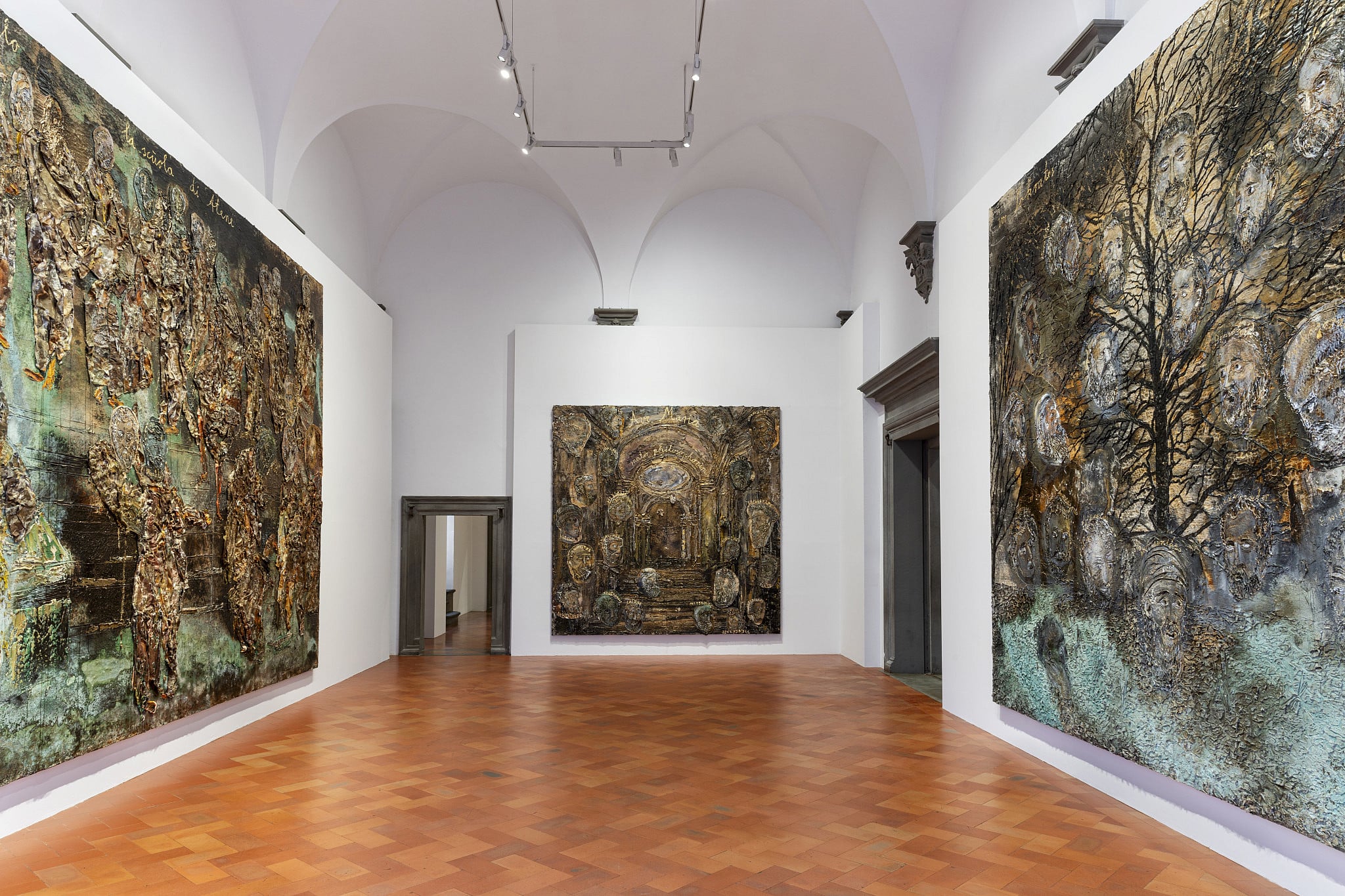
The exhibition with its attractive and telling title, and with its truly impressive and highly artistic title-work, which is so huge, 840 & 750 cm, that even in the large spaces of Palazzo Strozzi it had its place in its courtyard, which actually is a very well working decision, both visually and intellectually, this exhibition, in my perception, is an overall philosophical survey by Kiefer about the futility of human life and, as such it is also about a gloomy predestination of it.
Being a master of contemporary symbolism which is a complex dimension, in a good execution, as in the case of Anselm Kiefer is, the artist has his impressive visual monologue on the overall topic of sadness of realising not even fragility of human existence which is one of the main themes in art in general, but namely futility of it, which seemingly is evident to the artist. Such gloomy world is a complicated matter to create, simply because the thought itself is not inspiring – one can think, observing a hall after another in Palazzo Strozzi, full of impressive trade-mark Kiefer’s works addressing philosophy and philosophers, paying homage to van Gogh and his tragic life, mourning futility of knowledge as such, portraying several symbols of evil in the emphatic way, showing dead earth, dark skies, no light, no hope, nothing optimistic, nothing to live for – and still living, in a typical Kiefer’s paradoxical world which is thoroughly gloomy, and which, in his principal attitude is detracted from an usually accepted and practised disposition in art which aims to produce, create, and express hope and light, sometimes against all odds, as the way and sense of living.
We know about some of the other artists of our time who were so affected by the depth of the abyss in which the Second World War has put humanity that they all their life were expressing nothing but this painful depression, as Pierre Soulages did, for example. This is the art of human suffering, to me. And in the case of Kiefer, at the same time it is also the art of sometimes disarming, child-like perception and questioning reality, giving unexpected spaces for that reality to be improved somehow, or to leave some openings, at least, for the same purpose.
That outcome has to do with Anselm Kiefer’s life story indeed, as he himself pointed out in one of his interviews that ‘everything in his art comes from his childhood’, which is a known phenomenon both in art and literature. In the case of Kiefer’s story, this inner trajectory from his childhood onto his canvases and sculptures is palpable. Interestingly enough, he is a rare artist whose paintings look much like sculptures, and his sculptures are often close to paintings, his original manner’s feature which tells that the main tool with what Kiefer-artist works is his brain and its non-stop wondering of what human beings are doing with their lives on this planet.
Birth – Camp – Beginning That Means End
By placing the mentioned above three counterpoints throughout Kiefer’s Fallen Angels exhibition, the artist and the exhibition’s very able curator, one of the leading figures in the contemporary art world Arturo Galansino, made Kiefer’s personal and his generation’s of the German predominantly anti-Nazi children and grand-children of the Nazis and Wehrmacht members, reflecting on the life in the given historical circumstances in articulated, if subduedly, punctuated way. I call that line visible to me at the exhibition, Birth – Camp – Beginning That Means End. Such is my reading of the way of presenting the exhibition.
The Birth theme meets the visitors as the first exhibit, which is tellingly placed alone in a large room. From a typical Kiefer mixed media panel, an aeroplane’s wing stands out in a three-dimensional display, reaching out from a two-dimensional panel. Even without knowing the artist’s biography, one gets immediately that the aeroplane is military one. To create such an intuitive feeling for any viewer who enters the room and starts the exhibition, is a mastercraft, to me.
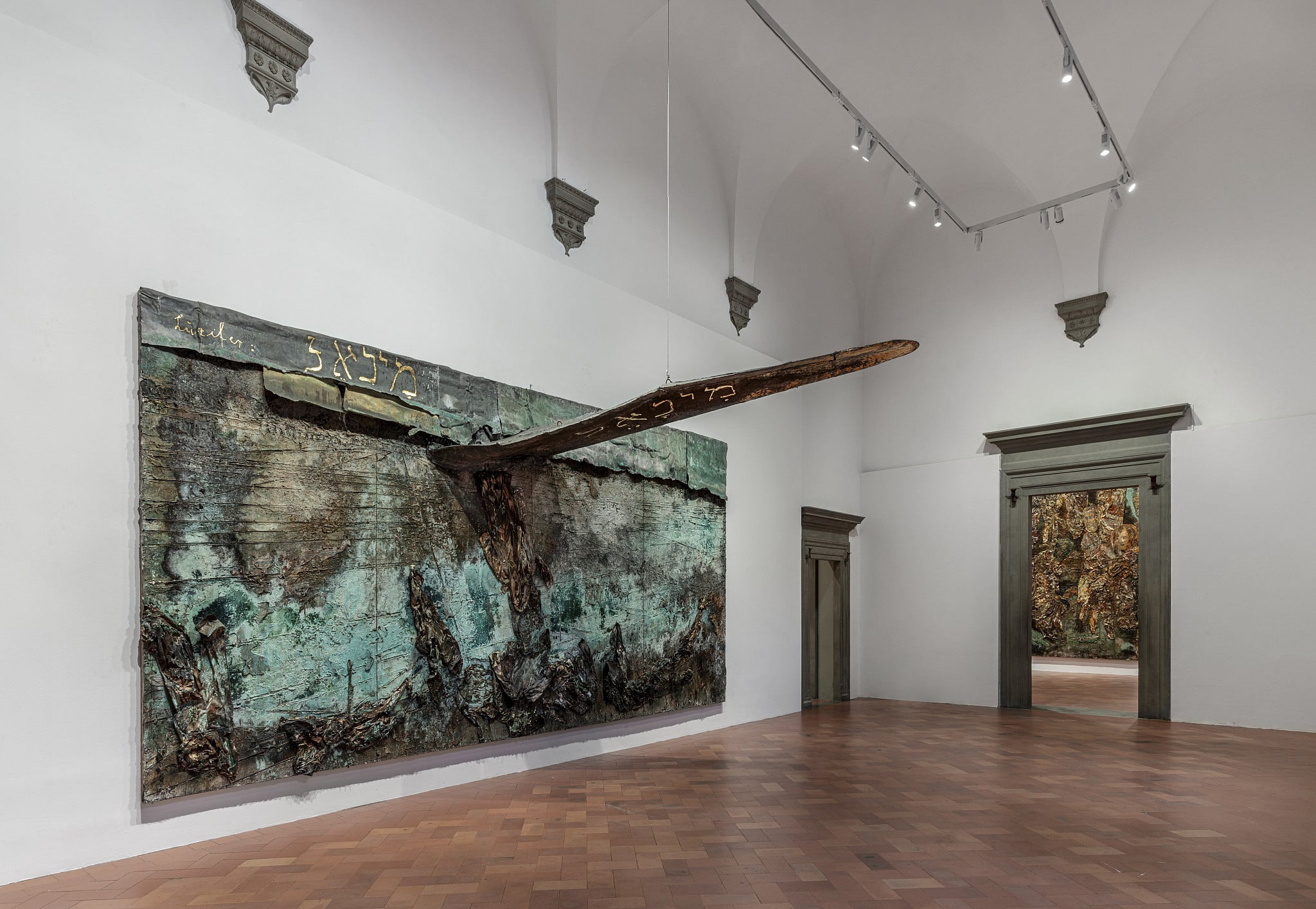
Those who know Anselm Kiefer’s life, instantly get the picture of him being born literally under the rubbles in Germany in the midst of the heavy bombardments of it by the Allies, just two months before the Nazi regime signed the capitulation act. As far as I am concerned, this work is one of the most powerful self-portraits of our time, in which the artist brilliantly managed not only to create a picture of birth of his own self, but made compellingly authentic portrait of the given epoch, uniting the time and the place: Germany, March 1945.
The work’s atmosphere adds to that ‘self-portrait’ an imaginable feature, as if Kiefer states in this work: ‘ a boy was born there and then’. That boy, as many of his generation, in different countries and at the different sides of the Second World War, had no toys, and instead, he played with bricks from ruins around. Being on his customary inner self-guard, Kiefer says in some interviews that ‘being a child, I did not realise the real meaning of the ruins and related to his bricks as to regular toys, without adding much drama to that”. Still, there is a child’s intuition which feels the inner truth of things around him unmistakably, and that truth gets into the subconsciousness of a child which is growing with such fundamental things of his inner life ever since. That German boy’s intuitive perception of life among the ruins around him eventually has developed into what one can call as an artistic trademark of his generation.
The artist’s message in this work opening the exhibition in Florence is tangible. This is the counterpoint one.
The word ‘Michael’ in Hebrew is placed by the artist in this work even twice. This word, the name of the archangel, is present all over the Fallen Angels exhibition. From Biblical history we know that it was the archangel Michael who led the group of other angels, questioning the Creator on the reasonability of creating the man. Kiefer’s message is clear, in his repeatedly addressing his viewer to the Archangel who was not quite sure about that primary intention.
But it also worth to remember that in Judaism – and Kiefer addresses his viewers to Judaism clearly, writing the name Michael in many of the exhibited works in Hebrew only – archangel Michael, one of four main, superior angels in Judaism, along with Gabriel, Raphael and Uriel – is the closest one to the Creator, he is also the most authoritative among the angels, and he is a mighty, leading saviour figure of the Jews and protector of Israel. Kiefer, who did study both Biblical history and Jewish mysticism, is fully aware of it, and places archangel Michael’s name in Hebrew in many of his important statement-like works with the meaningful reason, obviously.
The next counterpoint in my perception throughout the rich and large exhibition is placed in its middle, after a huge hall with exquisite homage to van Gogh – there is no art and no artist after van Gogh without him, in my subjective view, and for Anselm Kiefer, van Gogh was the main artist in his youth when young Anselm was just about to become an artist ,- and two following halls with interesting and enlightening , even if in a sad way, works dedicated to philosophy, philosophers, and our rejection of their wisdom, or at least people’s distancing from it. And then you step in the hall with beautiful and meaningful symbolic works on its walls, and the installation in the middle which is devastating to the degree that you physically feel as if the ground is moving off your feet. The installation is named Locus solus, Solitary Place ( 2019-2023), and is quite recent work by the artist.
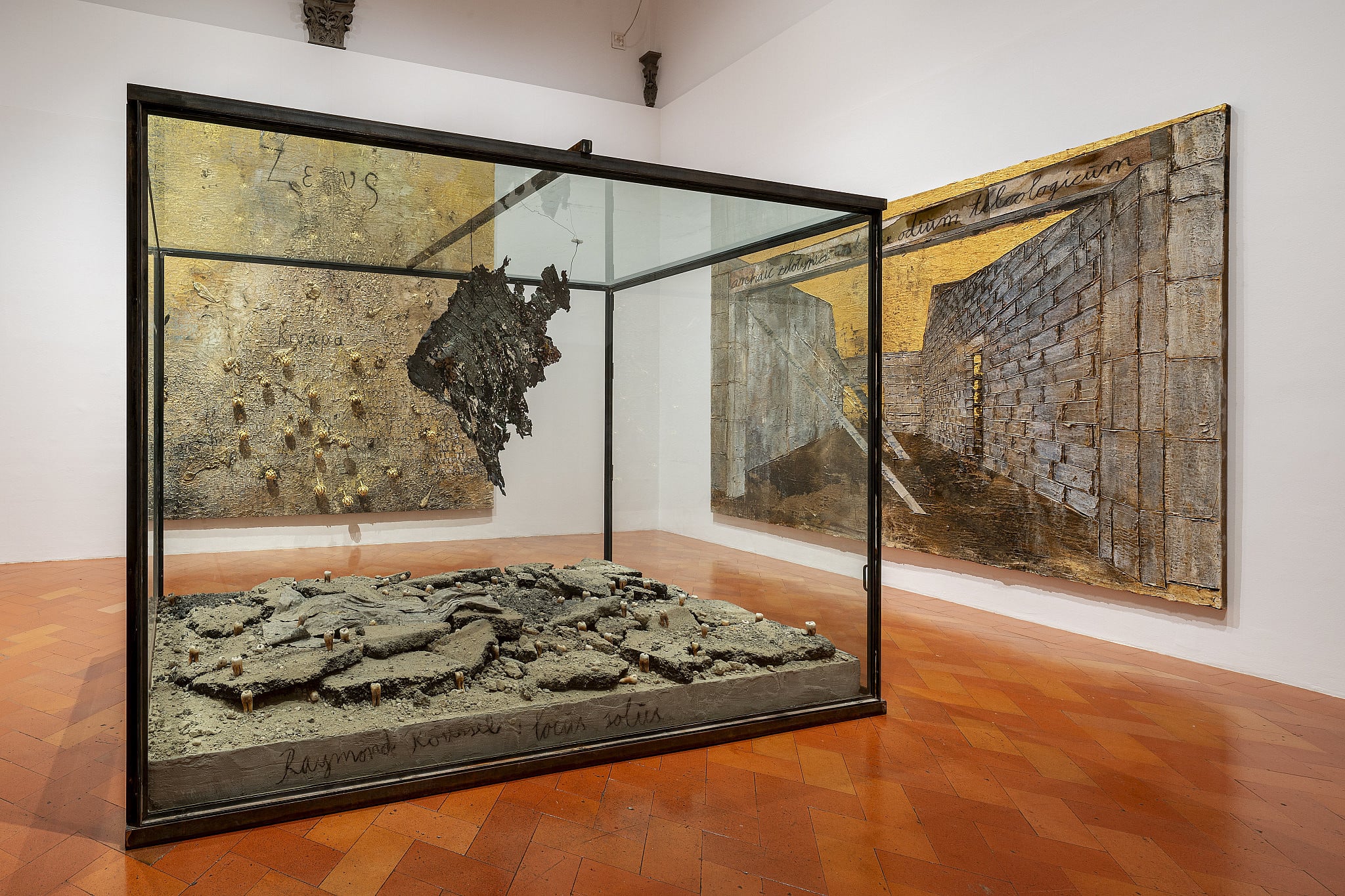
It is so deeply shocking that I do not remember when art affected me so deeply, to the core. There are different possibilities to interpret the work, and indeed, there are different interpretations of it, starting from very direct allusion of its name to a well-known Raymond Roussel’s novel written in 1914, which resonates well with Kiefer and his world, due to the mixture of the themes of science and spirituality in the novel, to some references to the mysterious qualities of lead, which is used in the work and which is one of the artist’s preferred materials, and its symbolism referring to the process of creation, in the light of the Kabbalistic tradition and alchemy, both of which are subjects of Kiefer’s acute interest.
There are also interpretations referring to a philosophical pondering of the physicality and non-physicality of life, and what’s left of us after our physical disappearance, with symbolic matter of something which is still present always, in unknown to us forms, the theme which is one of the central ones for Kiefer, his philosophy, and how it is embodied in some of his art.
I have had no chance to ask Anself Kiefer about this extraordinary work yet, and if I will have such an opportunity, that would be my first question to the artist. For myself, I thought that the whole installation might also refer to the Nazi extermination camps, and if it is what the artist meant indeed, or it can be one of Locus solus’ possible interpretations, it would be the most powerful statement on the horror of the camps I ever saw.
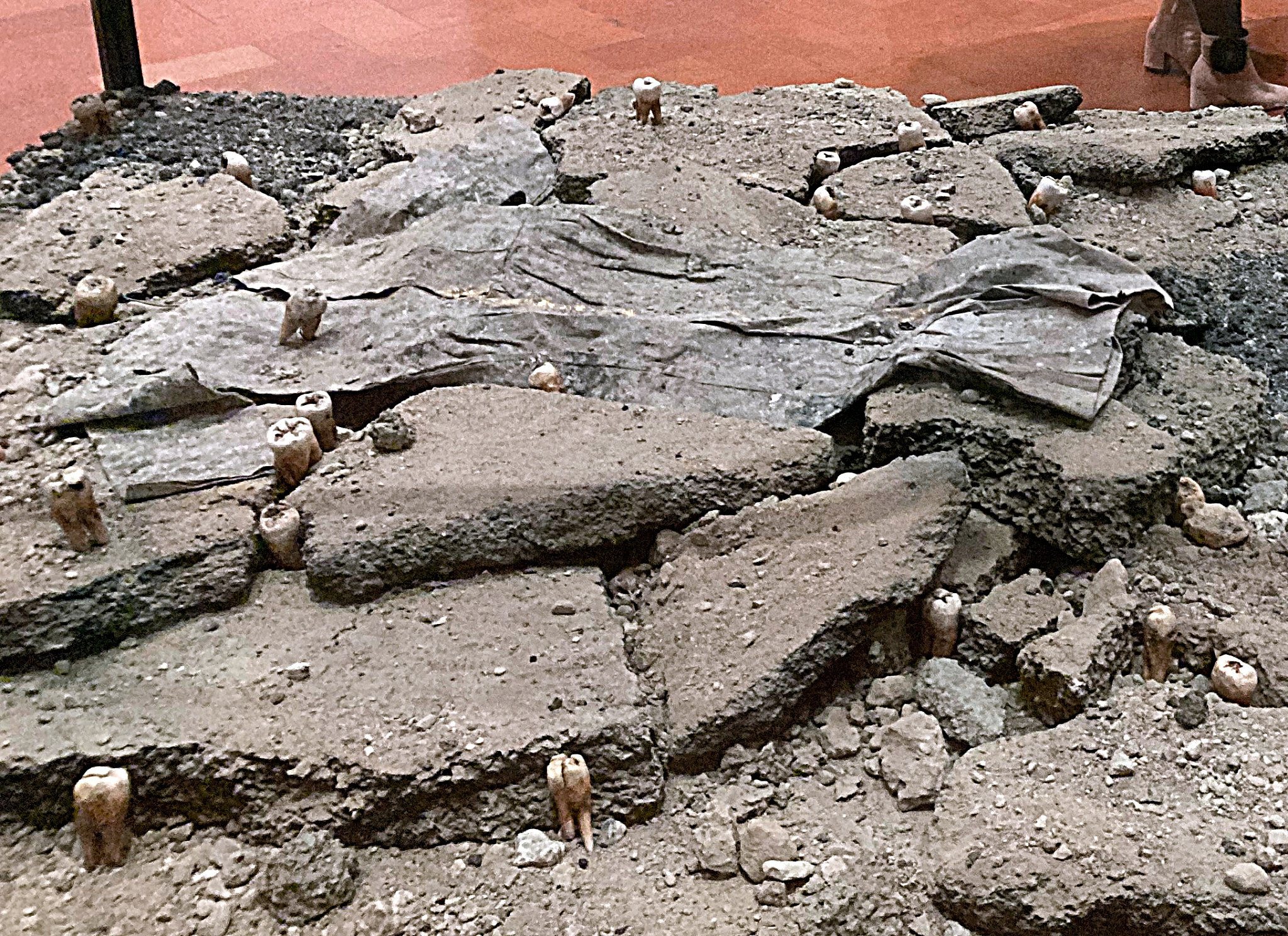
There is that terrifying dress which gets the same colour as the mercilessly hopeless dusty cracked concrete ground of that terrible, ultimately lifeless colour of the created landscape. And a landscape in Kiefer’s world is always a central element, of which I quite agree with the artist. I also identify with Kiefer in his belief that ‘there is no such thing as an empty landscape”. To me, a landscape always bears an energetic imprint, and that energy can be of positive or negative essence. The landscape that the artist created in his recent Locus solus terrifying installation tells it all in a shockingly profound way. The landscape of death.
There is also the lead-made part which hangs in the air above that ground of chilling horror, with human teeth all over concrete cracks, instead of grass and flowers in a living soil. Lead is one of the favourite materials for Kiefer, and it also bears in his works the symbolism the metal is attributed to in alchemy, which is another sphere of human knowledge and practice which is highly important and interesting for the artist. That lead-made part hanging in the air in the Locus solus installation can refer to a human soul which does not disappear with the end of our years on the earth. It is battered, with some holes, but it is there, which does correspond to the concept of the soul’s existence in Kabbalah, which Kiefer has studied keenly, as well.
At the same time, the form of the lead part of the installation reminded me of a map. Germany? – was my first thought, as I was thinking that the installation resonates strongly with the theme of an extermination camp. In that interpretation, the lead-made ‘map’ is quite similar to Germany in its biggest part, but not entirely. I’ve made a quick visual research, and came to the conclusion that it could be a part of the map of Europe, with Germany and Italy in it.
Of course, my reading of Kiefer’s chilling Locus solus installation is highly subjective. And most likely, the artist had a more general philosophical idea for that work referring to a human life as a phenomenon in general. But sometimes, big works generate a possibility for additional interpretations, and it always is a plus and a merit, as it makes such work yet more universal.
To me, this blood-chilling work could also be about extermination camps. And because of this my subjective interpretation, I regard it as a second – and central, both literally and metaphorically – counterpoint throughout the Fallen Angels exhibition.
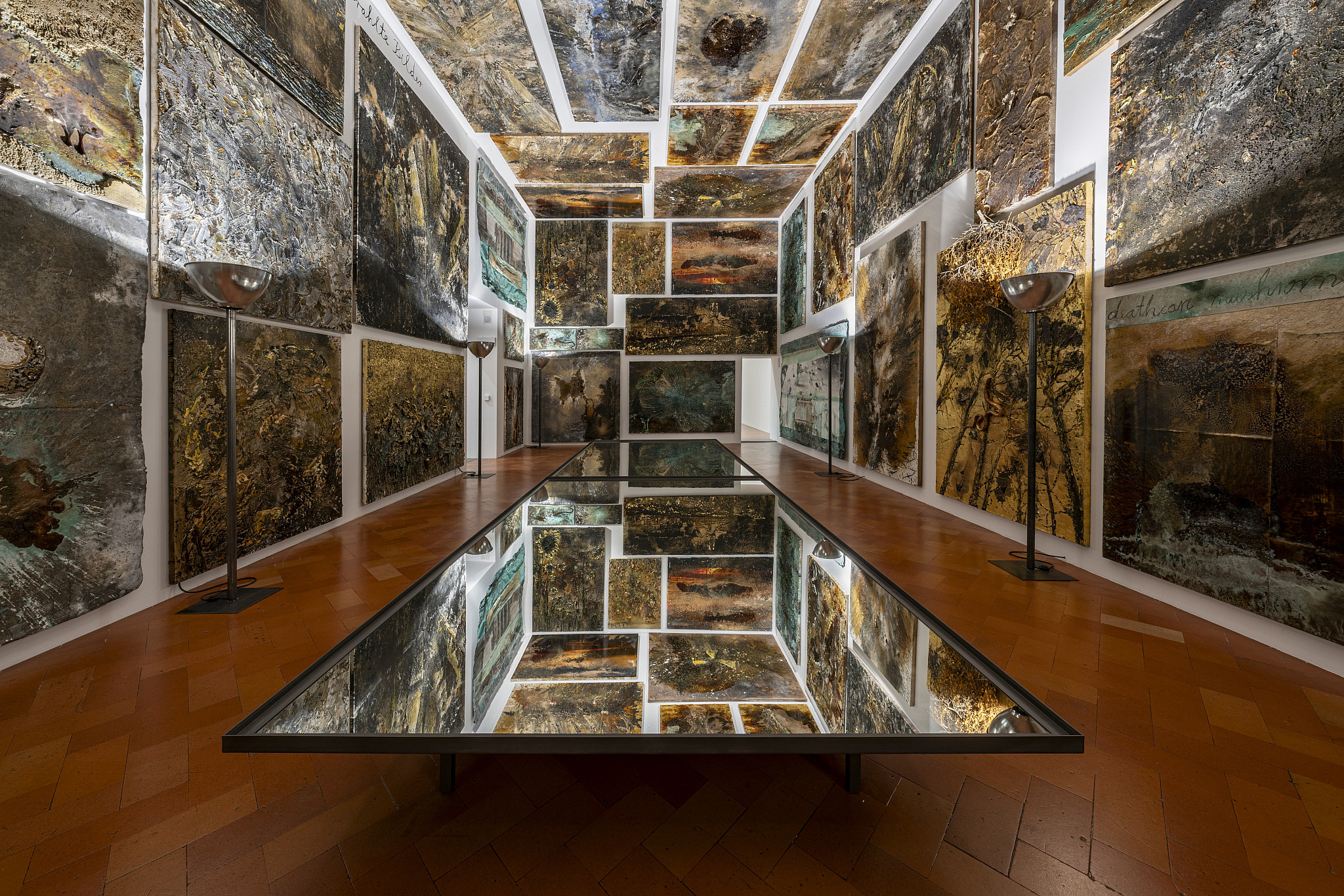
The third and last counterpoint is definite and clear. You are getting to it at the very end of the exhibition, after immediately grabbing attention, intentionally overcrowded by the works hall referring to the faults and contradictions of human nature reflected in many gloomy pictures of nature itself, with an elegant huge mirror placed on the floor.
Following, there is another very interesting space in which a giant Kiefer’s predominantly black and white known works referring to Germany in its amalgamation of history, tradition, space and spirit are placed with a very good effect, not only due to the deep intellectual components of the works, but precisely because they are exhibited in the highly artistic and at the same time thoughtful way.
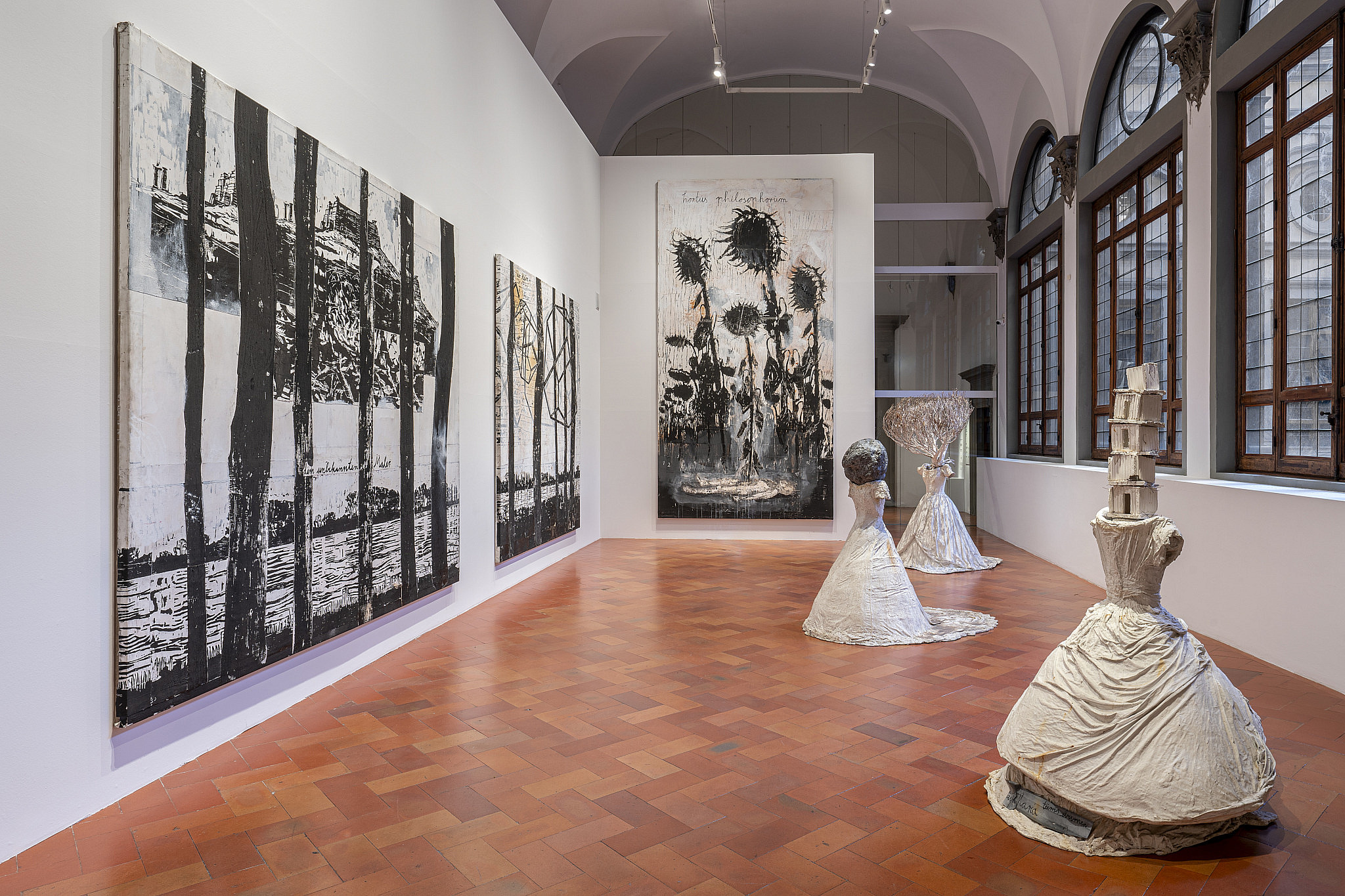
After that artistic-philosophical journey into the amalgamated German soil, history, literature, culture, landscape, and spirit, importantly, as Kiefer never tired to emphasise, one gets to the Counterpoint Three, the hall with those well-known early Kiefer’s photos with him in a Nazi salutes in his father’s uniform. Again, if one does not know his biography and career, it might puzzle a viewer. But if one is aware of Kiefer’s life, and history of his generation, everything comes in place with that painful self-irony hall, the Third Counterpoint of the exhibition, which I would characterise as the Beginning-Which-Means-End. The beginning because Kiefer in those political statement-like self-portraits was young, and his – and his generation’s – awareness of their country and their families’ horrifying recent involvement in an ultimate Evil’s Feast just fell upon their heads, both literally and metaphorically. That kind of beginning, with this kind of knowledge, effectively meant the end. The end of humanity. The abortion of it, almost literally so.
This is exactly what the Hitler’s concept and the Nazi regime was about – the abortion of humanity, and the generation of the German people born on the ruins of the Third Reich, also both literally and metaphorically, as Anselm Kiefer was, first being raised in a virtual vacuum of facts, growing up amidst the total omerta for twenty years, a generation-length omerta, had to face that truth about the massive, almost total, and in any case, far beyond acceptable in any more or less prone to life society abortion of humanity as a precondition of unfolding life of its young and growing members. This is a very depressing and deeply traumatic dominant moral factor to live and to create with. To create an intellectually honest and morally responsible art having such an inseparable mental component for people from the post-Nazi generation in Germany ( and Austria, for this matter) is a very demanding effort and serious human overcoming.
The Art of an Open Wound
No wonder that Anselm Kiefer as a representative of that generation saw his refuge in literature and poetry – because what else one can do, frantically searching for at least some answers, and also trying to find some ground under one’s feet in the shared emotions, thoughts and dreams of those who were talented and brave leaving us with unparalleled testimonies, like Paul Celan and Ingeborg Bachmann, the poets who did occupy the inner cosmos of Kiefer for a long time, in a great detail, who provided him with shared emotions which is a bit easier to bear this way, and unanswered questions which are stay unanswered till this day, but who did appear and were formulated by the wounded talented hearts of the Kiefer’s own generation, and whom he was listening to with all admirable devotion for years, creating his many works inspired by an ultimately tragic verses of Paul Celan and Ingeborg Bachmann , for which I personally am very grateful to the artist.
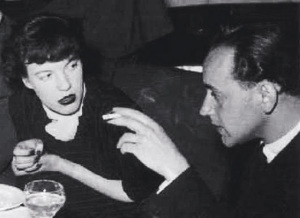
I have a personal experience with the friends who got Paul Celan very close to their hearts, in close detail, and who spent years of research on this unparalleled poet of the pain of the Holocaust and the Second World War. My friends are non-Jewish people. I know them well to understand what kind of heart one should have to dedicate years of one’s life and work to Paul Celan and his ultimately tragic world, with almost unfathomable degree of pain. Same goes for Ingeborg Bachmann. As in the case of Kiefer, my friends’ strive in doing this was complex, I think. Their motivation was to get to the bottom of what we, the Jewish people felt, during the Holocaust, its crimes, and during the post-Holocaust, importantly. They wanted to share this pain. I know it for sure, without much declaring anything by my friends, but I know them for long and good enough to get it. Their motivation also was to redeem to the best that they could, the obvious and well known ( in most cases) guilt of their fathers and grandfathers’ generations, many of whom did participate in the crimes of the Nazis and deeds of the Werhmacht, willingly or unwillingly, with the result annulling the difference. And thirdly, they wanted to do something, anything real and good, to correct the balance of evil and good which was totally negative as the result of the Shoah.
Anselm Kiefer created many very deep, impressive, and most importantly for me, honest, morally and intellectually, works based on Paul Celan and Ingeborg Bachmann’s poetry. Even if he would not create anything else in his long and productive artistic career, I personally would feel hugely indebted to him for that. I know what it means to work with Celan and Bachmann’s open wound-texts, images, and metaphors, and most importantly, what is behind it. It is not just harrowing for life, it goes beyond it. It is as black and white as it can get, without white there at all. Just like in Kiefer’s works. I understand the genesis of it. And I completely understand the way in which Anselm Kiefer while working in his giant studio feels the presence of Bachmann and Celan and consults with them during his work. There is nothing surrealistic there. It is the reality of this generation. And there is no surprise for me that Anselm Kiefer believes, feels that ‘there is nothing more real in this world than a poem’. Exactly so. Poem, poetry, a line of it is the niche of survival for this generation.
Neither Celan, nor Bachmann could not live with their innermost wounded and ruined so deeply by and after the Second World War, although Romanian Jew Celan who lost all his family to the Shoah was a direct victim of the Nazism, while non-Jewish, Austrian Bachmann whose father was a devoted Nazi, had a guilt-syndrome and who was deeply shocked by the depth of Nazism enrooted into human psyche, as she saw it. Both committed suicides, as Primo Levi did, and so many other tragic victims of the Nazis, their completely inhuman view of the world, and their methodical and thorough implementation of that view.

Anselm Kiefer, being a powerful artist, feels the tragedy by his open nerves. It is not easy to live in this mode, nor is it easy to create. But he does, for over half of a century, and he does it in a way which still impresses, and I believe will impress people for a long while. Not because his works are gloomy, and not because he is using many alien to conventional art materials, such as real plants or shellac, believing , following the Kabbalah line of thought, that any organic material bears a particle of a soul. Kiefer uses all those materials because he feels it, and he uses them accordingly. His art impresses and will impress because he bothers to send the message which is created still from an enlightened part of life.
The part which still asks questions, the part which is not indifferent, importantly. The part which is not playing cheap games with a popular culture, or ‘culture’ and it’s cliches and kitsch.
Why Have the Angels Fallen?
After living long enough, many of us get more or less philosophical. It is as inevitable as our wrinkles, possibly in the same proportion. A Fallen Angel is an elegant concept of a human sin. But not only. Essentially, it is a metaphor of our choice. Ours, not angels’. And there is a lot in our history which has been determined by people’s choices, often simply terrible ones, and often irreversible ones.
In my understanding, Anselm Kiefer in his newest exhibition, which productively combines the artist’s well known previous ones and his new works, poses his observation of our choices pretty blatantly intellectually, and quite powerfully artistically, in his impressive manner of expression, modern, elegant, being on the edge without falling from it. The artist who is also an avid reader for all his life, and for a long time writes for himself, always had doubts about human nature. In some of his interviews, Kiefer ponders repeatedly “what came not exactly as it should with us, human beings?” Why are we destructive? Why are we violent? What is the reason for that major fault that triggers everything wrong in what people do? Why do the angels fall? , in other words.
It is a massive, Shakespearian, question, which none of the multitude of philosophers, to whom Kiefer did pay a very serious attention to during his life, would be able to provide an answer. And the artist knows that.
He brought to us in his newest exhibition the images, the symbols which are easily recognisable, but are not trivial in Kiefer’s interpretation. His serpent lives as an organic part of the sunflowers, only it is sculptured, being a three dimensional part, standing out from the two-dimensional work as a subtle warning. Jacob’s ladder, a very unhappy one, is universal. His Book is lead-made, and hanging over it the Tree of Knowledge is completely withered and is upsided down, instituting not a metaphor even, but stating the state of things in our life today. The head and the face of a female figure of his sculpture, dressed in an innocent and gentle white silk, is replaced with Magritte-like huge heavy ultra-grey stone, in an alarming and speaking contrast.
Kiefer’s philosophers needed to be marked with their names next to their faces, to appeal to his viewers, to awaken the neglect of wisdom, which we all are facing daily today, and about which the artist is seemingly concerned.
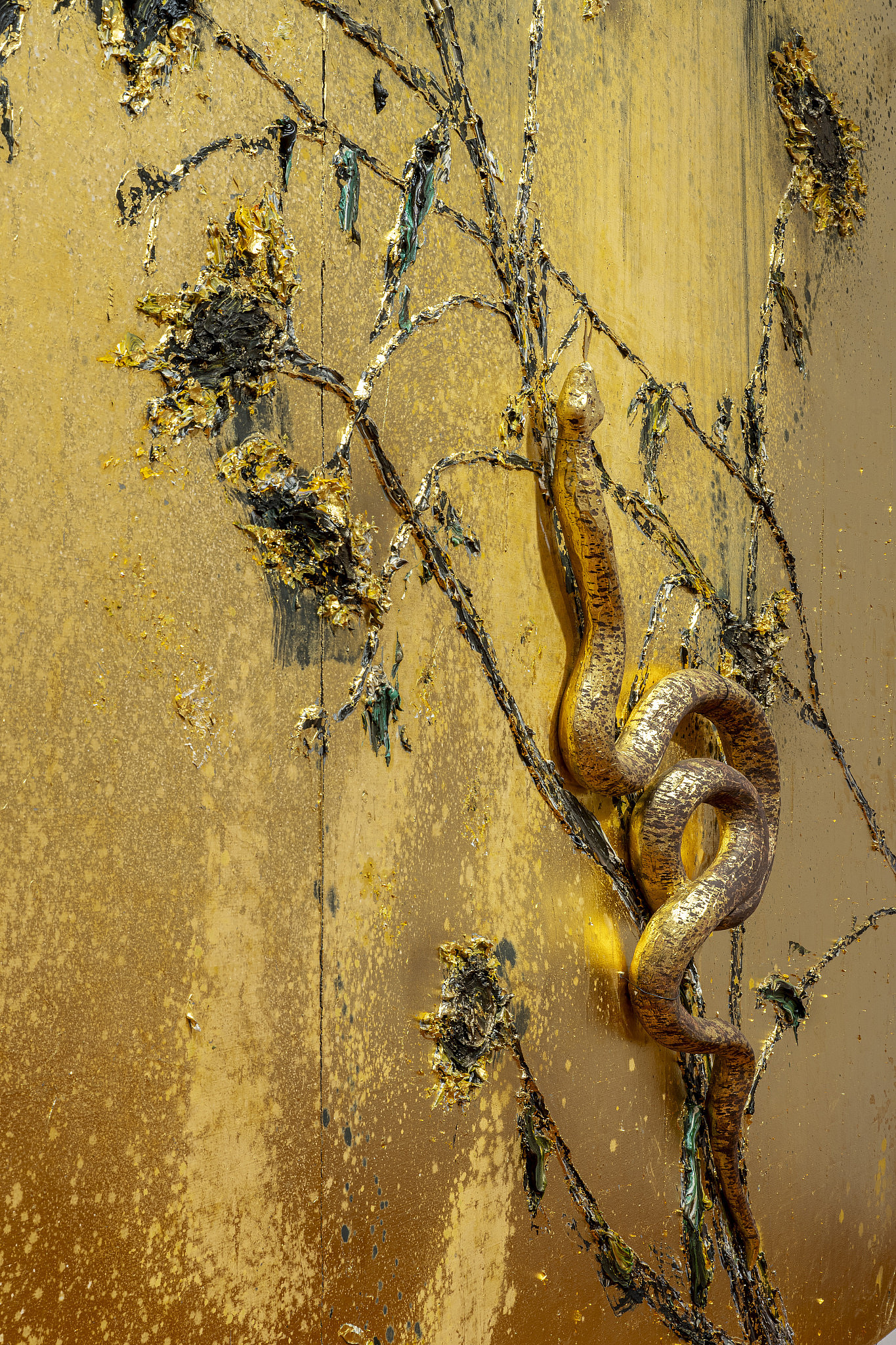
Remembering and thinking of the circumstances and consequences of various angels’ falls in an universal mythology – and Kiefer believes that mythology is largely universal, interpolating regularly in different cultures and beliefs – there is an impulse in those Anselm Kiefer’s works and in his newest Fallen Angels exhibition in general to make his viewers to think again, to reflect, to remind oneself of basic values, and of the essential matter of a human’s choice. ‘Human’ in its positive connotation is a key-word here.
To prepare such a large and versatile exhibition takes a lot of time. It obviously was not meant to be produced with screaming questions about humanity which has fallen upon us, especially Jewish people, both in Israel and world-wide, after October 7th, 2023. But in the earthy world , in which some people do not believe in coincidences, the Kiefer’s exhibition was opened almost a half of year after the new period that has occurred on this planet, the period of resurrected vile, ungrounded and intensifying dangerously anti-Semitism world-wide. The Kiefer’s exhibition in Florence has been opened in the time, which makes us be glad that our late parents and grandparents who survived the Holocaust, do not see and do not feel this atmosphere of growing, self-justifying and being allowed universally hatred towards Jews just everywhere, globally, that they do not know about ugly, unfair, racist, ultimate, unreasonable and counter-reasonable demonisation of Jewish state just because of the sole reason that the state is Jewish, at all levels of the international community and its various institutions.
It was not planned this way, I know, but there is amazing and meant-to-be actuality of the Fallen Angels to be shown to a wide public today, resonating very powerfully with sudden pain and moral dismay among the Jewish people worldwide today, and with sympathy and understanding towards us by surprisingly few non-Jews , the decent people who do understand what is going on, who see it in a fair and conscious way, and who acts accordingly.
It is quite surreal to live in the current atmosphere – after the Holocaust and all its lessons which were fully available in detail globally and for decades. As we can see and live through it, and as Anselm Kiefer saw during various stages of its artistic way, samples of which one can see at the Palazzo Strozzi at his monumental exhibition, angels are still fallen, irrelevant from the most painful and most detailed history lessons. Kiefer, with his solid philosophical background, always treated history as such with a very large portion of scepticism. And now, to our surprising dismay, we are seeing in real life how right he is about it in his powerful art.
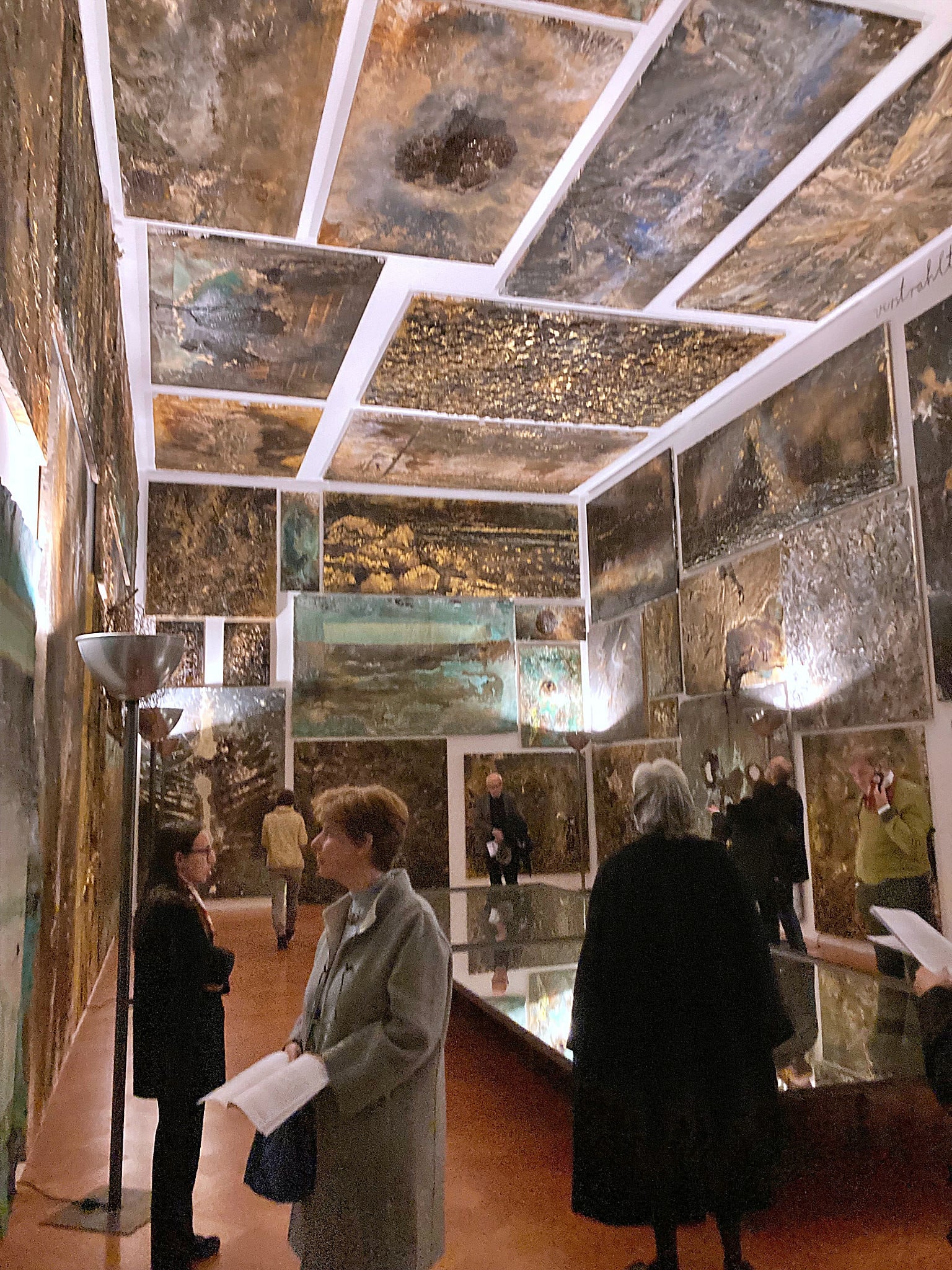
Anselm Kiefer. Fallen Angels Exhibition. Palazzo Strozzi, Florence, Italy. March 22nd – July 21st, 2024.
Florence
March 2024
Related Topics
Related Posts