The Christians Who Looked Away: What Antisemitism Demands of Us Now

In January 2015, I stood at Birkenau for the seventieth anniversary of the liberation of Auschwitz. The evening was freezing, and there was snow on the ground. White and crunchy, which meant it was crystallizing and growing colder still. As the sun began to fall, more snow. The organizers had erected a huge, heated white tent for the survivors and their direct family members, along with world leaders from more than forty countries. Those of us who were not family stood in the snow and watched the ceremony just outside the remains of Crematorium 2 on a large screen surrounded by speakers that were equally as big. As the camera panned the crowd inside the tent, I recognized many of the faces. They were survivors, many of whom were staying where I was, at the Center for Dialogue and Prayer in Oświęcim. Steven Spielberg was there, too. Every time my feet began to numb, I crunched over to one of the large heaters the organizers supplied for us.
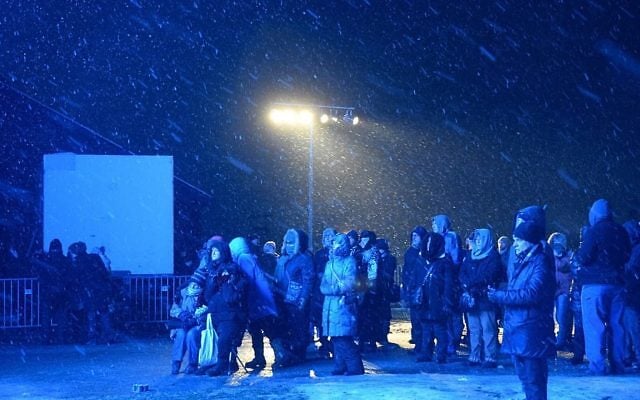
On the outdoor screen, I watched David Wisnia chant El Maleh Rachamim, the prayer for the souls of the dead. He had arrived at Auschwitz-Birkenau at sixteen, and he survived. Seventy years later, there he stood at the entrance to the place built to destroy him, praying for the ones who did not come home.
I had two thoughts. First, the prisoners here were barely clothed in thin striped uniforms and walked the long muddy paths in hard wooden clogs. How did anyone survive? I was wearing wool socks, boots, and thermals, and I had to squelch the temptation to complain. Second, as Wisnia’s haunting melody rose into the bitter air, my body filled with chills, and I thought, “Certainly, this would never happen again.” I had thought it before. In that frozen place, I felt it.
I had been to Auschwitz-Birkenau many times before, always with Eva Mozes Kor. Eva and her twin sister, Miriam, were ten years old when they arrived here and were handed over to Josef Mengele for his experiments. Over the years, I walked these grounds beside her and traveled with her through Poland, Romania, and Hungary, listening as she told me her family’s story, step by step. Somewhere along the way, I came to assume the world had moved beyond that horrible place and time. Eva never let me settle there. Any time I turned the Nazis, or the people who looked away, into cartoon villains, she stopped me. “They weren’t monsters,” she would say. “They were human beings, like you and me. When you turn them into monsters, you forget this could happen again.”
Eva died in 2019, and her words stay with me. In one way, they are a comfort: we are not surrounded by monsters. In another way, they are far more frightening. We are surrounded by people no different from the ones who lived then. Neighbors. Coworkers. Churchgoers. People like me.
I’m a Christian, and I’ve spent years studying how Christians came to tolerate the persecution of their Jewish neighbors. There is no single answer, and none of the answers excuse it. People were afraid to speak up and afraid to act differently from the loudest voices around them. The pressure did not come only from politicians in Berlin. It came from pastors and employers, teachers and town officials, and the neighbor who reported to the local party office. The ones who hated most were often the loudest, and their anger made silence feel safer. People worried about their jobs and their families. Many were swept up in an ideology before they understood what it was.
Standing in the bitter temperature at Birkenau on a winter night helped me realize, more fully than before, that anyone’s survival there was something like a miracle. In the same way, watching antisemitism play out in front of me over the past few years is helping me more fully understand the progression of how the concentration camps even came to be. I am watching with my own eyes how propaganda against the Jews works: on podcasts, on TV and in movies, in the news, and in small circles of friends and family. I think what is happening now is insidious in a different way, and maybe not localized at all. With the advent of the internet, antisemites don’t need to rely on centralized propaganda and news sources, or even on secret party officials in their own neighborhoods.
Propaganda, whether it comes from a party office or a podcast, works best on ground that has already been prepared. For Christians in Europe, the church had been preparing that ground for centuries. Church teaching is not the only reason Christians stood by, but it is one Christians in particular must reckon with. Christians in Europe heard Jews described as enemies of Christ in sermons, in Easter plays, and in the writings of church leaders. Many were taught that God had rejected the Jewish people and that the church had taken Israel’s place. If God had rejected the Jewish people, Christians could begin to believe that rejecting them was an act of faithfulness to God.
Martin Luther shows how far that teaching can go. In 1523, he wrote a tract called That Jesus Christ Was Born a Jew. He condemned the way Christians had treated Jewish people and reminded Gentile Christians that they were “aliens and in-laws,” while the Jews were Christ’s “blood relatives.” Twenty years later, in 1543, the same man urged Christian rulers to burn synagogues, destroy Jewish homes, seize Jewish books, and forbid rabbis to teach. Luther’s words did not cause the Holocaust, and modern racial hatred of the Jews has a history of its own. Still, centuries of Christian teaching helped create a world in which persecution could be tolerated. When the Nazis came to power, they found a hatred they could put to work. In November 1938, after synagogues burned across Germany on Kristallnacht, a Lutheran bishop named Martin Sasse printed excerpts of Luther’s writings against the Jews and sent them to his pastors.
I do not want to be like the Christians who stood by.
This essay is written to my fellow Christians. I am publishing it here because I want Jewish readers to know that some of us are paying attention, and that some of us are telling our churches what we owe our Jewish neighbors.
What Antisemitism Looks Like Now
On Yom Kippur in October 2025, an attacker drove a car into people gathered outside a synagogue in Manchester, England, and began stabbing worshipers. Two Jewish men were killed. In December, gunmen opened fire on a Hanukkah celebration at Sydney’s Bondi Beach, killing fifteen people. In March 2026, an armed man rammed a truck into Temple Israel in West Bloomfield, Michigan, while children were attending preschool. He exchanged gunfire with the synagogue’s security guards, and his truck, loaded with fireworks and gasoline, caught fire. He died at the scene; no one else was killed. The FBI later called it a Hezbollah-inspired act of terrorism “purposely targeting the Jewish community.”
The attacks have not stopped. In April, two Jewish men were stabbed in Golders Green, and Britain raised its national terrorism threat level to “severe.” On Yom Kippur this year, a gunman opened fire outside the Sons of Jacob synagogue in Belleville, Ontario, as the congregation gathered for Kol Nidre. Constable Jeff Smith was critically wounded stopping him, and police later called the shooting a premeditated, targeted attack on the Jewish community.
These attacks happened in different countries and under different circumstances, yet the victims were chosen for the same reason: they were Jewish, or they had gathered in recognizably Jewish places. Violence is the most visible form of antisemitism. It is not the only form, and it rarely begins there.
FBI data released in 2026 recorded 1,528 anti-Jewish hate-crime incidents in the United States during the previous year. Jewish Americans, about two percent of the population, were the targets of nearly two-thirds of all reported religion-based hate crimes. The climate around those crimes also includes harassment, vandalism, conspiracy theories, and a steady insistence that Jews exercise hidden control over governments, media, finance, and war.
When the Fringe Becomes Mainstream
Some of that language now reaches millions through personalities many Christians once trusted, and some still do. In October 2025, Tucker Carlson devoted a long interview to Nick Fuentes, who used the appearance to attack “these Zionist Jews” and “organized Jewry in America.” The interview produced a revolt within conservative institutions and condemnation from Republican leaders, including House Speaker Mike Johnson. Interviewing someone is not the same as agreeing with him. Giving an extremist an enormous audience while leaving his central claims largely unchallenged, however, changes the social status of those claims. What had been confined to the fringe enters ordinary political conversation.
Candace Owens has gone further, making conspiratorial claims herself. In November 2025, she alleged without evidence that Israel was blackmailing the president through the Jeffrey Epstein disclosures: “For those who struggle with context clues, THEY=Israel, who Jeffrey Epstein worked for. This is how our nation is run.” In February 2026, she amplified the claim that “America is controlled by the people who call us goyim.” In a December 2025 episode, she told listeners that “Jewish people were in control of the slave trade.” In March 2026, she told her followers, “You should absolutely be aware of where the Chabad is nearest your home. These people are dangerous.”
Melanie Phillips has called this the mainstreaming of Jew-hatred, and she has traced its movement through both progressive and conservative circles. Part of the danger lies in respectable leaders refusing to draw a firm line when conspiracy claims appear among their own allies. They may defend their silence as openness to debate, yet leaving those claims unanswered lets fringe ideas look credible.
None of this places the Israeli government, its policies, or individual Jewish public figures beyond scrutiny. Israel’s government can be criticized, its military decisions investigated, and its leaders opposed, and American aid can be debated. Israelis and Jews around the world do all of these things every day. Criticism crosses into antisemitism when responsibility moves from particular officials and policies to Jews as a people; when unsupported claims of secret Jewish control replace evidence; when Jewish institutions abroad become targets for anger at Israel; or when old stories about Jewish money, disloyalty, and manipulation return under new names.
Antisemitism often presents itself as forbidden knowledge. The speaker claims to be asking the questions others will not allow, and every missing piece of evidence becomes more proof that powerful Jews have hidden it. The theory cannot be corrected: denial confirms the conspiracy, objection proves control, and a request for evidence becomes censorship. An old prejudice takes on the posture of courageous inquiry.
Rabbi Jonathan Sacks compared antisemitism to a virus because it changes form in order to survive. Jews have been condemned for opposite things: for being rich and poor, capitalist and communist, separate from society and too influential within it. Rabbi Pesach Wolicki has addressed one form it takes today: viral posts claiming the Talmud teaches Jews to hate, rob, or kill non-Jews. As he explains, many of these quotations are invented, mistranslated, drawn from opinions the rabbis rejected, or pulled out of the discussion that gives them meaning. The fragments are then presented as proof of what all Jews believe. The method gives prejudice the appearance of scholarship.
Why Christians Must Recognize It
Christians should be especially prepared to recognize this pattern. We worship Israel’s Messiah, read Israel’s Scriptures, and confess a faith carried to the nations by Jewish apostles. The apostle Paul warned Gentile believers never to look down on the Jewish people: “it is not you who support the root, but the root that supports you” (Romans 11:18).
Our own history makes vigilance more urgent. Generations of Christians were taught that Jews were collectively guilty for the death of Jesus and condemned to suffer as witnesses to Christian truth, until Jewish humiliation seemed to make theological sense. Repentance requires more than disavowing the worst episodes of that history. It requires recognizing the habits of thought that made them possible.
One of the most influential of those habits came from Augustine of Hippo (354–430), a North African bishop whose theology shaped Western Christianity for centuries. His teaching became known as witness theology. Jews should be preserved rather than destroyed, he argued, because their continued existence and their possession of the Hebrew Scriptures served as witnesses to Christian truth. Augustine also read their exile and political powerlessness as evidence that God had rejected them and transferred their covenant identity to the church.
The theology of Jewish displacement is not only a matter of history. The Wisconsin Evangelical Lutheran Synod, an American denomination, states in answers on its official website that Jews “forfeited” their designation as God’s chosen people when they rejected Jesus, and it describes the church as “a continuation of the real Israel.” That language is far removed from the hatred in Luther’s late writings, and the difference is important. It still shows how displacement can remain embedded in Christian teaching after open hatred has been rejected.
The Jewish return to the Land of Israel challenges that whole framework. Melanie Phillips describes Judaism as “the inseparable fusion of the people, the religion and the land.” If Jewish exile and powerlessness were treated as proof that God had rejected the Jewish people, a sovereign Jewish state in the ancestral homeland does not fit the story Christians were taught to expect. Israel’s existence does not settle every biblical or political question. It does contradict the expectation that Jews would remain permanently scattered and subordinate.
Some people answer that challenge by claiming that today’s Jews are not really descended from biblical Israel. If modern Jews are impostors, the argument goes, then biblical Israel has not returned, and witness theology survives. That claim easily merges with racial conspiracies asserting that Jewish ancestry was fabricated, that the original Jews disappeared, or that some other group is the true Israel. What sounds like a dispute about ancient ancestry can join an old Christian theology of Jewish rejection to a modern conspiracy about Jewish identity.
How Christians Can Stand with Jewish People
What should Christians do now? Paul’s warning against Gentile arrogance gives us a place to begin. We should speak about Jewish people with humility and gratitude. Scripture also commands, “You shall not spread a false report” (Exodus 23:1), and warns against answering a matter before hearing it (Proverbs 18:13). Before Christians repeat an accusation involving Jewish people, we should ask whether it can be verified, whether it holds an entire people responsible for the actions of individuals, and whether criticism of a particular Israeli policy has turned into suspicion of Jews everywhere. A broadcaster who keeps presenting Jews as the hidden cause of wars, scandals, or political failures should not keep our trust.
Refusing to spread falsehood is only the start. Jesus commands us to love our neighbors, and Paul tells us to “weep with those who weep” (Romans 12:15). Churches can live out those commands by building relationships with their local Jewish communities, including synagogues, Jewish community centers, and Jewish schools, before an attack occurs, asking Jewish leaders what support would actually help, attending public vigils, and opposing threats against Jewish institutions as readily as we would oppose threats against our own. Christian leaders should correct antisemitic claims when they hear them, including when the person repeating them belongs to their own political party or draws an audience they would like to keep.
In 1994, the Evangelical Lutheran Church in America faced Luther directly. In a declaration to the Jewish community, it acknowledged “Luther’s anti-Judaic diatribes and the violent recommendations of his later writings against the Jews.” It went on: “we reject this violent invective, and yet more do we express our deep and abiding sorrow over its tragic effects on subsequent generations.” In 2021, the church revised and reaffirmed that declaration. It joins honesty about the past to responsibility in the present. For Christians, antisemitism is not poor manners, a partisan distraction, or somebody else’s prejudice. Resisting it is part of following Jesus.
The cost of silence is already visible: armed guards outside synagogues, Jewish celebrations treated as potential targets, and families deciding whether a Star of David is safe to wear in public. Dara Horn’s book People Love Dead Jews names another danger. A culture can honor Jewish victims of the past while showing far less interest in the safety and testimony of living Jewish people. Christian solidarity cannot stop at Holocaust remembrance while prominent voices teach enormous audiences to view their Jewish neighbors with suspicion.
Elie Wiesel warned, “Neutrality helps the oppressor, never the victim. Silence encourages the tormentor, never the tormented.” When Jewish people are threatened, neutrality is not a harmless middle ground. They should find Christians beside them, making their safety our concern and refusing to leave them alone beneath the weight of an ancient hatred.
For Christians, that begins with a posture of listening, learning, and serving. Listening to what our Jewish neighbors are living through, without explaining it away. Learning their history, and our own part in it. Serving in the ways they tell us would help. None of this asks Christians to punish ourselves. It asks us to show up as friends.
I intend to be one of those Christians. If you are a Jewish reader, I would like to know what you need from Christians right now. Tell me in the comments. I am listening.
Scripture quotations are from the ESV® Bible (The Holy Bible, English Standard Version®), © 2001 by Crossway, a publishing ministry of Good News Publishers. Used by permission. All rights reserved.