Arabs Vote in Israel! But not in Gaza or West Bank
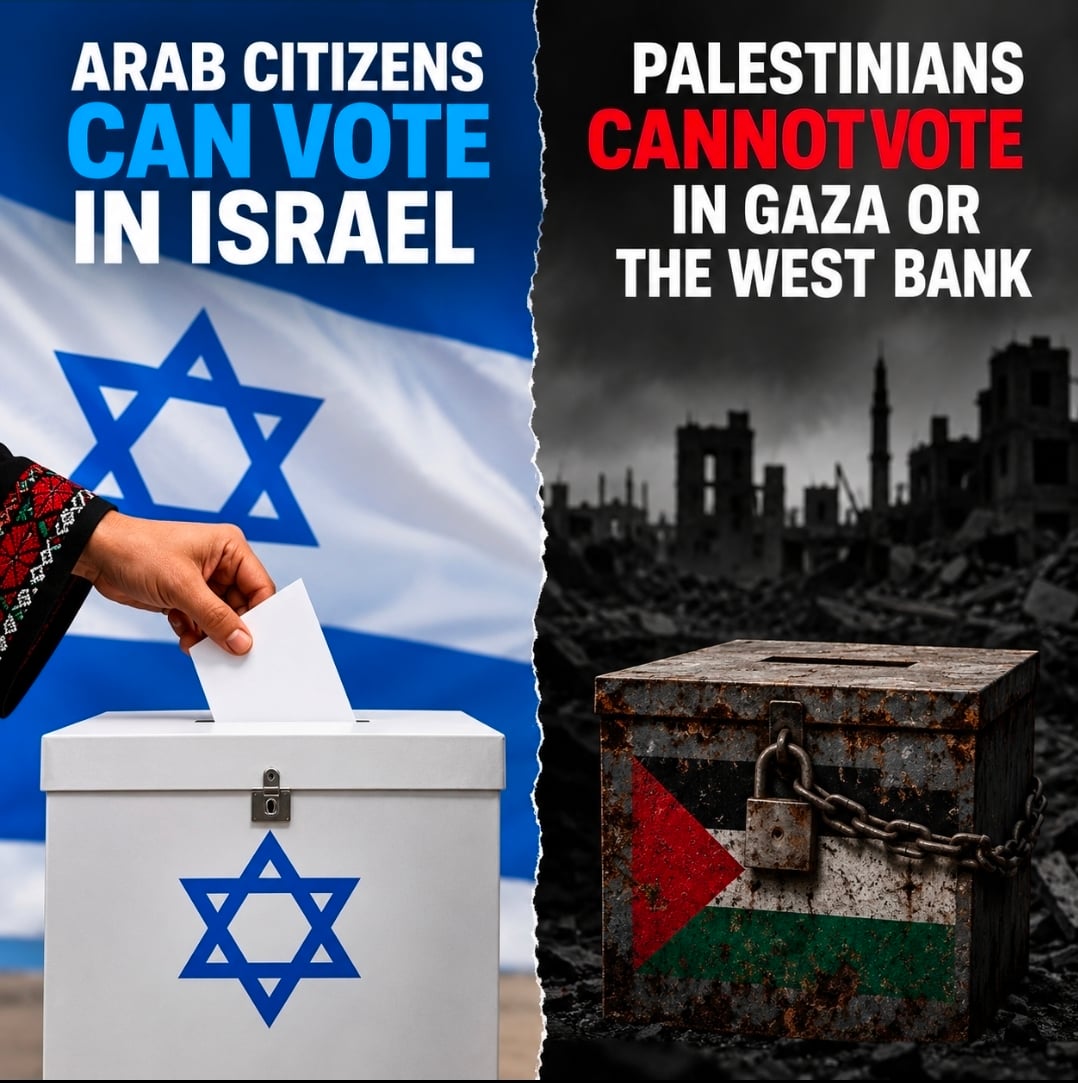
Israel’s Arab citizens can vote, serve in parliament, and challenge their government. Meanwhile, Palestinian national elections have been postponed yet again. It is time to confront an uncomfortable contradiction.
There is an extraordinary irony in the Middle East that the world seems reluctant to discuss.
In Israel, Arab citizens can vote, establish political parties, become members of parliament, serve in government, and openly criticize the prime minister.
Across the border, Palestinians in Gaza and the West Bank have not elected a national president since 2005 or a national parliament since 2006.
And yet Israel is routinely accused of being an apartheid state.
Let that contradiction sink in.
An Arab citizen of Israel can enter a polling station and vote to remove the government.
A Palestinian living in Gaza or the West Bank has waited approximately two decades for another opportunity to choose national leaders.
One political system holds regular, competitive national elections. The other has failed to renew its national leadership’s electoral mandate for an entire generation.
And somehow, the conversation about democracy in the Middle East so often begins and ends with accusations against Israel.
I am a Muslim, an American, a human rights activist, and someone who grew up under political persecution. I have no obligation to defend Israel blindly, nor do I have any reason to remain silent when facts challenge popular political narratives.
I stand with Israel because I believe in its right to exist, its democratic institutions, and the right of its people to live in security.
I also believe Palestinians deserve freedom, dignity, and democratic representation.
Those positions are not contradictory.
The democracy that critics prefer to overlook
Israel is a Jewish state, but its citizenship is not restricted to Jews.
Approximately one-fifth of Israel’s population is Arab. Arab citizens can vote in national elections, organize political movements, and elect representatives to the Knesset.
Arab political parties have participated in Israeli governments. Arab citizens have served as judges, diplomats, legislators, and public officials.
One of the most significant examples is the Islamist Ra’am party, which joined Israel’s governing coalition in 2021.
Think about the significance of that event.
An Arab Islamist political party participated in the government of the world’s only Jewish-majority state.
That does not mean Israeli society is free of discrimination or political tensions. No democracy is.
But it demonstrates something that deserves recognition: Arab citizens are participants in Israel’s national democratic institutions, not simply spectators watching Jewish citizens govern.
Meanwhile, Israel’s Arab legislators can publicly condemn government policies, challenge legislation, and campaign for political change.
They can criticize Israel from inside Israel’s own parliament.
This is a reality that deserves a prominent place in any serious discussion of Israeli democracy.
Mahmoud Abbas: Elected in 2005, still president in 2026
Now consider the Palestinian Authority.
Mahmoud Abbas was elected president in January 2005.
His four-year term expired in 2009.
Seventeen years after that original mandate expired, he remains president.
There has been no subsequent national presidential election.
In January 2006, Hamas won Palestinian parliamentary elections. A violent struggle between Hamas and Fatah followed, ultimately dividing Palestinian governance between Gaza and parts of the West Bank.
Since then, the Palestinian national legislature has not been renewed through elections.
An entire generation of Palestinians has entered adulthood without voting for a national president or parliament.
And the latest developments make this democratic crisis even more disturbing.
On October 10, 2026, Abbas announced that legislative elections scheduled for November 28 would be postponed until September 11, 2027, when presidential elections are also scheduled.
Palestinian officials cited security conditions and Israeli restrictions as reasons for postponement. Those obstacles deserve serious consideration, particularly amid the devastation in Gaza and instability in the West Bank.
But Palestinian leadership also has a responsibility to explain why national elections have failed to take place over such an extended period.
At some point, repeated postponement becomes a crisis of legitimacy.
No leader should enjoy an indefinite democratic mandate merely because holding another election is politically difficult.
Hamas and the destruction of democratic accountability
The situation involving Hamas deserves equally serious scrutiny.
Hamas won the 2006 parliamentary election, but that victory did not give it an unlimited mandate to govern Gaza indefinitely.
Following its violent takeover of Gaza in 2007, Hamas consolidated control without another national election.
The consequences extended far beyond the absence of voting.
Hamas developed an armed political system in which opposition, dissent, and independent political activity faced serious restrictions.
It invested enormous resources in military infrastructure and confrontation with Israel.
And on October 7, 2023, Hamas-led terrorists carried out a massacre in southern Israel, murdering civilians, abducting hostages, and committing atrocities that shocked the world.
I condemned those attacks immediately.
As a Muslim, I refuse to accept the argument that deliberately targeting Jewish civilians can somehow be justified as resistance.
Nor do I accept that Hamas represents every Palestinian.
That distinction is essential.
Palestinians are human beings with diverse political beliefs, hopes, and aspirations. They deserve the ability to reject violent extremism and elect leaders committed to accountable government.
The absence of genuine national elections has denied them an important democratic mechanism for doing so.
Supporting Palestinian civilians must never require defending Hamas or excusing authoritarian Palestinian leadership.
Is Israel an apartheid state? Examine the full reality.
The accusation of apartheid is one of the most serious allegations directed against Israel.
Organizations such as Amnesty International and Human Rights Watch have advanced that characterization, focusing on Israeli policies affecting Palestinians, including those living in the occupied West Bank.
Israel disputes the allegation.
The legal debate cannot be resolved solely by pointing to Arab citizens’ voting rights. Palestinians in the West Bank do not possess the same political status as Arab citizens of Israel, and the territory’s legal and security arrangements raise separate questions under international law.
But the opposite oversimplification is equally problematic.
It is misleading to discuss Israel as though Jewish citizenship and Arab citizenship are entirely separate political classes with no shared electoral system.
Arab citizens do participate in Israeli national elections. They can challenge the government and participate in political decision-making.
That is an important democratic fact.
The existence of serious disputes about Israel’s policies does not erase the democratic rights exercised by its Arab citizens.
Nor should accusations against Israel become an excuse to ignore the absence of Palestinian national elections.
If political rights are the standard, those rights should matter on both sides.
I know what political repression looks like
My perspective is shaped by personal experience.
I was born in Sindh, now under Pakistani rule, and grew up in a family that challenged political repression, religious extremism, and the abuse of state power.
My father, Ghulam Mohammad Laghari, was a human rights advocate who defended peasants, laborers, Hindus, Christians, and other vulnerable communities.
He spent approximately twenty-seven years of his life in prison under successive governments.
Religious extremists declared him a kafir, an unbeliever, because he refused to submit to their intolerance.
In October 1982, he died in government custody.
I was twelve years old.
Even death did not end the indignity inflicted upon our family. Police came to our home and put handcuffs on my father’s dead body.
That memory has never left me.
I learned early that political oppression is not an abstract academic argument. It is the fear of a knock at the door. It is a family waiting for someone who may never return. It is the humiliation of ordinary people who have no meaningful power over those governing them.
This experience shaped my understanding of democracy.
I do not measure freedom by the religious identity of those in power.
I measure it by the rights of the people living under that power.
That is why I recognize the importance of Israel’s democratic institutions and why I believe Palestinian leaders must also face genuine political accountability.
As a Muslim, I refuse to demonize Israel
In many Muslim communities, criticizing Israel has become a measure of political loyalty.
Defending Israel can bring accusations of betrayal.
I know those accusations personally.
I have been called a traitor, an unbeliever, and a Zionist agent for refusing to join the campaign to demonize the Jewish state.
But I will not abandon my convictions to satisfy extremists.
I have visited Israel.
I have walked through Jerusalem, met Jews, Muslims, and Christians, and witnessed the complexity of a society that is too often reduced to slogans.
I have seen Arab and Jewish citizens working in the same hotels, businesses, hospitals, and public institutions.
Israel has imperfections, divisions, and unresolved political conflicts.
But I refuse to pretend that these realities make Israel uniquely illegitimate.
And I refuse to treat the existence of a Jewish state as a crime.
The Jewish people have the same right to national self-determination, security, and dignity that I recognize for every other people.
As a Muslim Zionist, I believe supporting Israel and supporting meaningful Palestinian political rights can coexist.
They must coexist if the region is ever to escape endless conflict.
Why isn’t Palestinian democracy a global priority?
Consider how much international attention is devoted to Israel.
There are conferences, demonstrations, university campaigns, diplomatic resolutions, and constant arguments about Israeli political decisions.
Democratic governments should expect scrutiny, especially when their policies affect the rights of others.
But why is there not an equally sustained international campaign demanding accountable Palestinian national leadership?
Why is Mahmoud Abbas’s expired electoral mandate not a central issue in every discussion of Palestinian statehood?
Why does the absence of national elections receive so little attention compared with the enormous international debate about Israeli democracy?
Why are young Palestinians not being placed at the center of a serious international effort to establish credible, competitive national elections?
These are legitimate questions.
Palestinian society has held some municipal elections, including in April 2026. But local voting cannot substitute for national presidential and parliamentary elections.
Political accountability requires more than occasional elections for local councils.
It requires leaders who can be challenged, replaced, and removed peacefully.
The international community should demand that political institutions claiming to represent Palestinians establish those democratic mechanisms.
It should also support the conditions necessary for credible elections, including protection from violence, freedom of political activity, access for election observers, and the ability of eligible voters to participate.
Neither internal political repression nor external restrictions should be ignored.
Israel’s democracy deserves recognition, not erasure
Israel is not above criticism.
No democracy should be.
But criticism must be rooted in evidence, not the assumption that Jewish national sovereignty is inherently illegitimate.
The political rights of Arab citizens within Israel are real. So are the difficulties faced by Palestinians living under different legal and territorial arrangements.
Acknowledging both realities strengthens public debate rather than weakening it.
For me, the central issue is consistency.
If democratic accountability matters in Jerusalem, it must also matter in Ramallah.
If political freedom matters to Arab citizens of Israel, it must also matter to Palestinians in Gaza.
If an Israeli prime minister can be removed through national elections, Palestinian national leaders should not be insulated indefinitely from the judgment of their own people.
And if the international community genuinely wants a future of peace and coexistence, it must insist on political institutions capable of representing their populations through legitimate democratic processes.
There can be no lasting peace built upon unaccountable leadership.
The question that cannot be avoided
Here is the contradiction I want the world to confront.
An Arab citizen of Israel can vote against the Israeli prime minister.
A Palestinian living under the Palestinian Authority has not been able to vote for a national president since 2005.
Israel is criticized relentlessly as an apartheid state, while the prolonged democratic crisis within Palestinian national institutions receives comparatively limited attention.
That does not settle the legal debate over apartheid, occupation, or Palestinian self-determination.
It does, however, expose a serious omission in much of the political conversation.
Palestinians deserve something better than perpetual conflict and political leaders whose democratic mandates expired long ago.
They deserve genuine political participation, accountable institutions, and the right to decide who represents them.
Israel’s security matters.
Palestinian democratic rights matter.
Jewish self-determination matters.
And the protection of innocent civilians must never depend on religion, nationality, or political allegiance.
My commitment to Israel does not require me to abandon those principles. It is precisely those principles that inform my support for the Jewish state.
Israel’s democracy should be evaluated fairly. Palestinian leadership should be held accountable. And Palestinian citizens should not have to wait another generation to choose their national government.
Democracy is not a slogan reserved for criticizing Israel.
It is a principle that must apply to everyone.
Mansoor Laghari
Muslim Zionist | Human Rights Activist | U.S. Army Veteran | Founder, Global Youth Unity Project