
The Architecture of Survival: From the Camps to Gaza’s Tunnels
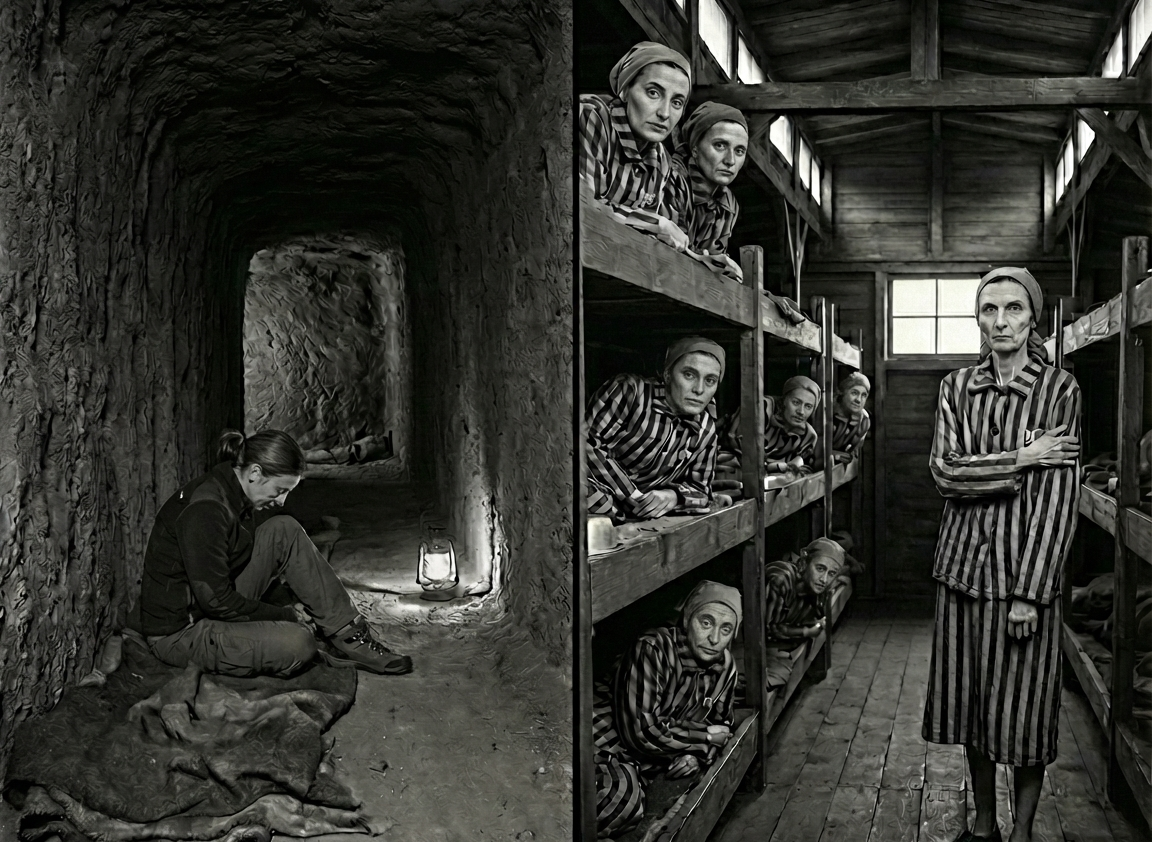
In the wholesale destruction of humanity unleashed in the Nazi death camps, freedom, autonomy, and personhood were systemically annihilated. Yet out of that uniquely engineered hell came something that defied intent: Lager Shvestern—camp sisters—women who bound themselves to each other by necessity. In an environment designed to dismantle identity, they formed a scaffolding—a buffer against the pervasive dehumanization.
Now pivot to October 7, 2023, and the abduction of the Israeli women, where we encounter a starkly different architecture of captivity. These women did not enter a world of mass confinement. Instead, they were absorbed into a system defined by separation, concealment, and instability.
In the claustrophobic darkness of the tunnels beneath Gaza, rather than the communal networks that emerged in the camps, many of the abducted women endured isolation, fear, and terror without the sustaining presence of a sisterhood.
The intent of identifying this distinction is not to weigh one tragedy against another. This is not a contest in suffering. It is a way of understanding something essential about trauma: connection itself can be a survival tool—and for women, that tool often takes a particular form.
Holocaust camp life was built on deprivation—of food, hygiene, privacy, names, and dignity. Yet the camps also imposed a brutal proximity that made sisterhood possible. Hundreds of women were crammed into a single barrack, sleeping in tiers, living inside each other’s breath. This grotesque density created conditions in which women could do what women have long done: orient toward one another, monitor one another, and intervene.
My mother-in-law, Rifka, was barely a teenager when she entered the camps. She survived in part because two older women—D’vorah and Gitl—took her in and claimed her as their own. It was an apprenticeship in survival. They taught her how to read a room, how to conserve strength, how to keep her face neutral and her posture steady. When, after a severe beating, the elderly D’vorah became too weak to stand in line for rations, Rifka and the women inmates tore pieces from their own food to sustain her. In a system of engineered starvation, such acts were a matter of survival. They provided what the camps were designed to erase: the steadying presence of women who looked out for one another.
Many women abducted on October 7 were rotated among locations, held in small, unstable groupings, or confined with captors rather than with fellow hostages. Kept in tunnels or safe houses for months, they were deprived of daylight and meaningful human contact—the structural opposite of the camps’ massification.
Even when these women encountered other captives, they were held in groups too small and too unstable to form a lasting community from which collective survival strategies could emerge. None were held in anything resembling communal barracks—with the continuity, density, and shared routine that once allowed Lager Shvestern to function as an informal system of survival. The conditions simply did not allow for the dense social life that made such bonds possible.
This difference matters. Not because one form of captivity is “better,” but because isolation fundamentally alters the inner experience of time, fear, and control.
While the Holocaust attempted to obliterate individuality through mass incarceration and extermination, the October 7 captivity sought to erase the individual by removing the world entirely. Both lead to a “shattering of the self,” but the path back to “wholeness” is very different for each.
Psychology now confirms what history long suggested: isolation is not merely lonely; it is clinically destabilizing. Large-scale research on solitary confinement consistently links social isolation and sensory deprivation to anxiety, depression, anger, cognitive disturbance, and, in some cases, psychotic symptoms. A major review of ~382,000 incarcerated individuals found significantly worse mental-health outcomes among those held in isolation than among those detained with others.
This distinction is fundamental to understanding women’s survival in the Holocaust camps—and its absence on October 7. The barracks were brutal; yet within their forced density, women forged networks of care that buffered despair and boosted morale. The Lager Shvestern “mothered” orphaned children, formed families without bloodlines, and used vigilance to ward off danger.
It is tempting to call this heroic, but it’s more ordinary, more ancient. Women are both biologically and socially wired toward attunement—toward reading faces, anticipating needs, responding to vulnerability. Traits etched into the female experience.
When women are deprived of connection—when they are isolated, silenced, or made invisible—the psychological damage deepens. The tragedy of October 7 is that the absence of a consistent communal network meant this survival instinct often had no soil in which to take root. Isolation itself became part of the trauma.
In her testimony to The New York Times, Amit Soussana reported being held alone, chained by her ankle in a dark room. Her survival was a solitary act of fierce resistance with no one to hold her hand or pray with her; the mental effort to “stay human” became an Olympian feat.
This is not a historical footnote. It is a moral lens—one that reveals how survival is shaped not only by strength, but by connection, shared purpose, witnessing, and care. Rifka survived because two women stood beside her when her world collapsed. They did not save her with weapons. They saved her with vigilance, guidance, and the steadying presence that told a terrified girl: You are not alone.
For many women in the camps, survival was less an individual feat than a collective undertaking. It is an inheritance—written into how women observe, how they attach, and how they hold one another up. It is not a solo act.
And it is precisely why isolation is such a cruel weapon.