Rafi Glick
From Kibbutz to the global stage

As Washington, Beijing, Moscow, Tehran and Jerusalem Converge, Wars May End

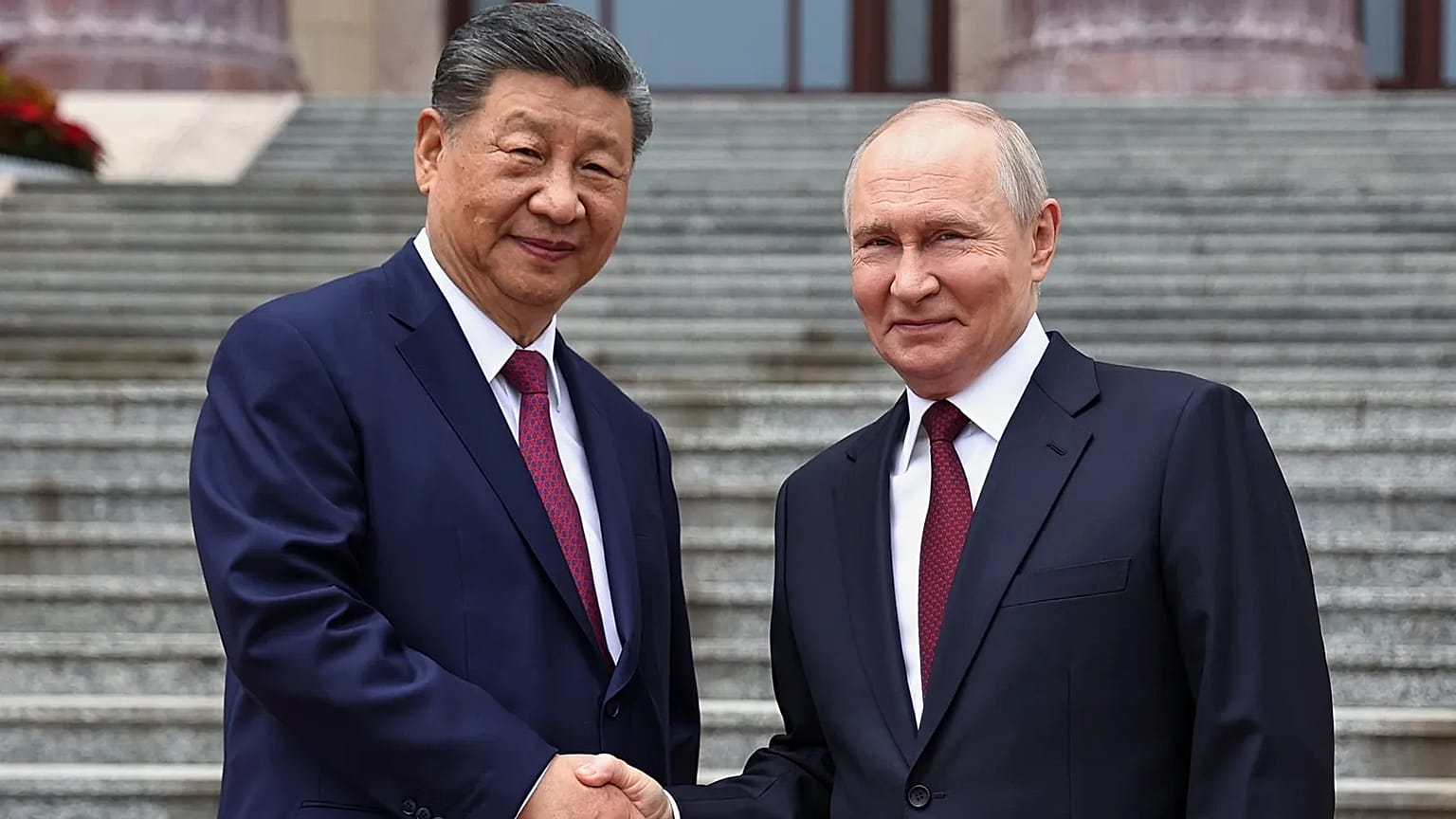
Image: Xi Jinping and Vladimir Putin during talks in Beijing. Photo: AP.
With the conclusion of President Trump’s visit to China and his sudden announcement on Monday, May 18, postponing the planned military strike, signs are growing that a broader global arrangement may be taking shape — one in which the American-Iranian conflict could become linked to other major geopolitical flashpoints, including Ukraine, the South China Sea, and the wider Middle East.
Trump’s remark last week that Taiwan should exercise restraint and avoid “making noise” may also hint that Washington increasingly views the South China Sea, Ukraine, Iran, and the Middle East as interconnected components of a single strategic system.
Russian President Vladimir Putin’s visit to Beijing today — during which, according to reports, the sides discussed a wide range of strategic issues — together with the UN Security Council’s call to halt the bloodshed in Ukraine, CNN’s report that Xi Jinping warned Putin he may one day regret invading Ukraine, as well as reports from Al Jazeera and Anadolu suggesting a gradual shift on parts of the battlefield in Ukraine’s favor, growing Russian concerns over intensified Ukrainian military pressure, rising casualties, and public statements within the Russian parliament expressing concern about Russia’s economic situation under the weight of the war — all may indicate that Trump, Xi, and Putin are exploring the possibility of a broader geopolitical settlement.
At the same time, signs of mounting pressure are also emerging within the United States itself.
Particularly notable was yesterday’s Senate vote, in which four Republican senators joined Democrats in demanding that the administration regulate and authorize the war in accordance with the American War Powers framework. This comes alongside growing public dissatisfaction over the economic costs of prolonged conflict, the approaching midterm elections, and Republican concerns over potentially losing their majority in both the Senate and Congress.
Therefore, despite the noise, contradictory statements, and continuing tensions — and following Trump’s recent remark that “Netanyahu will do what I tell him to do” — it is possible that behind the scenes, a broader diplomatic framework is gradually taking shape, aimed at reducing the intensity of regional conflicts and stabilizing the international system.
About the Author
Rafi Glick is a writer, lecturer, farmer, and business executive with decades of experience at the intersection of academia, technology, agriculture, and international trade. • He has served as a Senior Teaching Associate at Ben-Gurion University of the Negev, Ono Academic College, Ariel University, Ruppin Academic Center, and as a guest lecturer at Sofia University’s Faculty of Economics and Business Administration (FEBA). At Ben-Gurion University he also advised the BGU–NHSA Accelerator in the Faculty of Science. • In business, Rafi was CEO of Bidsnet Ltd., a pioneer in deploying fiber-optic cables through unconventional infrastructure (in partnership with CableRunner), delivering high-speed connectivity to homes, enterprises, institutions, and cellular networks. Earlier he held senior roles at ECI Telecom and served on the board of RLF Venture Capital, working with partners such as Intel, Teva, and the Jerusalem Development Authority. • He contributed extensively to Israel’s trade and investment ecosystem: he directed industrial and agricultural technology divisions at the Israel Export Institute, founded Israel’s AGRITECH as international exhibition, and served on the board of the Israeli Investment Center at the Ministry of Industry and Trade. • In his early career, Rafi established and served as the first director of the Cargo and Aircraft Supply Security Department in the Security Division at Ben-Gurion Airport (1972–1976). He lived in Kibbutz Parod until 1974. • Rafi has also been recognized for his writing: in 2008 he was named Best Economic Blogger by TheMarker, Israel’s leading business daily. • Today he continues to publish essays and commentary—with a special passion for astrophysics, space exploration, technology, economics, and social issues. From Kibbutz Parod to the global stage, Rafi Glick’s career reflects a lifelong commitment to building connections—between people, industries, and ideas. Email: rafi.glick@gmail.com
Related Topics
Related Posts
Sign in or Register
Please use the following structure: example@domain.com
Or Continue with
By registering you agree to the terms and conditions
Register to continue
Or Continue with
Log in to continue
Sign in or Register
Or Continue with
check your email
Check your email
We sent an email to you at .
It has a link that will sign you in.