CFO | Empower Society for Good I Author
Ashamnu: When Righteous Causes Forget the Other
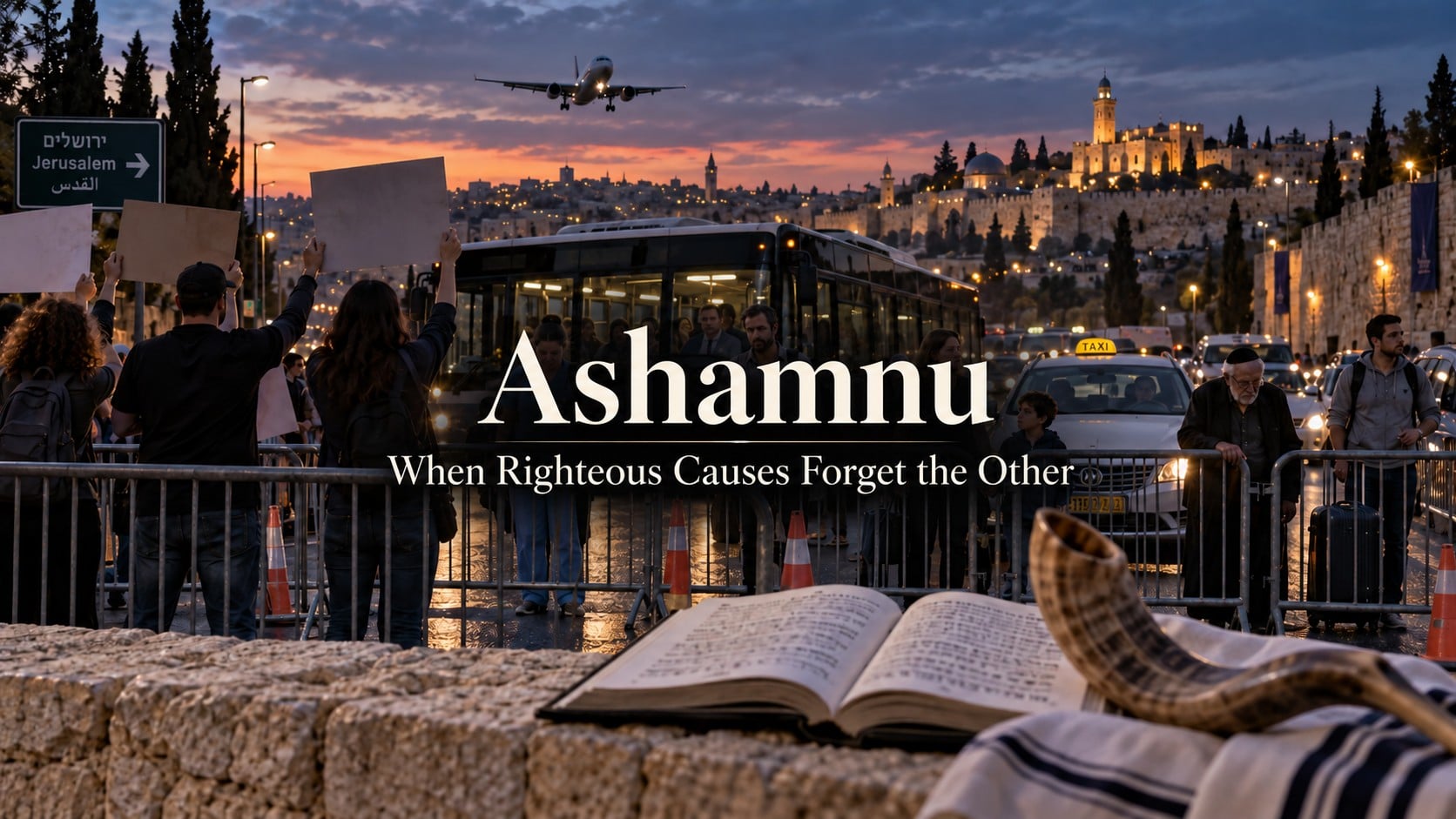
This Yom Kippur, one word keeps returning to me: Ashamnu.
We have sinned.
But this year I hear it in a very specific way: we have stopped considering the other.
Inside Israel, we see it in our actions.
A road was blocked, and someone could not get home.
Our actions affected others, and we did not care.
A strike was called, and someone lost a day’s pay.
Our actions affected others, and we did not care.
An airport was closed, and families were stranded.
Our actions affected others, and we did not care.
Someone waited five hours for luggage. Someone missed a flight. Someone missed work. Someone missed treatment.
Our actions affected others, and we did not care.
That is not simply political tension.
That is societal breakdown.
A society begins to break when people no longer feel responsible for the consequences of their actions on strangers. When my cause becomes so urgent that your life becomes irrelevant. When my anger becomes so righteous that your dignity becomes expendable.
Protest is sometimes necessary. Strikes may sometimes be legitimate. Civil action has a place in a democracy. But even a justified cause does not release us from responsibility for the human cost of our methods.
We see it in our words too.
Cruel rhetoric against the IDF wounds soldiers and their families.
Words spoken against Haredim, secular Jews, settlers, leftists, protesters, judges, police, teachers and nurses reduce whole communities to labels.
Our words affected others, and we did not care.
Hurtful words are not harmless because they are spoken for a righteous cause. They land in homes, in families, in children, in soldiers, in communities. They can humiliate, harden, divide and wound.
Ashamnu.
We have acted as though our pain is the only pain.
We have acted as though our cause cancels another person’s dignity.
We have acted as though people we do not know do not matter.
And then there is the world’s judgment of Israel.
On Yom Kippur we recall the Ten Martyrs, the Asarah Harugei Malchut. They were not criminals. They were teachers of Torah, carriers of Jewish memory, men who kept Judaism alive under Roman power. Rome understood that if Jewish teaching continued, Jewish identity would survive.
That is why the story still hurts. It reminds us that Jews have often been judged by empires not because we were guilty, but because we refused to disappear.
In Rome, it was Torah. In later generations, it was Jewish faith, Jewish separateness, Jewish survival. In our generation, it is Zionism, Jewish sovereignty, and our insistence that we have a right to live in our own land.
I am not saying Israel is perfect. I am not saying we are beyond criticism. Yom Kippur demands the opposite. Teshuvah requires honesty, accountability and self-examination.
But there is a difference between criticism and condemnation. There is a difference between asking Israel to act morally and deciding that Jewish sovereignty itself is the crime.
The world often speaks as though Israel is not a normal nation with history, grief, fear, obligations, failures, enemies and human beings. It speaks as though Jews are somehow less entitled to borders, less entitled to self-defence, less entitled to memory, less entitled to a place among the nations.
It is a form of moral dehumanisation.
But this cannot only be a complaint about the world.
We ask the world to see us as human.
But do we see each other that way?
We ask the world to recognise our history.
But do we recognise the pain of the person blocked on the road, stranded at the airport, mocked in uniform, dismissed in a black hat, or shouted down because he votes differently?
If the world’s sin is that it refuses to see the Jewish people fully, our teshuvah must be that we refuse to stop seeing each other fully.
This is where national teshuvah begins.
Not only in speeches. Not only in politics. Not only in demanding fairness from the nations. It begins with the word Ashamnu.
We have failed to consider the other.
I do not want to stand in shul this Yom Kippur and beat my chest only for private sins, while ignoring the public habits that are breaking us.
My father’s yahrzeit falls at this time of year, and I keep returning to one of the deepest lessons of his life: treat everybody with dignity.
Not as a slogan. Not as a sermon. He lived it.
He treated workers, customers, friends, strangers, people of every background, with basic human respect. He did not need to agree with a person in order to greet them properly. He did not need them to be important in order to make them feel seen.
That lesson feels very small until you realise it may be the foundation of a whole society.
Rambam says teshuvah is not just regret. It is not just confession. It is facing the same situation again and choosing differently.
That is a terrifying standard.
It means that if next week, next month, next crisis, we use the same tools of contempt, disruption and dehumanising language, then we have not done teshuvah.
We have only performed regret.
So the question is not only: are we sorry?
The question is: when we are angry again, afraid again, convinced again that our cause is righteous, will we still consider the other?
After writing these words, I tried to pause and actually listen to the Selichot we say on Erev Yom Kippur.
Sometimes the shortest lines are the ones that stop you.
One passage asks:
Lord, when You consider mankind each morning, and do not judge with exacting rigor, if You were to adjudicate the claims of body and soul, could a person prevail in judgment?
That is the part I think I had not said strongly enough.
Yes, actions matter. Words matter. The other person matters.
But why?
Because we are not only answerable to one another. We are answerable to God.
We place so much faith in human beings: politicians, courts, armies, protests, governments, commentators, alliances, strategies. We need all of them in their place. Judaism does not ask us to be passive.
But if we place our ultimate trust in man, we will fail again.
Rambam’s teshuvah is not only about behaviour. It is about returning to truth. God runs the world. We stand before Him. Our anger is not sovereign. Our slogans are not sovereign. Our politics are not sovereign.
And then final paragraph of Selichot turns to this plea:
Your people and Your heritage, who hunger for Your goodness, who thirst for Your kindness, who long for Your salvation, may they recognise and know that to Hashem our God belong mercy and forgiveness.
And perhaps that is the final thought I want to take into Yom Kippur: that we are Your people. Your heritage. A people still hungry for Your goodness, still thirsty for Your kindness, still longing for Your salvation.
But if we are Your people, then the person in front of me is also Yours.
The person stuck behind my roadblock. The person stranded by my strike. The soldier wounded by my words. The Haredi Jew dismissed by my contempt. The secular Jew mocked by my certainty. The stranger whose life I disrupted and whose name I will never know.
The most dangerous moment in a society is when people believe they are acting in God’s name, or in the name of justice, democracy, Torah, security, freedom or the nation, and therefore no longer have to consider the human being in front of them.
That is not righteousness.
That is how a society breaks.
Ashamnu is not only a confession.
It is the beginning of responsibility: for our actions, for our words, and for the people we affect but may never meet.
Related Topics
Related Posts