Head of the Hannaton Educational Center
Featured Post
Rabin’s legacy: We must carve a path through our deep disagreements
He modeled the struggle for peace within, with our neighbors, and for the sake of our children’s security - and we can follow in his footsteps without falling apart
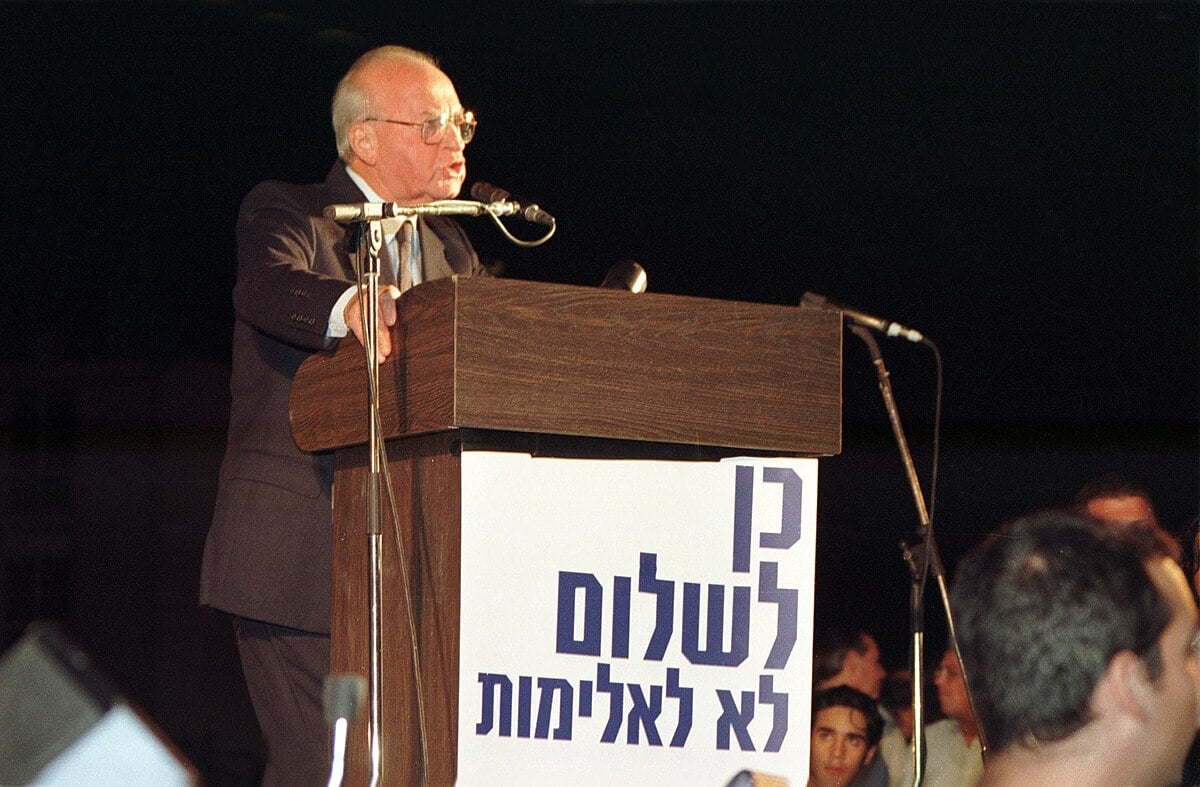
Prime Minister Yitzhak Rabin addresses thousands of supporters, gathered in the Tel Aviv Municipality plaza. Rabin was assassinated on his way home from the rally, on November 4, 1995. (Wikipedia)
Last year, I participated in a rally in Yitzhak Rabin (z”l)’s memory. Very close to the scene of his murder, on Ibn Gabirol Street in Tel Aviv. There was loud music playing from a nearby party. I tried to go up to the apartment to ask for the music to be lowered, but no one listened.
A society does not fall apart only in dramatic moments. It also erodes in the thousands of collective moments when we stop hearing one another.
Rabin’s assassination should have been the most glaring wake-up call. And yet, with each passing year, we continue to argue over his legacy. There are those who want to remove politics from memory and emphasize that the tragedy and its fallout belong to all of us – both right and left, religious and secular. This position holds an important sentiment, as it recognizes that the assassination harmed all of Israeli society. But what is politics if not life itself?
Rabin was no angel nor any other mythical figure, but a man of flesh and blood. He was a public leader. There is something so painful today about the chasm between what was once considered a leader’s proper conduct and what we are willing to accept from today’s politics. What was once considered intolerable has become, in many cases, part of our current public landscape.
Rabin’s assassination represented a deep fracture from within — our inability to manage a dispute without turning an adversary into an enemy, denying its legitimacy and descending into violence. More than three decades have passed since then, and we have still not managed to internalize its full magnitude.
Those who want to talk only about unity and not about the common goal, about the path and not the question of where we are headed, may find that the unity they wish to preserve is actually rendered meaningless. A society cannot exist for long without a vision for its future and without discussing the fundamental questions for how to get there. With that, a society that stops talking about the pursuit of peace, and is content with the pursuit of quiet, forfeits the ability to shape its future.
Our problem today is not just that we don’t know how to hold space for disagreements. Rather that we still have not learned how to grapple with the fact that we are built from them. In the Jewish tradition, there is a distinction between a dispute that is considered “for the altruistic sake of Heaven” and one that is not. A dispute for the sake of Heaven is not a polite disagreement in which the goal is for everyone to ultimately agree. It can be sharp and painful, but its purpose is to clarify the truth, bring deep learning, and spur change. A dispute that is not for the sake of Heaven allows the camp’s victory to become more important than the truth, and defeating one’s opponent more important than an attempt to build a common future. It is critical to differentiate between the two, as this difference is what will determine whether a society can manage to emerge stronger because of its differences or collapse because of them.
We must realize that it is impossible to fight for the goal (an enduring political solution) without simultaneously fighting for the ability to live together as one nation. One cannot remember Rabin’s assassination and at the same time erase the political controversy that preceded it from the discussion. We must face the gaps within our society head on, and the acts of incitement and violence that have ensued. Peace cannot be built if the society in which it exists is falling apart. Without togetherness, there is no path forward. Without a common path and goal, unity is devoid of meaning.
For years, we sought togetherness without a true goal. Instead of insisting on talking about the future, we looked to manage the present and hoped that the quiet we were seeking would prevail. Then came October 7 and it exposed the heavy price of this concept of “quiet” and the devastating failures it brings. Even after the disaster, we found it difficult to formulate a vision for the future that we could all agree on.
The year that sparked the war was not in isolation though. In other years, we also struggled for our goal to live quietly without paying enough attention to the ability to live together. This too is a recipe for failure.
We don’t have to agree on everything. We need to stop treating disagreement as a threat to our very existence. In a democracy, the majority rules, but its decision should not give license to erase minority voices. The minority position and experience must also be heard and safeguarded, because today it is the words of the minority, but tomorrow it may turn out to be our shared way forward.
Rabin’s legacy is the legacy of his life and the legacy of his assassination, and the two remain intertwined. In life and in death, he represents the struggle for peace within us and with our neighbors, as well as our children’s security. To hold this complexity is the task at hand, and to do service to his memory we are called to draw lessons alongside the possibility of deep dispute, without falling apart because of it.
Related Topics
Related Posts