
From Yemenite tradition to the coming Beith HaMikdash
At the Table, Not Under the Canopy
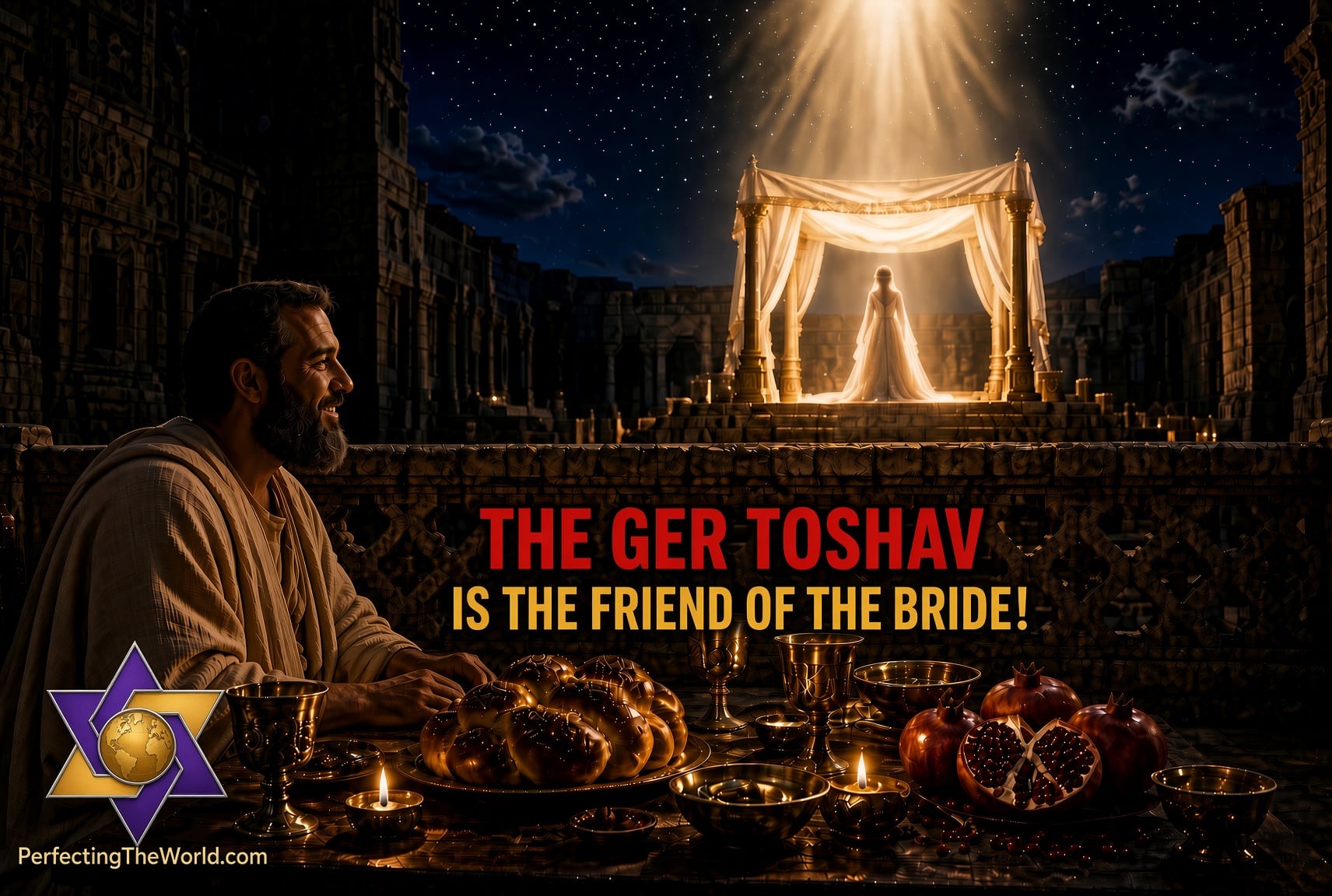
"At the Table, Not Under the Canopy: Israel as the Bride, Her Honored Companions, and the Boundaries of the Covenant." (image generated using AI)
The Bride, the Friends, and Those Left in the Outer Darkness
There is a primary, undeniable romance running like a golden thread through the Hebrew Scriptures: Hashem is the Husband, and Israel is His Bride.
Every covenantal mechanism, every boundary stone, every legal distinction between native-born and foreigner, and every prophetic warning in Scripture flows directly out of this singular relationship. When Hashem speaks of His people in the Tanakh, He does not use the language of an indifferent sovereign organizing a geopolitical project. He uses the language of an ardent, jealous, and devoted lover:
“For your Maker is your husband, the Lord of Hosts is His name; and the Holy One of Israel is your Redeemer; the God of the whole earth He is called.” — Isaiah 54:5
Mount Sinai was not merely the delivery of a civic code; it was a cosmic wedding under a suspended mountain canopy (Chuppah). The Ten Words were the intimate terms of the marriage contract (Ketubah). The pledge spoken by the collective mouth of Israel—Na’aseh V’nishma (“We will do and we will obey”)—was the bride’s solemn I do.
To read Scripture accurately, one must first fix this core identity in stone: Hashem is the Bridegroom, and Israel is the Bride.
Everything else in the biblical narrative—the rules of entry, the boundaries of the Sanctuary, the warnings against lawlessness, and the status of the nations—is added to protect, affirm, and guard the sanctity of this marriage.
1 · The Interrupted Wedding: The Golden Calf and the First Fences
When popular religion approaches the Scriptures, it frequently commits a quiet act of identity theft. It takes the deeply intimate, historical, and covenantal language reserved for Israel and flattens it into an abstract, universal metaphor—claiming an invented institution has stepped in to take the place of the original spouse.
Yet the Tanakh leaves no room for such replacement. Hashem’s commitment to His Bride is eternal, even through the agonizing tragedy of her unfaithfulness:
“And I will betroth you to Me forever; yes, I will betroth you to Me in righteousness and justice, in lovingkindness and mercy; I will even betroth you to Me in faithfulness, and you shall know the Lord.” — Hosea 2:19–20
To understand why protective boundaries were erected in the first place, one must look at the tragic rupture at Sinai. Israel making the Golden Calf (Chet HaEgel) while Moses was on the mountain was equivalent to a bride committing adultery under the very shadow of the Chuppah (Exodus 32).
The spoken Word at Sinai was originally intended to be inscribed directly onto the tablets of the human heart—an immediate, internal, spiritual union. But the sin of the Calf broke the first set of stone tablets. The relationship degraded from immediate spiritual intimacy to a mediated, externalized, stone-written law.
Because unmediated proximity to the Holy kills an unfaithful Bride, protective boundaries had to be erected. The strict legal distinctions (Ger Toshav vs. Ezrach, who eats the Pesach, the Soreg partition in the Temple) were put in place to protect both Israel and the nations while the Bride was in a state of partial exile.
Any true messenger or royal representative of the Father sent to gather the flock does not arrive to invent a new Bride out of foreign cloth. Operating strictly within the framework of the House of Israel, the mission has always been to redeem, cleanse, and gather the scattered Wife so she can be reunited with her Husband under the terms of the promised New Covenant (Jeremiah 31:31).
2 · Jeremiah 31: The Completion of the Sinai Vow
Jeremiah 31:31–34 is frequently twisted to argue that God abandoned His unfaithful Bride and chose a different, global replacement. But the text explicitly says:
“Behold, the days are coming, says the Lord, when I will make a new covenant with the house of Israel and with the house of Judah—not according to the covenant that I made with their fathers… My covenant which they broke, though I was a husband to them…” — Jeremiah 31:31–32
Jeremiah 31 is not the creation of a different marriage with a different woman. It is Hashem promising to finally execute the original Sinai design: taking the externalized law off cold stone tablets and placing it directly into the hearts of the same Bride (the House of Israel and House of Judah).
The arc of the covenant
- Sinai Intention: Internal Heart-Torah planned at the betrothal.
- Golden Calf Rupture: Adultery under the canopy breaks the first tablets.
- External Torah & Fences: Stone tablets and legal boundaries erected to protect the house.
- Heart Inscription: Jeremiah 31 promises the completed betrothal in the Messianic era.
This “Heart-Torah” is a matrimonial promise made specifically to the collective body of Israel. It guarantees the permanent fidelity of the Bride so she can never fall into idolatry again.
When Jeremiah states, “No longer will a man teach his neighbor… ‘Know the Lord,’ for they will all know Me,” he is describing the total internal transformation of Israel. It does not mean the non-Jewish nations have no need for instruction. In fact, the Prophets describe the exact opposite for the rest of the world.
Isaiah 2:2–3 explicitly states that in the latter days, the nations will stream to Jerusalem saying: “Come, and let us go up to the mountain of the Lord… He will teach us His ways, and we shall walk in His paths. For out of Zion shall go forth the law.” And Zechariah 8:23 describes ten men from every language grabbing the skirt (Tzit-tzit) of a Jewish man saying, “Let us go with you, for we have heard that God is with you.”
Israel receives the internalized Ketubah as the completion of Sinai. The nations draw near to learn from her mouth.
3 · The Distinction: Ger Tzedek and Ger Toshav
If Hashem is the Husband and Israel is the Bride, where does that leave the non-Jew who loves the God of Israel? The Torah establishes two distinct, honorable paths—and neither one is exile.
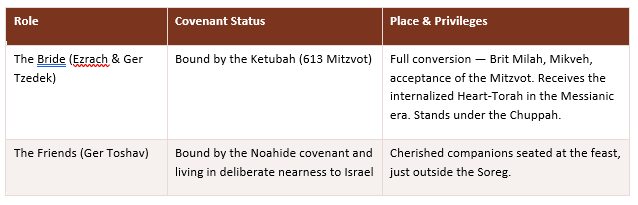
The Noahide covenant itself is the universal moral floor. It becomes the foundation of the Ger Toshav only when a person steps toward the household of Israel. Apart from that movement, the Noahide remains outside the gate—righteous in the basic sense, yet still a stranger to the nearer place the Prophets describe.
Path A — The Righteous Convert (Ger Tzedek)
A non-Jew who chooses to bind themselves entirely to Israel undergoes Giyur (conversion)—including the “Sacred Cut” (Brit Milah), immersion in the mikveh, and acceptance of the 613 Mitzvot before a Beit Din.
Halakha establishes that a convert is like a “newborn child” (k’katan she’nolad dami). Their old identity as a Gentile dissolves, and they become a full, seamless cell in the body of the Bride. In the post-heart-writing era, the instant Giyur is complete, the convert inherits the internalized “Heart-Torah” because they are now an organic part of the Wife.
Path B — The Resident Friend (Ger Toshav)
A non-Jew who abandons idolatry (Avodah Zarah) and lives in moral alignment alongside Israel is a Ger Toshav. The Torah repeatedly commands Israel to love, protect, and provide for the Ger Toshav (Leviticus 25:35).
However, Exodus 12:43–48 explicitly forbids the Ger Toshav from eating the Passover (Pesach) sacrifice. The Passover meal is the annual anniversary meal of Israel’s betrothal and redemption from Egypt. An honored family friend may attend the wedding and rejoice at the feast, but he does not step into the marital chamber or wear the wedding ring.
This sign of the marriage—the Ot given by the Husband to His Bride (Exodus 31:13)—belongs exclusively to the contract. To attempt to wear the Husband’s ring without ever signing the Ketubah is not an act of worship; it is an unauthorized trespass into a private covenant.
And here is the point the nations most need to hear: the place of the friend is not the far country. It is just outside the Soreg—the low latticed partition in the Temple that marked how near a Gentile could stand. That boundary was never a wall of rejection; it was the measure of an astonishing nearness. Of all the peoples of the earth, the Ger Toshav stands closest of all to the Holy, closest to the Bride, near enough to see the lamps burning and hear the vows spoken. Being a Ger Toshav is not a second-class rejection; it is a position of immense dignity. They are the honored companions celebrated in Psalm 45:
“She shall be brought to the King in robes of many colors… with gladness and rejoicing they shall be brought; they shall enter the King’s palace.” — Psalm 45:14–15
4 · The Anatomy of a Wedding Crasher
The tragedy woven throughout history is the refusal to honor these sacred boundaries. In the ancient parables of royal banquets, those who end up in the “outer darkness,” weeping and gnashing their teeth, are not merely unfortunate passersby. They are covenant crashers.
The King’s banquet hall is not an open-door free-for-all. To enter, one must submit to the King’s terms. Yet human presumption constantly attempts to rewrite the invitation. Throughout the warnings of the Prophets, this presumption manifests in subtle, yet devastating ways:
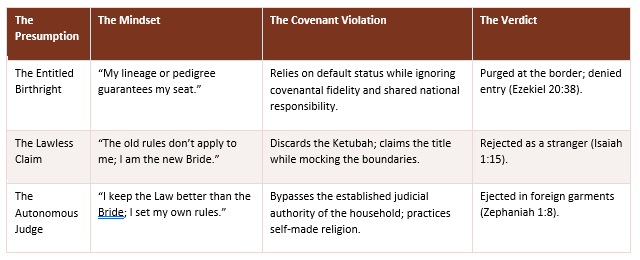
The Danger of Entitlement
The Prophets repeatedly warn against the presumption that raw lineage or physical proximity automatically grants an unconditional seat at the table. In Ezekiel 20:38, Hashem warns of a coming purge where those who rely on their pedigree—yet live in active rebellion against the covenant or refuse to bear the burdens of their brethren—will be stopped at the border. They assume their birthright is absolute, only to find that covenantal unity and obedience are the actual requirements for entry.
This is the warning against genealogical presumption in every age: the claim to be Israel—or the deepest sons of Israel—while standing apart from the shared burden of the people. Zion is not honored by those who wrap themselves in her name and her provision yet turn their backs on her defense and her welfare, mistaking their pedigree for a license to be carried rather than a summons to carry. Fidelity is measured not by how loudly one claims the seat, but by whether one shoulders the household’s weight alongside his brothers.
The Danger of the Discarded Contract
There is a tragic, widespread assumption that one can arrive at the King’s feast and claim the seat of the Wife while wearing the garments of lawlessness (Anomia) and proudly scorning the original Ketubah. Such worship is not welcomed but refused:
“When you spread out your hands, I will hide My eyes from you; even though you make many prayers, I will not hear… your hands are full of blood.” — Isaiah 1:15
To claim intimacy while destroying the household rules is to render oneself a legal stranger to the King. The louder the boast of spiritual works and accomplishments, the more complete the estrangement—for the King does not negotiate the terms of His Bride’s contract.
The Danger of the Autonomous Judge
Equally perilous is the one who recognizes the beauty of the Torah but refuses the humility required to submit to the Bride’s established household. They read the Ketubah, but they bypass the judicial authority (Halakha) given directly to Israel. They invent their own calendars, establish their own purity standards in isolation, and march into the Bride’s house to lecture her on how she is failing her own marriage.
Zephaniah foresaw exactly such a scene at the LORD’s own sacrificial feast: “I will punish… all such as are clothed with foreign apparel.” (Zephaniah 1:8). The man inspected the house without ever joining the household—and was found, at the feast, still wearing the clothing of a stranger.
5 · Standing Outside Together
The bitter irony of self-appointed righteousness is that it always ends in the exact same location.
Whether one relies on genetic entitlement, lawless grace, autonomous zeal, or a self-righteous isolation that shuns the mutual responsibility of the community, the refusal to honor the Bride’s boundaries locks the door from the inside.
In Hebrew idiom (Psalm 112:10), “gnashing of teeth” is the agonizing rage of envy, pride, and total humiliation. Standing outside in the cold night, looking through the lit windows of the banquet hall, the presumptuous are forced to witness the reality they spent a lifetime avoiding:
- The Actual Bride: Israel—restored, cleansed, with the Torah written directly upon her heart—seated under the Chuppah in glory alongside her Husband.
- The Actual Guests: Righteous men and women from the nations (Ger Toshav) who entered with humility, kept the moral boundaries, honored the household, and took their rightful, honored seats just outside the Soreg—nearer the Bride than any who forced the door.
- Their Own Folly: The sudden realization that attempting to steal the Bride’s gown, rewrite the King’s Ketubah, or spurn the unity of the household did not elevate them—it permanently excluded them.
6 · The First Step Across the Threshold
It is not enough to admire the household from a distance. The honest reader who has followed the argument this far arrives at a single, practical question: If I am not the Bride—and I am not—then what do I actually do? The Tanakh does not leave the friend standing in the road. There is a threshold, and there are steps across it.
Renounce the borrowed ring
The first step is also the hardest: to lay down every claim that was never yours to make. Abandon idolatry (Avodah Zarah)—not only carved images, but the subtler idol of the stolen identity, the insistence on being the Bride, the appropriated Ketubah. You cannot enter the feast wearing the Husband’s ring you were never given. You enter by taking it off.
Take up the covenant that is actually yours
The nations were never left without a covenant. Long before Sinai, the sons of Noah were bound to a moral floor that upholds a just and human world. These are the terms the friend keeps—honorably, and in full standing:
- Establish courts of justice — build and submit to the rule of righteous law.
- Do not blaspheme — honor the Name of the God of Israel.
- Do not practice idolatry — worship Him alone.
- Do not commit sexual immorality.
- Do not murder.
- Do not steal.
- Do not eat flesh torn from a living animal — reverence for life, even in the taking of it.
These seven commandments are not a consolation prize, nor are they a finished destination. They are the beginning of the road. The self-identified Noahide who keeps them while remaining content to stand far from Israel has not yet approached the gate. The invitation to the table is extended to those who draw near—who abandon not only idolatry but isolation, who learn from Zion rather than from a self-contained system, and who take their place as honored friends adjacent to the Bride. The Noahide covenant is the threshold. The Ger Toshav is the one who has crossed it.
Draw near to learn — from her mouth, not your own
The friend does not instruct the Bride; he learns from her. This is the posture Isaiah and Zechariah foresaw for the nations in the latter days—not lecturing Israel on her marriage, but taking hold of the hem and saying, “let us go with you, for we have heard that God is with you” (Zechariah 8:23). To draw near to the living community of Israel, to support her, to receive Torah from Zion rather than from one’s own invented calendar—this is what nearness looks like in practice. It is the walk from the road to the place just outside the Soreg.
And the road stays open
For some, the call will go further, and the door of Giyur remains open to any who would bind themselves wholly to the Bride as a Ger Tzedek. But let this be clear: the Ger Toshav is not a waiting room. It is a destination—complete, dignified, and near. No one seated at that feast will wish he had forced the door instead.
The Joy of Knowing Your Place at the Table
To restore the Tanakh’s understanding of the Bride is to restore sanity and reverence to biblical faith.
Hashem is the Lover. Israel is His Bride, bound to Him by blood and oath at Sinai. The ejection of the crashers is not arbitrary; it is the righteous fury of a Husband defending His Wife against centuries of abuse, identity theft, and internal contempt.
Those from the nations who love Hashem are invited to draw near—either by taking the sacred legal steps to fully join the Bride as a Ger Tzedek, or by standing faithfully as a Ger Toshav, an honored friend just outside the Soreg, nearer the Bride than any presumptuous claimant will ever stand.
There is no shame in being a guest at the King’s table. There is only peace, joy, and the simple beauty of a house whose boundaries are respected, whose Lover is adored, and whose Bride is honored. The Noahide who remains at a distance is not under judgment for keeping the seven laws; he is simply not yet seated among the guests. The road from outside the gate to the place just beyond the Soreg remains open. The road to that table is open tonight. Take the first step.
– Yosef Eitan
PerfectingTheWorld.com
Related Topics
Related Posts