At the UN, Iran Won the Image. Israel Must Fight for the Truth
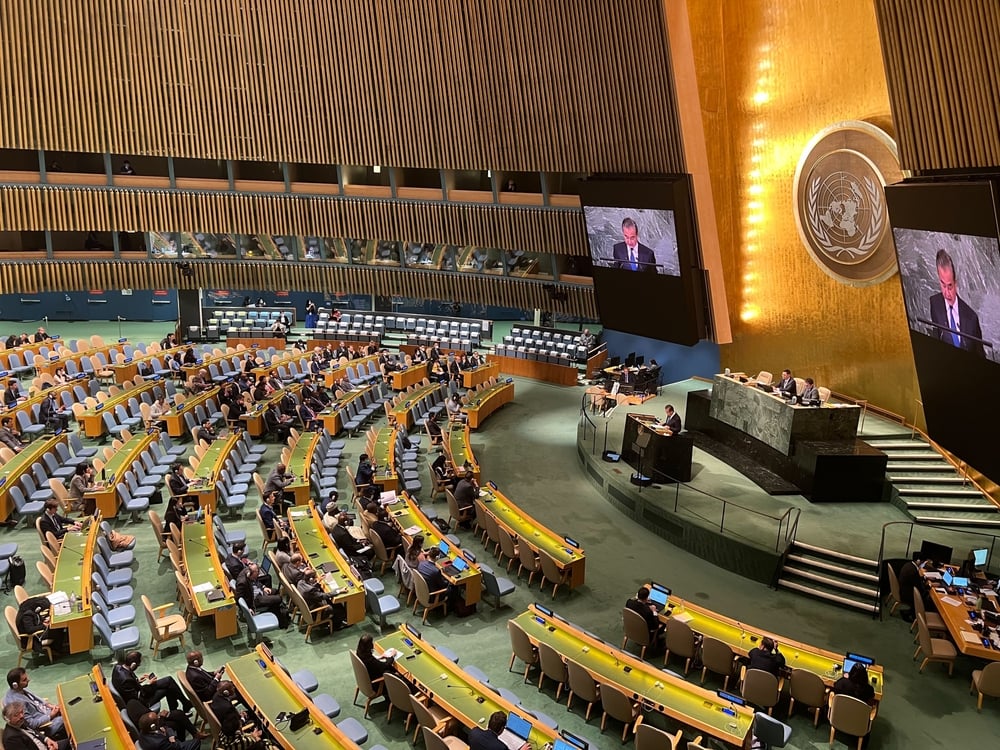
The most revealing moment at this year’s United Nations General Assembly did not come from the podium. It came from the delegates who rose from their seats and walked out as Prime Minister Benjamin Netanyahu began to speak. The cameras captured the spectacle perfectly: a procession of diplomats leaving the hall, delivering their verdict on Israel without having to listen to a word of its defense.
The previous day, Iranian President Masoud Pezeshkian had addressed the same assembly. He portrayed Iran as a victim of aggression, held up photographs of Iranian children killed in the war and accused Israel and the United States of terrorism. The American delegation walked out and Israel boycotted his speech. Yet there was no comparable procession of diplomats determined to show the world that Iran’s leader was unworthy of their presence.
The contrast was impossible to miss. Israel’s elected prime minister was met with a carefully staged act of rejection. The representative of a regime that crushes dissent at home was given the space to present himself as the voice of a wounded nation. In a chamber supposedly devoted to human rights, the Iranian people who oppose that regime barely entered the picture.
Only days earlier, a UN fact-finding mission had reported on Iran’s extraordinarily brutal suppression of protests that began in December 2025. Its investigators described security forces killing protesters and bystanders, including children; mass arrests; torture; and violations amounting to crimes against humanity. Iran’s own authorities published a list of 3,038 people killed, while the mission warned that the true number could be significantly higher. The government also imposed an internet shutdown lasting more than five months, obstructing families searching for loved ones and making its actions harder for the world to see.
Tens of thousands of deaths are well known, but the regime’s restrictions have made a complete accounting extraordinarily difficult. The same authorities that demand the world see the photographs they display at the UN have worked to prevent the world from seeing what they have done to their own citizens.
Pezeshkian’s tears for dead children were of the crocodile variety because he did not hold up the photographs of the Iranian children killed during his government’s murderous crackdown. Where was the international outrage for their parents, or for the women and men imprisoned because they demanded a different future? The Iranian regime seeks the world’s sympathy for suffering it can attribute to its enemies while demanding silence about suffering for which it bears responsibility.
That is why the difference in treatment at the UN matters. It exposes a struggle over narratives, in which an image can travel further than a fact and a diplomatic gesture can substitute for a moral argument.
The walkout told millions of viewers that Israel was beyond the pale. It did nothing to establish whether Netanyahu’s claims were true or false. Its purpose was to ensure that, for many watching, they would never need to be heard.
Israel is a democracy whose leaders can be challenged in public, attacked in its press and removed by voters. Iran’s rulers respond to public challenge with prisons, executions and gunfire. This does not mean Israel is above criticism or that every Israeli decision is beyond dispute. It means that any moral comparison which overlooks the nature and conduct of the Iranian regime has abandoned the facts before it begins.
Anti-Israel activists have become extraordinarily effective at creating a fog around those facts. They offer a simple story in which Israel is always the aggressor, its enemies are always the victims, and any evidence that complicates the picture is waved away as propaganda. Iran benefits enormously from that story.
A regime that represses its own population can wrap itself in the language of justice and present its confrontation with Israel as proof of its moral standing.
Israel cannot afford to assume that the truth will speak for itself. It must fight the war of narratives with the same seriousness it brings to defending its borders: patiently, relentlessly and with evidence that people can examine.
That means bringing the testimony of Iranian protesters into the conversation, documenting the threats posed by Tehran and its proxies, and explaining Israel’s actions in terms that reach beyond those already inclined to agree. It also means recognizing civilian suffering honestly. A credible case for Israel is stronger when it refuses to hide from difficult facts.
The delegates were free to leave during Netanyahu’s speech, but walking out is easy. Facing the full record is harder. Anyone who claims to stand for human rights must find room to hear the people Iran’s leaders have tried to silence, even when doing so disrupts the preferred story about Israel.
At the UN, the cameras showed the empty seats. They should also have shown the absence that mattered most: the voices of Iranians murdered, imprisoned and cut off from the world by their own government. Israel’s answer to the spectacle must be to clear the fog, again and again. Truth and light remain the greatest disinfectants.