Political Analyst - Columnist
August 1964: Greek warplanes support Cyprus
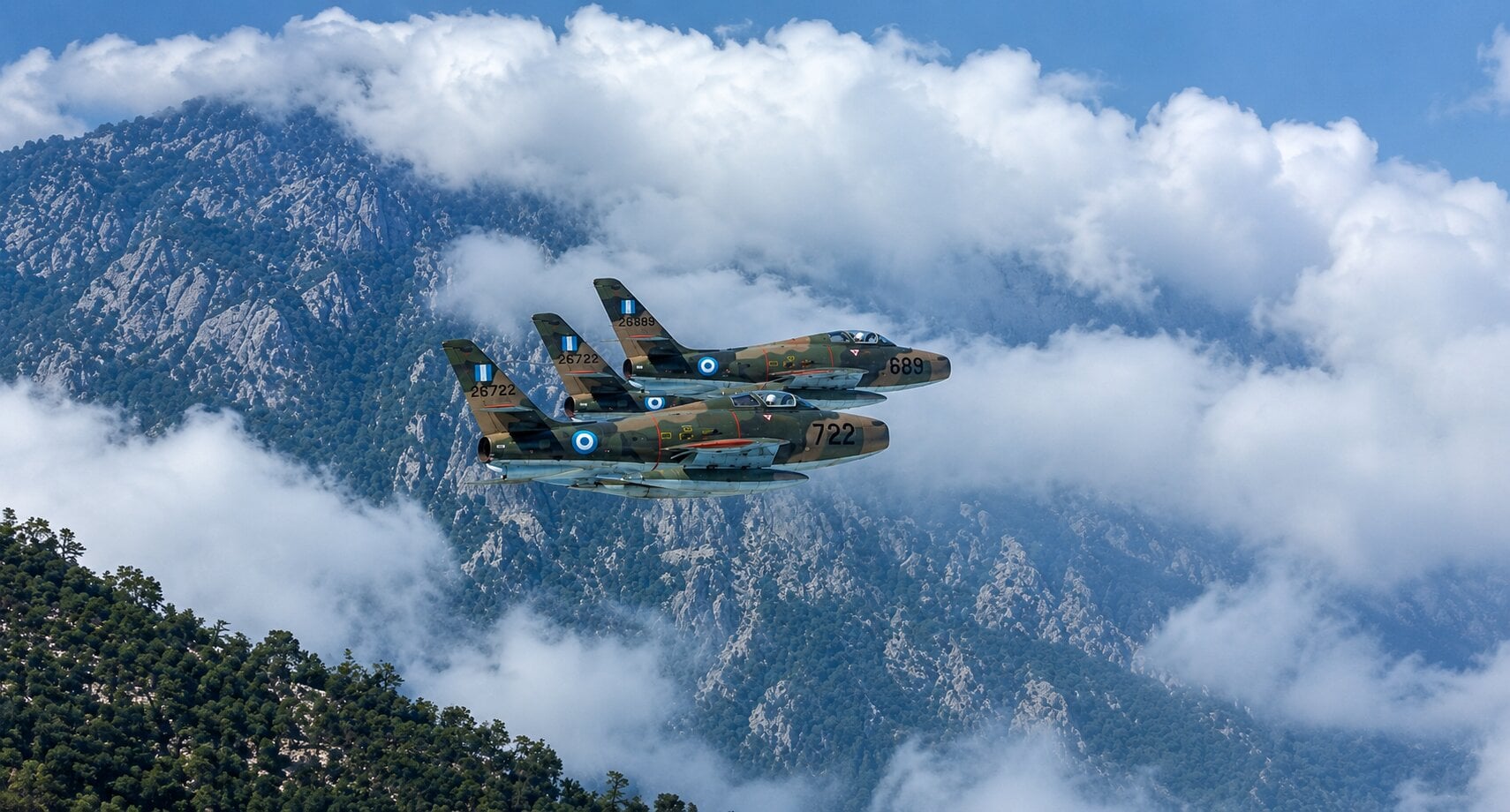
Republic F-84F Thunderstreak of the Hellenic Air Force (1957-1983), AI-generated image.
August 1964.
For a few days now, fierce fighting has been raging in Cyprus between Turkish forces and the National Guard. The reason for this was the Turkish Cypriot rebellion that had erupted since December 1963, following the refusal of the Turkish Cypriot community to accept the 13-point amendments to the Cypriot Constitution proposed by the President of the Republic of Cyprus, Archbishop Makarios III. Thus, riots broke out, leading, in 8-9 August 1964, to the dispatch of Greek warplanes to the island for the first time in modern history. A mission that remained secret for many decades. This story was a clear “prelude” of the “suicide missions” of the tragic summer of 1974.
The historical context
The state of the Republic of Cyprus was founded as a single bi-communal state on 16 August 1960, gaining its independence after almost a century of British rule (1878-1960). There were two legally equal communities on the island, the Greek Cypriots and the Turkish Cypriots. In 1960, the Greek Cypriots constituted approximately 78.2% – 81.14% (depending on whether the statistics include the Maronites, Armenians and Latins, who were included in the Greek Cypriot community by virtue of the Constitution). The Turkish Cypriots constituted approximately 18.1% – 18.86%. Also, a percentage of 1% to 3% consisted of citizens of third countries.
It is noted that neither community was fully satisfied with autonomy, as the Greek Cypriots considered it their right to unite Cyprus with Greece (union), while the Turkish Cypriots fought for partition (“taksim”). After two relatively peaceful years, in November 1963 tensions increased when the President of the Republic of Cyprus, Archbishop Makarios III, proposed 13 constitutional changes that were met with anger by the Turkish Cypriots.
Intercommunal Riots of 1963-64
On 30 November 1963, President Makarios sent to the Vice President of the Republic of Cyprus, the Turkish Cypriot Fazil Küçük, a memorandum containing 13 points for the revision of the constitutional regime. A common component of the 13 points was the abolition of the separate majority (Greek Cypriot and Turkish Cypriot) for the passage of laws, as well as the establishment of single municipal councils in the municipalities. Furthermore, the first of the 13 points aimed at the abolition of the right of veto of both the President and the Vice President of the Republic.
Makarios’ proposals had been preceded by consultations between him and the British High Commissioner to Cyprus, Sir Arthur Clarke, who had encouraged Makarios to proceed with the amendments.
At the same time, the Turkish Cypriots also maintained contacts with the British. In fact, on 1 December 1963, the Deputy Speaker of the Cypriot House of Representatives and President of the Turkish Cypriot Parliament, Rauf Denktaş, arrived in London for talks with the Secretary of State for Commonwealth Affairs, Sir John Tilney.
It should be noted that Makarios’ proposals were formulated at a time when there was governmental instability in both Greece and Turkey, the two countries which together with Great Britain were the guarantor powers of the Republic of Cyprus, according to its constitution. Although Makarios’ goal was to form a unified authority in Cyprus, the crisis that followed was the beginning of the de facto separation of the two communities. On 29 December 1963 the partition of Nicosia was imposed with the famous “green line”, as it was called a little later.
Küçük responded negatively to Makarios’ proposals, stating on 3 December 1963 that the then-current constitution should be applied in its entirety. On December 10, the Cypriot Foreign Minister Spyros Kyprianou met in Athens with the Greek Prime Minister Georgios Papandreou and informed him of the situation on the island. On December 16, the Turkish ambassador to Nicosia, Emin Dirvana, delivered Ankara’s rejection of Makarios’ proposals, which the Cypriot president had simply “notified” to the guarantor powers. Makarios, in turn, rejected the Turkish response as interference in the internal affairs of the Republic of Cyprus. Three days later, the Foreign Ministers of Greece, Sophocles Venizelos, Cyprus’ Spyros Kyprianou and Turkey’s Kemal Erkin met at the Greek embassy in Paris. Despite Venizelos’ optimism, the meeting did not reduce the tension that had meanwhile been building in Cyprus.
It is worth mentioning here that the US President John F. Kennedy had prevented Makarios from proceeding with the revision of the constitution as early as of 1962, presenting the argument of not disturbing the stability of the island. Athens had also maintained a similar position under prime minster Konstantinos Karamanlis and later. Despite this, Makarios decided to proceed with the proposal for the constitutional amendments, which caused a rift with the Turkish Cypriot community and gave the Turks the pretext they were looking for to provoke the so-called “Turkish riot” of Christmas 1963.
21 December 1963: The Outbreak of the Crisis
The incident that triggered the events of the “Bloody Christmas” occurred in the early hours of December 21, 1963. On the evening of that day, the Greek Cypriot police operating in the old Venetian Walls of Nicosia were conducting routine checks. At one of these checks, the officers asked for the identity documents of a group of Turkish Cypriots returning home by car after a night out. As soon as the officers tried to examine the women in the car, the driver resisted and a fight ensued. Soon, a crowd gathered in the vicinity and shots were heard. By dawn, two Turkish Cypriots had been killed and eight others, both Greek Cypriots and Turkish Cypriots, had been injured.
Following the shootings, crowds of Turkish Cypriots gathered in the northern part of Nicosia, led by the Turkish Resistance Organization (TMT). In the morning of December 22, the funerals of the two Turkish Cypriots who were killed took place without incident. However, shots were fired in the afternoon of December 22. Cars full of armed Greek Cypriots roamed the streets of Nicosia, shooting indiscriminately, while Turkish Cypriots opened fire on police cars. At the same time, Turkish Cypriot snipers opened fire from minarets and from the roof of the Saray Hotel in Sarayönü Square. The shootings spread to the suburbs of Nicosia, as well as Larnaca. The Greek Cypriot administration cut-off the telephone and telegraph lines in the Turkish Cypriot neighborhoods in Nicosia and the police took control of Nicosia International Airport. Greek paramilitary groups led by Nikos Samson and Vassos Lyssarides were activated, too.
On December 23, a ceasefire was agreed between President Makarios and the Turkish Cypriot leadership. However, fighting continued and intensified in Nicosia and Larnaca. In Turkish-populated areas, mosques were converted into machine gun positions for Turkish Cypriot paramilitary groups. Later that day, Greek Cypriot paramilitaries led by Nikos Samson launched the Battle of Omorfitas: They attacked the suburb, which they occupied, with the Turkish Cypriot residents of the neighborhood later being expelled from their homes.
Ultimately, this first phase of intercommunal unrest was defused on 28 December 1963 with the intervention of the three guarantor powers, Greece, Turkey and the United Kingdom. A permanent consequence of the conflict was the creation of the Green Line in the Nicosia area and the deployment of UN peacekeepers in Cyprus from then to the present day.
August 1964: Tensions escalate again
After the intercommunal conflicts of 1963-64, which were mentioned above, the situation in Cyprus was extremely tense. The tensions and suspicion between the two communities were evident.
The official Turkish Cypriot authorities, led by Fazil Küçük as vice-president of the Republic of Cyprus and Rauf Denktaş as president of the local Turkish Cypriot parliament, acted openly as instruments of Turkish foreign policy, having equipped people of every social class (students, workers, etc.) and having secured control of specific enclaves. At the same time, they expelled Greek Cypriots from areas that they themselves considered to be purely Turkish Cypriot.
Everything indicated that Küçük and Denktaş were acting with the aim of creating bridgeheads for a possible Turkish intervention and occupation of parts of Cyprus.
President Johnson’s letter to PM İsmet İnönü and the Johnson-Papandreou meeting
On June 5, 1964, US President Lyndon Johnson sent a letter to Turkish Prime Minister İsmet İnönü, which he forwarded to Greek Prime Minister George Papandreou. In it, the US President strongly emphasized the United States’ strong opposition to a possible Turkish military intervention in Cyprus, as this could provoke a generalized Greek-Turkish war, endangering NATO’s southeastern flank. Johnson went further without mincing his words: He directly noted that a Turkish landing on the island would be perceived by the US as an anti-NATO action and would have practical negative consequences for US-Turkish relations in terms of armaments, while at the same time, on a diplomatic level, it would mean the isolation of Turkey without America wishing to intervene to provide it with any form of cover for a possible new regime that would be created on the island.
It is believed that this letter played a decisive role in the de-escalation on the part of Turkey. However, it would be wrong to assume that the complete deterrence of the Turkish plans was achieved thanks only to the determination of the US president. On the contrary, at Johnson’s meeting with Papandreou at the end of June 1964 at the White House, the American president noted to the Greek prime minister that his action might have harmed the Greek side at the given moment, but that could change in the future and that is why Greece should behave “carefully”.
Given the Turkish attacks on Cyprus, which continued and intensified with air strikes, all sources testify that Johnson knew about the dispatch of a Greek division to Cyprus and did not wish to deal with the issue further, to the extent that the Greek military presence would not cause more problems.
The Turkish Air Attacks (August 8–9, 1964)
In August 1964, Turkish Cypriot forces in the Tillyria enclave (Kokkina/Erenköy) clashed fiercely with the National Guard of Cyprus, as well as with irregular Greek forces. At that time, Ankara found the opportunity it was looking for to consider that the Turkish Cypriots were threatened and decided on immediate military intervention.
On August 8 and 9, 1964, the Turkish Air Force launched extensive air raids in the Tillyria area, even using napalm bombs. The attacks caused heavy casualties and great destruction, shocking public opinion in Greece and internationally. Cyprus was essentially being bombed by air without having any significant anti-aircraft defense.
The Greek reaction and the F-84F fighter-bombers
In this climate, the government of Georgios Papandreou convened an emergency “small” cabinet meeting in Athens with the participation of the Minister of National Defense Petros Garoufalias and the Minister of Foreign Affairs, Stavros Kostopoulos. The main dilemma was crystal clear: Greece would either limit itself to diplomatic overtures or, as a guarantor power of Cyprus national integrity, would demonstrate practical military support to Cyprus, taking the risk of a generalized Greek-Turkish war.
Finally, after a desperate request by President Makarios and the Minister of Interior Polykarpos Georgatzis for air support from Greece, the Greek government decided to send some F-84F Thunderstreak swept-wing turbojet-powered fighter-bombers from Crete (Souda base) to Cyprus.
According to many sources, the Greek aircrafts carried limited or no national insignia, in order to maintain a margin of “controlled engagement”.
History has proven that the decision to send the F-84F was ultimately a risky but measured and very well-planned escalation, which showed determination without reaching the point of an official declaration of war.
On the afternoon of August 9, 1964, four Greek F-84F warplanes took off from the 338th Fighter-Bomber Squadron in Souda base (Crete), heading for Cyprus. Their goal was to fly over Nicosia and Mansoura with the objective of “showing the flag” and preventing the further spread of the Turkish bombing and offensive effort.
That first mission consisted of the following airmen:
No. 1 Captain Theodoros Louloudakis
No. 2 Lieutenant Dimitrios Tremoulis
No. 3 Lieutenant Konstantinos Theodoropoulos
No. 4 Lieutenant Dimitrios Klitorakis
Having been left with only a limited amount of fuel, the four airmen arrived over Cyprus with no problems. Facing the shores of the island they all observed the area of Morphou burning horribly by the Turkish bombardments. Then, the Greek planes were divided into two pairs. One headed towards Nicosia and the other towards Mansoura. Although they had been noticed by the British radars of Akrotiri Royal Air Force Base, this was not enough to threaten them as they had maintained radio silence and indicated no national insignia. So their identity was not clear. This fact caused one of the aircrafts to receive sporadic friendly fire from the National Guard of Cyprus, fortunately without effect.
Just a few minutes later the announcer of the Cyprus Radio Corporation (CRC/RIK) could barely broadcast and his words were mixed with his tears: “At this moment Greek warplanes are flying at a very low altitude over Nicosia and Mansoura. Mother Greece has not forgotten us. They are here!” As Lt General Georgios Mitsenas notes in his monumental book-document “Greek Wings in Cyprus” (Athens, 2004), the two pairs of aircraft flew at a low altitude at full power, causing the roofs of houses to shake and their windows to creak. All the Greek Cypriots came out of their homes to greet the planes, screaming with joy and national pride. The image of young and old waving their hands and various objects to greet them would remain forever etched in the memories of the four Greek pilots. This mission boosted the morale of the Greek Cypriots and from a military point of view functioned as the first action of “hard deterrence” of the Turkish plans that Greece put forward over Cyprus.
Moreover, it was followed by two other operations, an example of the very good staff organization that existed at that particular time, despite the technical difficulties which frequently occurred.
The first of these operations was the dispatch of Greek Harvard T-6G aircrafts, also on the afternoon of August 9, 1964.
Their crews consisted of the following airmen:
No. 1 Captain Vasilios Kottas and Lieutenant Panagiotis Lymberopoulos,
No. 2 Captain Kyriakos Avgerinidis and Chief Petty Officer Paschalis Vrontidis
No. 3 Lieutenant Georgios Kakaris
No. 4 Captain Georgios Roussos
No. 5 Lieutenant Gerasimos Katsigiannis and Chief Petty Officer Kapsomenakis
The objective of the Harvard was to cooperate with Dornier aircrafts which were stationed at Athalassa airport of Cyprus.The Dornier planes were part of the Greek Cyprus Air Detachment, which the Papandreou government had sent along with the division. The goal of the Dornier was to drop target designating flares to indicate the locations where the Turkish landing force was to operate. While everything was ready for the operation, this was aborted. On August 10, 1964, the President of the United Nations Security Council, Sievert Nielsen, had sent letters to İnönü and Makarios requesting that Turkey immediately cease the bombing and use of force and that the Republic of Cyprus order its armed forces to cease fire. Thus, by order of the Greek government, the Harvard took the return route to Greece.
Before the Greek Harvard reached Rhodes, where they were to land, Turkish RF-84F aircraft attempted to intervene to harass them.According to G. Mitsenas, the Turks had been informed by the British about the Harvards’ return from Cyprus. However, the harassment was not possible because the Harvards flew at a very low altitude, undetected by the Turkish aircraft.At the same time, Greek F-86D fighters took off from Kastelli, Crete, to intercept the Turkish fighters over Rhodes. Turkish radars detected the imminent presence of the Greek fighters, informed the Turkish aircraft and the latter returned to Turkey without any interference.
The third and final Greek air mission to Cyprus during 1964 was the dispatch of photographic aircrafts to Cyprus a few days after the ceasefire of August 10th. The aircrafts were RF-84F Thunderflash and belonged to the 348th Tactical Reconnaissance Squadron (T.R.A.), which was based in Souda Base, Crete.
The pilots who manned the aircrafts of this particular mission were the below mentioned:
No. 1 Lieutenant Efthimios Roulias
No. 2 Lieutenant Theofanis Dimopoulos
No. 3 Lieutenant Nikolaos Papadopoulos
No. 4 Lieutenant Stavros Dranias
No. 5 Lieutenant Ioannis Printzios
No. 6 Lieutenant Sergios Papasis
The six Greek pilots took off from Souda Base and arrived in Cyprus with the aim of photographing points in the areas of Kyrenia, Morphou and Agios Hilarion. Out of the above pilots, Roulias, Dimopoulos and Papasis were repeatedly harassed by British Lightning aircraft. The British pilots flew close to the Greek, beckoning them to leave Cyprus. The Greeks, unconcerned, continued their mission and took the photographs, as they had been ordered. Taking the return route to Souda, they did not encounter any other problem, apart the limited fuel. They landed normally in Crete, having succeeded in their mission.
The above missions of the Greek Air Force proved the obvious, which ten years later became a tragic issue: At the time when Greece had a responsible leadership, with courage and a concrete plan, it was in a position to organize a complete military operation and to support Cyprus in practice, safeguarding its national dexterity for another decade. Despite the objective difficulties, the threatening enemy, the interests of international actors, internal political disputes and of course the often very intense differences between Athens and Nicosia, the operations of 1964 were carried out successfully. Therefore, this should have been a great signpost for the future.
Instead, in 1974, the Greek and Greek Cypriot national abjectness seemed criminally insurmountable and the dying wound of Cyprus opened deeply to remind us of it to this day, with the 37% of land of Cyprus being illegally occupied by the Turkish military forces which invaded the island on July and August 1974.
Source note: Data were used from the book by the Vice Marshal Georgios D. Mitsenas “Greek Wings in Cyprus: Operations 1964-1974 as experienced and narrated by the protagonists”, Athens 2004.
Author’s note:
This text is dedicated to the sacred memory of my grandfather, Brigadier General Dimitrios I. Tremoulis and to all of his colleagues, who were the first Greek aviators who flew over tormented Cyprus to support its struggle for freedom and national self-determination. The struggle of free people to live upright and not walk hunched over.
Related Posts