Examining Extremism, Identity, and Influence
August 5: Two Kashmirs, Two Futures
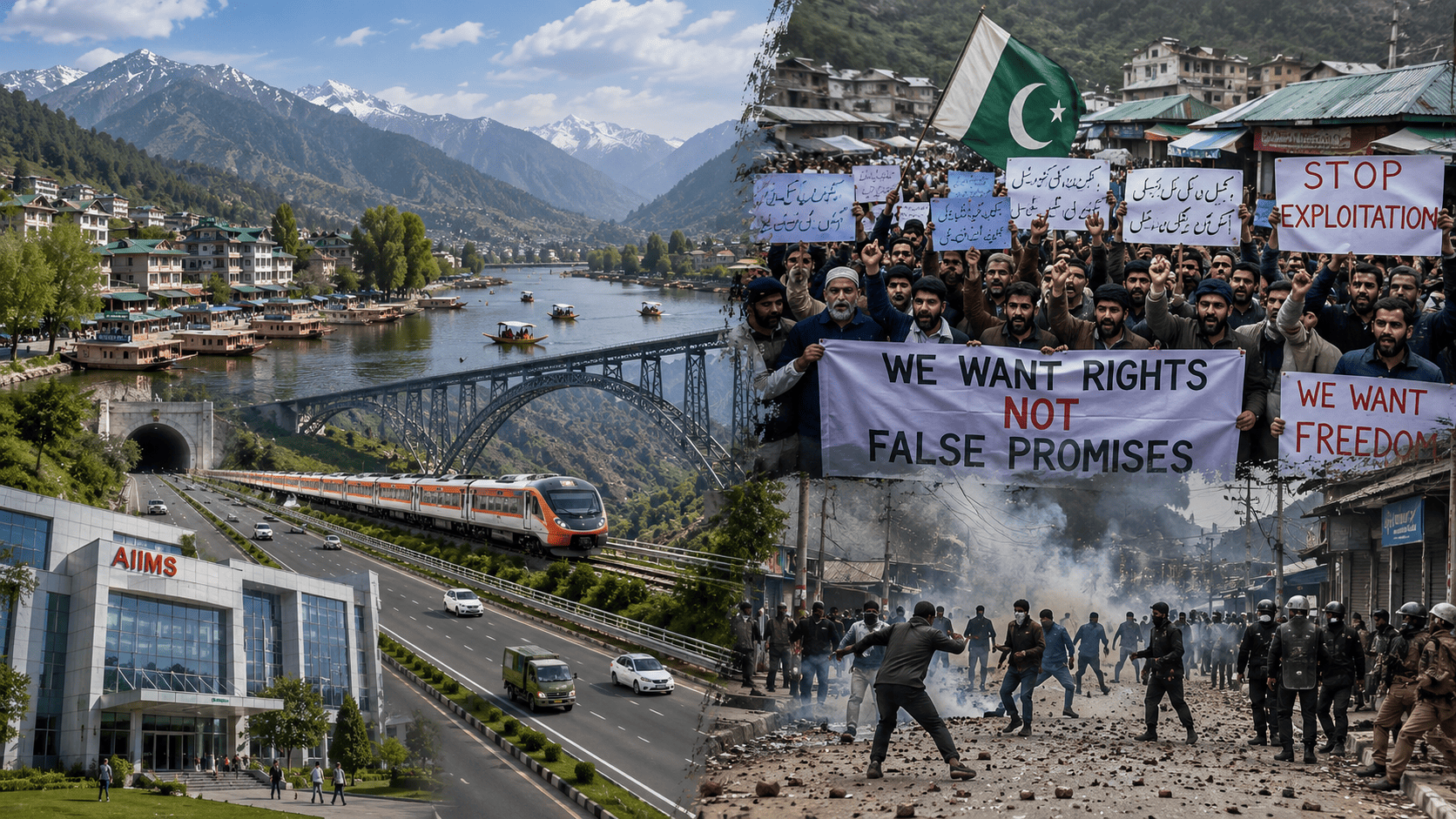
Photo Illustration: Author
One has prioritized integration, public investment and long-term development. The other continues to struggle with structural economic and political constraints.
Every year on August 5, India and Pakistan tell very different stories about Jammu and Kashmir. In India, the day marks the anniversary of the 2019 decision to revoke Article 370 and Article 35A, bringing the former state into closer constitutional integration with the rest of the country.
Across the border, Pakistan observes “Youm-e-Istehsal” or the “Day of Exploitation,” presenting the India’s legal right as evidence of oppression and injustice.
These competing narratives have dominated political discourse for years. But beyond speeches and diplomatic exchanges lies a simpler question: what has actually changed on the ground? More than five years after the constitutional changes, the comparison between Jammu & Kashmir and Pakistan-occupied Jammu & Kashmir (PoJK) reveals two very different paths.
One has focused on integration, infrastructure and public investment, while the other continues to grapple with political uncertainty, economic challenges and limited institutional autonomy.
Democracy and Local Governance
When Article 370 was revoked by Indian Government, many critics argued that democratic representation in Jammu and Kashmir would suffer. Instead, the years that followed saw local democratic institutions become more active.
The District Development Council elections in 2020 brought elected representatives into local administration across the region. Panchayats and Urban Local Bodies have also taken on a larger role, allowing local communities to participate more directly in governance.
At the same time, central government schemes now reach villages with fewer administrative hurdles, while several national laws have extended legal protections for women, Scheduled Castes, Scheduled Tribes, Other Backward Classes and economically weaker sections.
The picture across the Line of Control is quite different. Pakistan-occupied Jammu & Kashmir continues to function under constitutional arrangements in which key powers remain concentrated in Islamabad.
Gilgit-Baltistan, despite repeated assurances over the years, still lacks full constitutional provincial status. Many political observers have questioned how much authority local elected institutions actually exercise when major decisions continue to rest with Pakistan’s federal establishment.
The mass protests that swept Pakistan-occupied Jammu & Kashmir in 2024 were not simply about rising electricity bills or inflation. They were the culmination of years of public frustration over poor governance, a struggling economy and the rising cost of everyday life. Although the protests eventually subsided, the underlying problems never really went away.
Economic hardship, inadequate public services and growing dissatisfaction with governance continue to cast a shadow over the region in 2025 and 2026 as well.
Clashes between protesters and security forces, along with reports of arrests and casualties, underscored the tensions between citizens demanding accountability and Pakistan authorities trying to contain dissent.
Development That Can Be Seen
Perhaps the biggest change in Jammu and Kashmir has been in physical infrastructure.
Roads, tunnels and highways have transformed connectivity across difficult terrain. Projects such as the Chenani-Nashri Tunnel, the under-construction Zojila Tunnel and the Chenab Rail Bridge have significantly improved transport links.
The Udhampur-Srinagar-Baramulla Rail Link is set to connect the Kashmir Valley with India’s national railway network, ending decades of geographical isolation.
Air connectivity has also improved. Srinagar Airport has recorded unprecedented passenger traffic, while Jammu Airport has expanded its services to accommodate growing demand. These developments stand in sharp contrast to PoJK, where railway connectivity is virtually absent and aviation infrastructure remains limited.
Healthcare has also expanded considerably. AIIMS Jammu has become operational, while another AIIMS campus is coming up in Awantipora alongside several new Government Medical Colleges.
Residents of Jammu and Kashmir are now covered under the Ayushman Bharat-Pradhan Mantri Jan Arogya Yojana, giving them access to government-funded health insurance that reduces the burden of expensive medical treatment.
Education has followed a similar trajectory. Institutions such as IIT Jammu and IIM Jammu, along with new engineering colleges, nursing institutes and skill development centres, have widened educational opportunities and strengthened workforce development.
PoJK, meanwhile, continues to face persistent challenges. Investment in higher education, healthcare and industrial growth remains limited. The local economy depends heavily on federal transfers, remittances and government employment, leaving relatively few opportunities for private-sector expansion. These structural weaknesses continue to fuel unemployment, particularly among young people.
Growth Beyond Security
Tourism has emerged as one of the clearest indicators of the region’s changing trajectory. According to data presented in the Jammu & Kashmir Legislative Assembly, the Union Territory received more than 1.77 crore tourist visits in 2025, including over 36,000 foreign visitors, despite the disruption caused by the April Pahalgam terror attack. Visitors are no longer limited to traditional destinations such as Srinagar, Gulmarg and Pahalgam. Adventure tourism, winter sports, religious pilgrimages and rural tourism have all contributed to the sector’s rapid expansion.
Private investment has also picked up. Companies have announced investment proposals across tourism, renewable energy, manufacturing, logistics and education. Although many projects are still under implementation, the scale of investor interest reflects growing confidence in the region’s long-term prospects.
Technology has become another driver of change. Expanding 5G connectivity, digital governance, Direct Benefit Transfer (DBT) programmes and Aadhaar-linked welfare systems have improved access to government services while reducing leakages in public spending. From land records to healthcare registrations, more services are now available through digital platforms.
Across PoJK, the situation remains far less encouraging. Economic activity continues to rely heavily on government employment and remittances. Electricity shortages, infrastructure gaps and recurring fiscal pressures remain common concerns. Restrictions on media and periodic communication controls have also attracted criticism from international press freedom organisations, with the latest of banning of Qatari Al-Jazeera by the Pakistan establishment, despite receiving tons of donations from the “Islamic Brotherly nation of Qatar”.
Perhaps the biggest difference lies in the opportunities available to young people. In Jammu and Kashmir, entrepreneurs increasingly participate in India’s startup ecosystem and digital economy. In PoJK, many young people continue to leave in search of better education and employment elsewhere.
Looking Beyond Political Narratives
None of this means that Jammu and Kashmir no longer faces challenges. No region transforms overnight, and constructive debate over governance will always remain important.
At the same time, any honest assessment must separate political arguments from measurable outcomes. The constitutional changes of August 2019 can be viewed differently depending on one’s political perspective. What is much harder to ignore is the visible expansion of infrastructure, welfare programmes, healthcare, education, digital connectivity and economic integration that has taken place since then.
Pakistan’s annual observance of “Youm-e-Istehsal” continues to frame Kashmir primarily through the language of grievance. Yet the conditions inside Pakistan-occupied Kashmir raise difficult questions of their own. Economic hardship, repeated protests, limited political autonomy and governance challenges have increasingly become impossible to overlook.
Ultimately, August 5 is no longer just a symbolic date. It reflects two different approaches to governing two parts of the same historic region. One has prioritized integration, public investment and long-term development. The other continues to struggle with structural economic and political constraints.
In the end, history is unlikely to judge either side by official statements or annual commemorations. It will judge them by something much simpler: whether ordinary people enjoy better opportunities, better services and a better quality of life. On that measure, the growing contrast between Jammu & Kashmir and Pakistan-occupied Jammu & Kashmir is becoming increasingly difficult to ignore.
Related Topics
Related Posts