
Australian judicial inquiry final report finds police failures but no justice
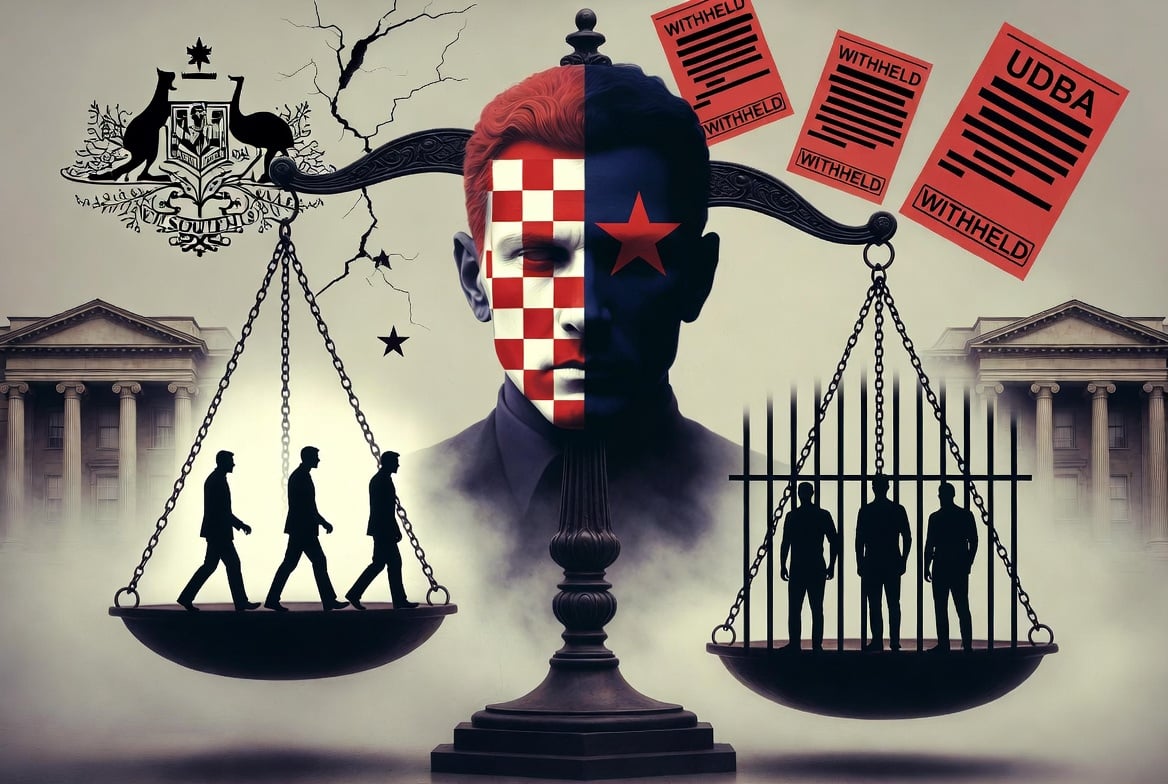
The reality of the recently released New South Wales (NSW) Croatian Six inquiry report is unmistakable: Australia’s justice system fundamentally failed six men and their community.
Ironically, it may have also failed itself.
At the same time, the presiding judge, Justice Robert Hulme’s 850-page, two-volume final report, reached an interesting compromise.
One of the report’s most controversial conclusions found that NSW Police and/or the DPP withheld vital intelligence that should have been shared with the defence and acknowledged that this information questions the credibility of the prosecution’s star witness.
It identified a range of shortcomings in the initial investigation. However, the report specifically concluded that only three of the six convictions should be referred to the NSW Court of Criminal Appeal.
These conclusions, based on withheld evidence and flawed investigations, directly undermine the logic of referring only three convictions for review, exposing a central inconsistency in the inquiry’s approach.
Witness credibility cannot be selectively applied.
This fundamental contradiction is why the inquiry fails to deliver real justice, instead reinforcing the persistent problem of institutional self-preservation overriding accountability.
For years, the NSW Police’s ‘political intelligence unit,’ known as Special Branch, held intelligence on Vico Virkez, the prosecution’s central witness, suggesting he had links to the notorious Yugoslav secret police (UDBA) and complex connections with Croatian nationalist groups that neither the jury nor defence ever knew.
Not least of which was that Virkez, whose real name was Vitomir Misimovic, was not even a Croat but an ethnic Serb from Bosnia who was cosplaying as a Croatian ‘nationalist’.
Just over a decade later, he would, on the ABC’s Four Corners, confess his initial testimony was fabricated and that he was ‘coerced’ by NSW Police, including disgraced former detective Roger Rogerson.
Rogerson himself was ultimately convicted of murder and died in prison in 2024.
This was not peripheral information.
It went directly to the credibility, motives, and possible loyalties of the prosecution’s most important witness.
No criminal justice system can function effectively if such vital information is withheld.
As any lawyer will freely admit, disclosure is not a courtesy for defence lawyers. It is crucial for protection against wrongful convictions.
When the state has evidence that undermines its case, the accused must obtain it to receive a fair trial.
That never happened with the Croatian Six.
The consequence is that every aspect of the prosecution’s case comes under scrutiny.
Instead of fully addressing these findings, the report offers a compromise—acknowledging injustice without fully assessing its extent.
Indeed, Justice Hulme accepted precisely that proposition – up to a point.
His report concluded that the undisclosed intelligence created reasonable doubt regarding three of the convicted men.
But why only three?
This is where the report’s ‘half pregnant’ reasoning appears to face internal challenges.
From the moment that Maksimilian Bebic, Vjekoslav Brajkovic, Anton Zvirotic, Ilija Kokotovic, Joseph Kokotovic, and Mile Nekic were arrested on February 8, 1979, on charges relating to plotting acts of terrorism, the prosecution alleged this was a single conspiracy that involved all six men.
It is also a prosecution fact that Virkez did not testify against only half the accused.
He was the prosecution’s central witness throughout the entire case for all six men.
Therefore, if Virkez’s undisclosed moonlighting as a foreign intelligence operative undermined the credibility of the case, it did so for all six men.
Witness credibility cannot be selectively applied.
A witness is either materially compromised or he/she is not.
The inquiry never satisfactorily explains how a witness whose credibility is fatally undermined from the start in relation to three defendants, at the same time, somehow remains sufficiently reliable to sustain convictions against the remaining three.
Or was it really the Croatian Three and not Six from the very beginning?
That distinction may satisfy the technical language of the report, but it is far harder to reconcile with common sense or with ordinary principles of criminal justice.
The wider implications of this outcome could possibly be troubling, to say the least.
This case developed during the Cold War. Australian intelligence viewed Croatian nationalism as a security issue and worked closely with Belgrade. Too closely, as it turned out.
Yugoslavia, a communist country with an appalling human rights record, curried favour with both East and West, monitored émigrés with the UDBA, and even carried out assassinations against emigres it deemed as threats, while Western governments, including Australia, valued their ‘security cooperation’ with the Yugoslav regime over transparency.
This historical background explains the environment in which these decisions were made.
But it does not excuse, diminish, nor ameliorate them.
If anything, the Croatian Six case demonstrates why intelligence agencies should never become gatekeepers of justice.
The NSW Police Special Branch existed to collect information, not to determine what evidence juries should hear.
Once police officials begin deciding which facts courts are permitted to know, the equilibrium between state security and the rule of law shifts dangerously in favour of secrecy.
From what has come out, not just in this inquiry but also in past investigations of this case, including by veteran Australian journalist Hamish McDonald in his book Reasonable Doubt, it appears that this is exactly what occurred.
The report further indicates that essential facts were not disclosed, even though six men were convicted of serious offences.
This is a concern for all Australians, regardless of their political, religious, or ethnic persuasion.
The rule of law depends upon the proposition that no government agency, not even an intelligence agency, is able to stand above the requirements of a fair trial.
Yet the inquiry also reveals another disturbing truth: Institutions rarely admit their own catastrophic failures voluntarily.
Indeed, the report invites criticism because its conclusions appear narrower than its own factual findings.
For almost half a century, successive governments defended these convictions. Police investigations were upheld. Prosecutorial decisions were defended. Intelligence secrecy remained intact.
To acknowledge today that all six convictions were fundamentally unsound would carry consequences extending far outside the courtroom.
It could raise several challenging questions about ASIO, the Commonwealth, the NSW Police, prosecutorial decision-making, and ministerial oversight.
For example, who knew about Vico Virkez?
Who decided the intelligence about him should remain secret?
Why was it never disclosed?
Would disclosure have altered the verdict?
Should the NSW government apologise?
Should some form of compensation now follow?
What about Virkez’s 1991 on-air Four Corners admission that he lied on the stand and that all six men were not guilty?
These are not simply legal questions, but political ones.
That is but one of the multitude of possibilities that hang over this report like the Sword of Damocles.
To be clear, there is no evidence or suggestion that Justice Hulme deliberately tailored his conclusions to achieve a politically convenient outcome.
Mostly, it demonstrates that the NSW justice system failed to meet standards Australians now rightly expect.
His Honour followed the law as he saw it.
Judges decide cases according to the evidence before them and within the statutory frameworks provided by Australia’s various state Parliaments.
But judicial independence does not shield judicial reasoning from public scrutiny, especially in a trial that, to this day, remains one of the longest in Australian legal history, occupying 172 sitting days and featuring 111 witnesses.
Indeed, the report invites criticism because its conclusions appear narrower than its own factual findings.
Once the inquiry accepted that the authorities withheld evidence against the main witness, trust in the prosecution should have all but dissipated.
The report’s decision to maintain three convictions while questioning the other three is not grounded in a definite legal principle. Instead, it signals an institutional desire to avoid upheaval and protect its own legitimacy rather than to confront full accountability.
While this form of institutional self-preservation is hardly new, the fact remains that public faith depends upon rational coherence.
The law demands and requires proof beyond a reasonable doubt.
If reasonable doubt emerges because the state’s primary witness was affected by intelligence not disclosed to the defence, it is difficult to understand why that doubt should apply only to part of the case.
Justice cannot be meted out by fractions.
Nor can it be apportioned out in politically palatable bite-sized bits.
The Croatian Six inquiry report confirms that a range of intelligence failures occurred. It exposes the NSW DPP and police’s role in withholding material of obvious forensic significance.
Mostly, it demonstrates that the NSW justice system failed to meet standards Australians now rightly expect.
Those are important achievements.
But they are incomplete.
Some would say woefully so.
Instead of fully addressing these findings, the report offers a compromise—acknowledging injustice without fully assessing its extent.
That may help reduce institutional embarrassment.
It does little to strengthen confidence in the administration of justice.
No criminal justice system can function effectively if such vital information is withheld.
History has a habit of revisiting cases where the official findings look inconsistent with the facts.
The inquiry has highlighted failures that are now not only apparent but also seem systemic.
Its greater legacy, however, may be something considerably more profound.
It demonstrates that democratic institutions often find it much easier to admit some error than to confront the full implications of that error.
For 47 years, the Croatian Six have argued that the state has failed them.
The inquiry’s report confirms that, in significant respects, they were right.
The lingering question is whether Australia’s legal, security, and political institutions also have the courage to admit just how right they were.
Only time will tell.