
Avoiding Disaster in Lebanon
The first problem with solving problems in the Mideast is that every solution has been tried without success. The second problem is that failure doesn’t preclude repetition. A sad lesson of adulthood is that politicians care less about solving problems than showing concern. Doomed efforts still make good campaign ad copy.
In Lebanon, the military and diplomatic options have been exhausted. A security zone near Israel’s southern border? Tried that until the steady drip of casualties motivated a sudden IDF pullout in May 2000 – a move that betrayed Israel’s Christian Phalangist ally and brought Hezbollah to its doorstep. A Lebanese government commitment, enshrined in the UN resolution, to disarm Hezbollah and preclude the presence of armed personnel, assets, and weapons south of the Litani River? Tried it in 2006 and Hezbollah, like an infection, once again quickly spread south to the Israeli border. The Lebanese government, fearful of civil war and dominated by Hezbollah, has consistently played a game of “we pretend to disarm Hezbollah and you pretend to believe us.”
Empower the Lebanese Armed Forces? The United States has spent over $3 billion to strengthen the LAF since 2006 but, like the Lebanese government, it has consistently proven unwilling to confront Hezbollah fighters. International peacekeepers? Please, must we rehash the predictable, manifold failure of UNIFIL?
Today, the IDF has once again surged into south Lebanon. It has again pushed Hezbollah north and begun dismantling its vast surface and subterranean military infrastructure. Per tradition, the Lebanese government laments the country’s status as an Iranian satrapy and offers to continue pretending to disarm Hezbollah.
The new ingredient tossed into this stale political stew is the sudden desperate need of US President Donald Trump to please and appease Iran. Fresh from forfeiting a war it declined to win, the US is busily surrendering every financial and strategic point of leverage to its erstwhile enemy – an enemy that Trump now praises as rational and smart. In doing so, Trump purports to speak for Israel as well, since Prime Minister Benjamin Netanyahu “will do whatever I want him to do.”
Well before the Memorandum of Understanding between the US and Iran was finalized, Iran demanded that Israel stop bombing Hezbollah’s redoubt in the Beirut suburb of Dahieh. Trump immediately forced Israeli compliance with an embarrassing tantrum at Netanyahu. Happy with Trump’s performance (and posting an AI image of Trump on his knees before its supreme leader), Iran promptly upped the ante by demanding a full Israeli withdrawal from Lebanon so Hezbollah, soon to be flush with US-provided cash, can rearm and reload and continue its war. After all, this is the way things are done in Lebanon.
The easy Israeli response would be sure, we covet not one dunam of Lebanese territory, we’re happy to leave – as soon as Hezbollah disarms and supports Lebanon’s accession to the Abraham Accords. As if to anticipate this, Trump couched his demand for Israel’s retreat in the language of humanitarian concern – so many innocent lives lost to Israeli devastation! This from a man who celebrates targeting alleged civilian smuggling boats whose survivors are slaughtered as they wave for help.
The frustrating conundrum for Israel is that, even without Trump’s sudden support of an enemy with so much American and Israeli blood on its hands, it isn’t clear what could be achieved, in the longer term, with a free hand. Hezbollah can attack Israel from beyond the Litani River. It is already using difficult-to-neutralize fiber-guided drones to inflict casualties on the IDF. Hezbollah knows that after October 7, 2023, the Israeli public’s tolerance for casualties has increased. But that just means the price is higher. Israeli reverence for life is eternally outmatched by radical Islam’s glorification of death.
As long as Iran funds and arms Hezbollah, and as long as Hezbollah can recruit from a large, easily radicalized Shia population in Lebanon, the ability to achieve lasting strategic objectives is limited. Bombing Dahieh will not deter radical revolutionaries who view civilians as potential footsoldiers or else just in the way. Securing territory will only prompt pricetag attacks on IDF troops and, potentially, Israeli civilians by terrorists who welcome martyrdom.
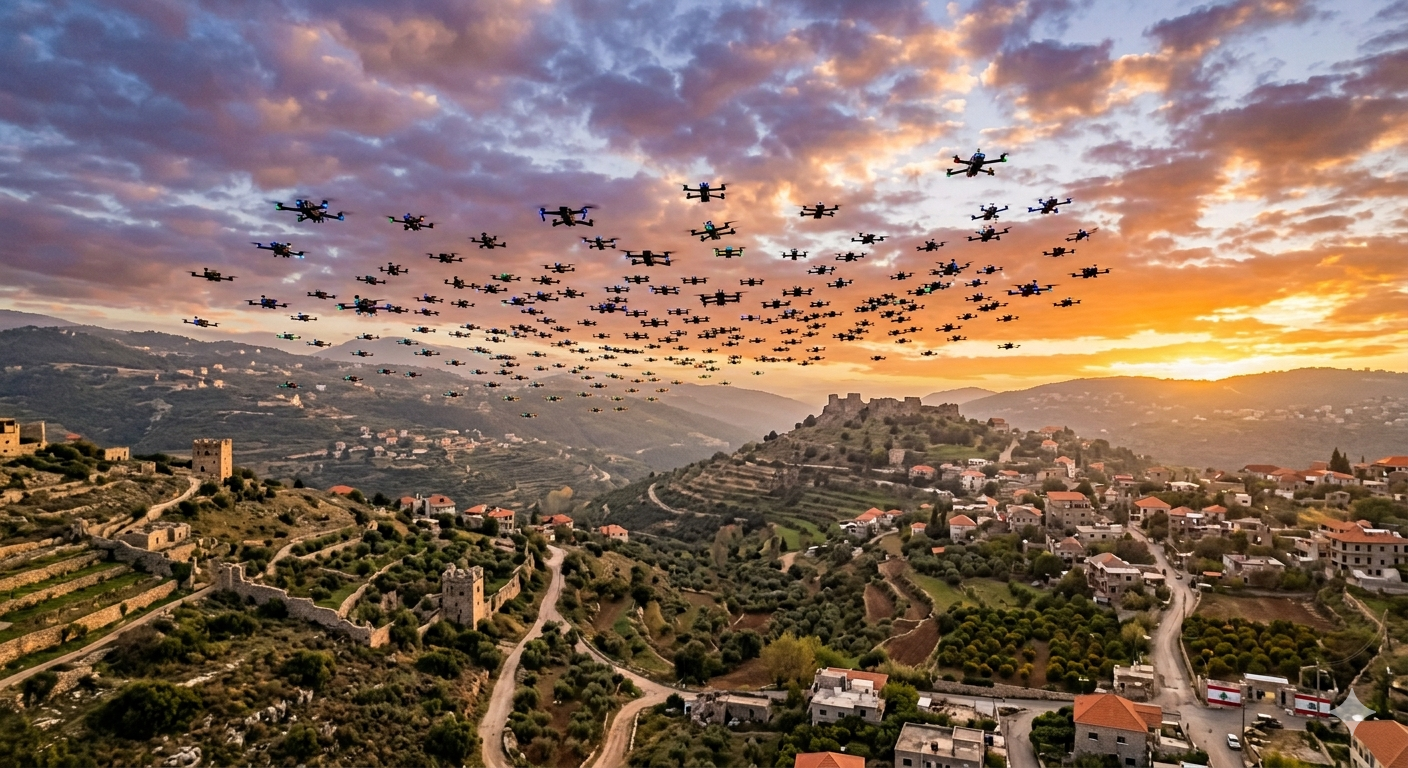
Structurally, the conflict is similar to what Ukraine faces, and that country’s increasing success in defending territory provides an example for Israel to consider. There, Russian conscripts rush Ukrainian positions in doomed waves or in small groups. Their motivation is not martyrdom but superiors who will kill them if they hesitate. Either way, they are efficiently eliminated by thick swarms of countermeasure-resistant drones that observe every inch of a hot conflict area and can attack instantly and autonomously. Ukraine is on track to produce over 7 million drones this year.
Israel would not need 7 million drones to continuously patrol and enforce a cordon sanitaire in southern Lebanon, nor would it need to withdraw all troops in order to limit casualties. Indeed, it will need troops in place because a true cordon sanitaire is impossible – there are non-hostile Christian villages whose inhabitants did not ask for this fight. Ukraine has had success in defeating fiber-guided drones with predator drones that detect and target them. Protected by a drone canopy, IDF personnel could interact more extensively with local populations and allow them as much of a normal life as possible in a kill zone. Beyond providing cover for IDF operations, drones could detect and attack Hezbollah fighters who daily attempt to infiltrate the south, as well as monitor north-south traffic and enhance the safety of otherwise-vulnerable checkpoints.
It is true that even firm and sustainable control of southern Lebanon will not defeat Hezbollah, which can attack from beyond the Litani. But it will prevent strikes against Israel’s north with difficult-to-neutralize weapons such as antitank missiles. Longer-range munitions can better be intercepted and their sources quickly neutralized by air. With Israel’s north largely secured, attacks on Hezbollah leadership secreted within civilian populations can be patient and pinpoint, since the objective is not deterrence but degradation.
All of this may seem more than a little theoretical when Israel’s most important ally has suddenly morphed into an existential threat, and Israel’s ability just to defend itself is now questioned by its friends. But Israel can’t surrender its north and eventually put the entire country in the crosshairs of Iran’s local auxiliary. It will have to resist Trump even as it faces growing hostility from the JD Vance-Tucker Carlson wing of the Republican Party and an implacable foe in “progressives” ascendant among Democrats. A premature withdrawal from Lebanon would simply repeat the pattern of 2000 and 2006, and with potentially far greater long-term consequences.