Strategic Intelligence Consultant & Insights Advisor
Axel Springer’s Mathias Döpfner in Geneva: “We all shall be Zionists”
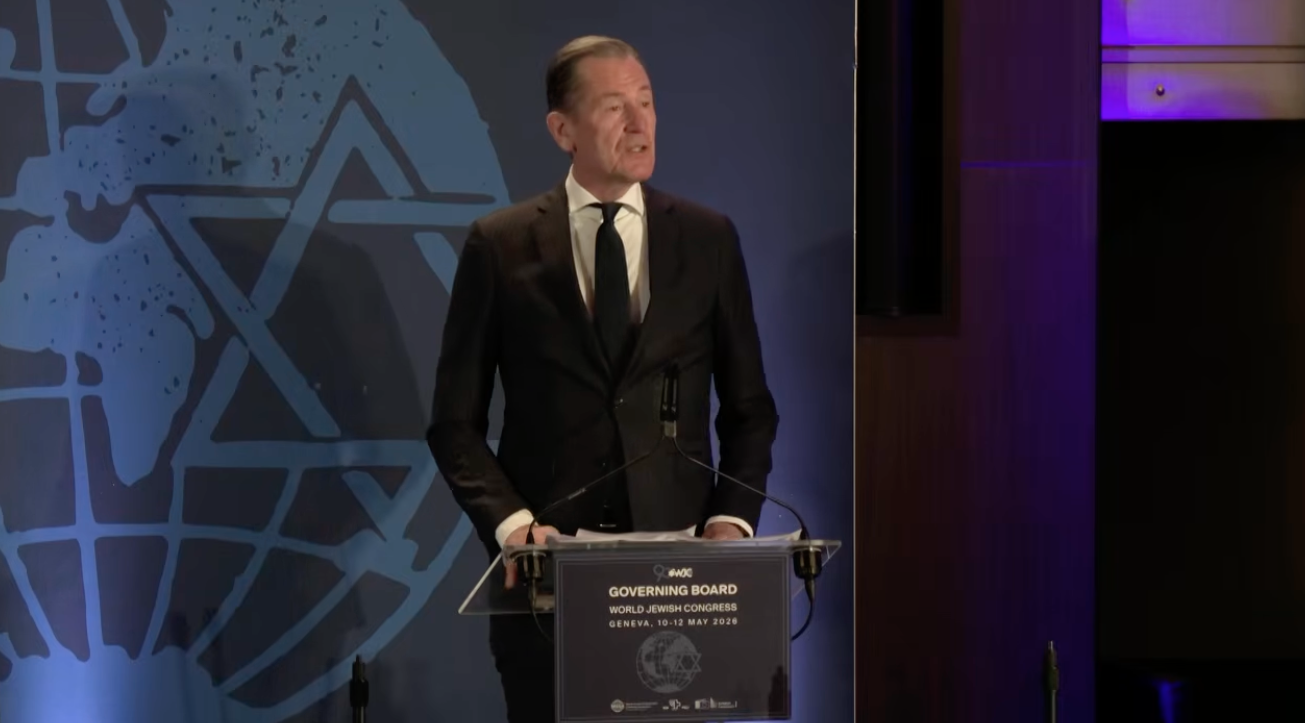
Mathias Döpfner (source YouTube; screenshot used in accordance with Clause 27a)
The World Jewish Congress, founded in Geneva in August 1936, returned this month to the city of its birth for the WJC Governing Board meeting of 2026. The Governing Board is where the strategic priorities of the international Jewish diaspora are set — the WJC federates communities from more than a hundred countries, and remains its principal diplomatic voice before governments and international organizations. This year’s meeting took place in the long shadow of October 7, 2023, in a city that is also home to the UN Human Rights Council that has condemned Israel more often than Syria, North Korea, Iran, and Venezuela combined.
Onto that platform stepped Mathias Döpfner, Chairman and CEO of Axel Springer SE, one of Europe’s most powerful media houses — owner of Bild, Welt, Politico, and Business Insider. Döpfner is rare in contemporary European public life: a corporate leader who is also one of the continent’s most outspoken defenders of liberal democracy and the State of Israel. He is not Jewish. He calls himself, with deliberate provocation, a goy. In Geneva, he delivered perhaps the most uncompromising public address of his career, and closed it with a sentence that should now be circulated across every European chancellery and every Western university common room: “We all shall be Zionists.”
Five proposals, no caveats
Döpfner refused to give “another ‘Never Again’ speech.” The phrase has become moral lip service: if it meant anything, there would have been no October 7 pogrom, no chants of “death to the Jews” in European capitals, no Jewish parents afraid to send children to school in a kippah. So instead, he put five concrete proposals on the table — and did not soften them with diplomatic hedges.
First, zero tolerance. Open hatred of Jews — in word and in deed, regardless of origin — must result in expulsion wherever the law permits. He cited British Conservative leader Kemi Badenoch’s blunt formulation: “Anything that’s inciting violence against Jews has got to go.” Not only in Britain. In every democratic country.
Second, preferential immigration and citizenship for Jewish families in Europe. The numerical contrast is stark. Jews are 2.2 percent of the American population — roughly 7.7 million. In the European Union and the United Kingdom combined, they are 0.2 percent — about one million, ten times less. Europe, Döpfner argued, must become more Jewish. If the continent intends to take its own rhetoric of multiculturalism and tolerance seriously, that means making Jewish life more visible, not less. The proposal is striking precisely because it is so rare to hear from a European executive at his level — and so obviously correct.
Third, regulation of social media platforms — and TikTok above all. Censored by the Chinese Communist Party, the platform operates almost unchecked in Western democracies, where it is now the single most influential information channel for young people. In the month after October 7, pro-Palestinian posts on TikTok outnumbered pro-Israeli ones by seventeen to one — a great many of them openly antisemitic, full of conspiracy theory and direct incitement. The United States has forced TikTok’s Chinese parent into a sale. Europe, Döpfner said, must follow. That a platform feeding the user data of European children to the intelligence service of a Communist dictatorship operates with effectively no editorial liability is, in his words, “a macabre joke of history.”
Fourth, expose woke ideology as a Trojan horse. Under the banner of decolonization, anti-racism, social justice, and climate activism, raw antisemitism is now routinely smuggled into respectable institutions. Greta Thunberg, he observed dryly, no longer seems much concerned with the carbon footprint, but increasingly concerned with stoking antisemitic prejudice. The woke movement, infiltrated and reshaped by Islamists, has executed a re-evaluation of all values: success is suspect, weakness is virtue, and whoever decides who counts as a victim wields the new moral power. And the movement, Döpfner said with characteristic precision, has decided that the victims are the antisemites. Where “from the river to the sea” is chanted on campuses, where Jewish students are harassed and Israel’s right to exist is denied, “the Enlightenment ends and hell begins.”
Fifth, the duty of memory. Döpfner described a journey he had taken into the eastern Polish borderlands — to the killing fields of Operation Reinhard, where roughly 1.3 million Jews were murdered between August and October 1942. He walked the railroad tracks to Sobibor and Belzec, and ended at Majdanek, on the outskirts of Lublin, where he entered what is likely the only intact Holocaust gas chamber still standing. A “shoebox” in concrete. Blue chemical deposits on the walls. Glazed peepholes through which the guards watched their victims convulse. “We have reached the lowest point of human civilization,” he said. Then he asked a question with the force of an accusation: why do so few non-Jewish donors fund the upkeep of Holocaust memorials? Is it really only the Jews’ responsibility to ensure that their murderers are not forgotten?
The West hates itself
If the five proposals are the actionable spine of the speech, the diagnosis behind them is what gives it its force. “In antisemitism,” Döpfner said, “the West hates and envies itself.”
That sentence deserves to be read slowly. The Jewish people, despite millennia of persecution, have shaped and enriched Western civilization in ways wildly disproportionate to their numbers — in business, science, medicine, culture, technology. Excellence, Döpfner observed, breeds envy. Envy is “the most sincere form of recognition.” But envy left unanswered turns lethal. What the contemporary West can no longer tolerate in the Jews is precisely what the West used to claim as its own ideal: excellence, ambition, civilizational confidence, and the will to defend oneself.
If the free world — not as a geography but as a set of values — does not defeat antisemitism, Döpfner warned, it will destroy itself. Postwar Germany is the cautionary case, and he was not gentle about his own country: a nation that broke its moral and spiritual backbone in the Holocaust and has remained, ever since, somewhat broken — without healthy patriotism, without genuine drive for excellence, trapped in an endless culture of guilt and atonement that has produced, tragically, no real consequences for the present. The Germany of the twentieth century, he said, should now serve the entire free world as a negative example.
The largest immediate threat is Islamism. Islamist terror in the name of a hijacked religion is “the most aggressive and most dangerous attack on our values.” Western passivity in the face of it may be the most suicidal mistake of our age.
A call to non-Jews
It is here that the speech turned, in its final movement, away from the Jewish community in the room and toward everyone else.
The fight against antisemitism, Döpfner said, is above all a duty for non-Jews. “If you don’t fight antisemitism out of altruism, you should at least do it out of egoism, out of a healthy self-interest.” Patriotism and Zionism, he argued, are siblings. The allies of Israel who are not patriots of their own countries are false friends; one cannot defend Jewish self-determination while abandoning the civilizational basis from which that defense becomes coherent.
And then the closing line. “Whether Jew or non-Jew,” Döpfner said, “anyone for whom democracy, freedom and humanity truly matter must be a Zionist today.” Twenty years ago, he recalled, he had first made that declaration in a conversation with the writer and Nobel laureate Günter Grass — who was revealed weeks later to have served in the Waffen-SS, and whose appalled reaction at the time, Döpfner noted, only confirmed that he had been right. “With the awareness that true tolerance must never, never again be tolerant toward intolerance — we all shall be Zionists.”
Europe’s moral test
The phrase is not a slogan of exclusion. It is the opposite. It is a liberal proposition: that defending the right of the Jewish people to self-determination and security is constitutive of defending democracy itself, political freedom, and the principles of an open society. It is, in its essence, a defense of Western civilization against those who — from the left, from the right, or from the camp of jihadist Islamism — would prefer to see it dismantled.
Europe now stands before a moral test. It will be judged not by what it declares at “Never Again” memorial events, but by what it does — or fails to do — when Jewish schoolchildren are afraid to walk into class, when judges refuse to see motive sitting on the perpetrator’s phone, when Chinese-owned algorithms shape what Europe’s children come to believe. The choice is not between pro-Israel and anti-Israel. It is between a Europe that defends its Jewish citizens, Israel’s right to exist, and its own democratic values — and a Europe that hides behind empty words.
Mathias Döpfner went to Geneva to remind everyone in that room — and everyone outside it — that those two Europes cannot coexist.
Related Topics
Related Posts