
Bams, Cracks, Dots, and Jews
How a Chinese game became a Jewish-American tradition, and why everyone seems to be playing it again.
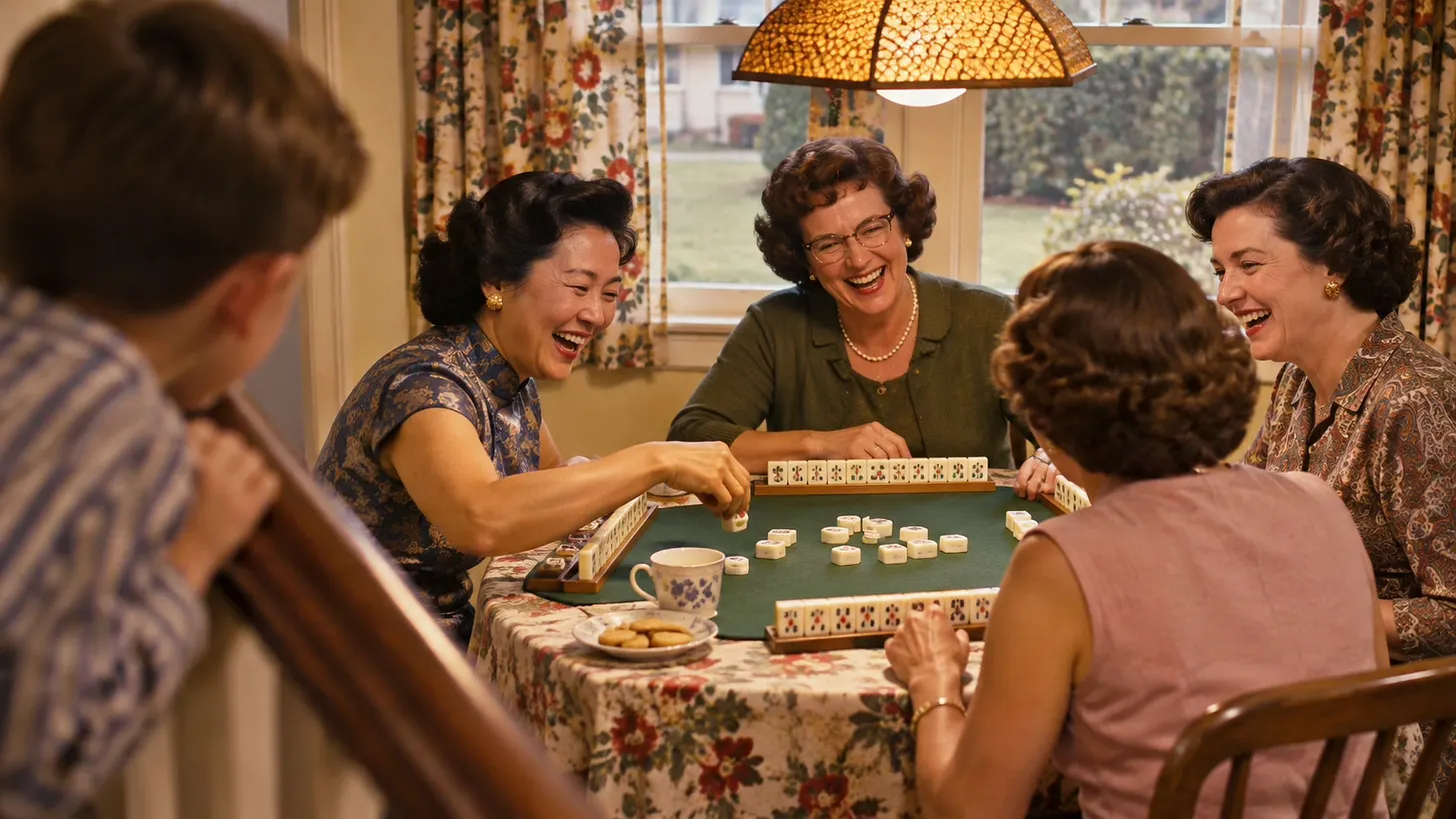
Growing up in Holbrook, Massachusetts, we lived in a neighborhood called Sunset Gardens, where every street was named after a flower. One street over, on Rose Way, lived the Lungs, a Chinese-American family who introduced our little corner of suburban Massachusetts to a game that would become an enduring part of Jewish-American culture.
Roberta Lung introduced Chinese mah jongg to several of her neighbors, including my mother, Ruth Rose, and Rita Fleschel. She taught them how to play, and before long, the women were gathering regularly for games that became a neighborhood fixture.
What I remember most vividly are the sounds: the unmistakable rattling of tiles being mixed across the table, punctuated by a strange new vocabulary—bams, cracks, dragons, flowers, dots. Whenever someone won, a shout went up that sounded to my young ears like “Sheck.” To this day, I have no idea what they were actually saying.
But above all, I remember the laughter. Even from my upstairs bedroom, with the door closed, I could hear those women laughing. Whatever was happening around that mah jongg table, they were having a wonderful time.
The Lungs were more than neighbors. Every Chinese New Year, they gave us little red envelopes containing money, a traditional gift meant to bring good fortune in the coming year. I didn’t understand their significance. I just knew that Chinese New Year was a pretty good deal for a Jewish kid growing up in Holbrook.
Roberta’s husband, Barney, owned the Aloha Restaurant in Hingham, a South Shore institution known for its dark Polynesian-style lounge, enormous fish tank, Chinese food and tropical cocktails. Occasionally, we were treated to takeout from the restaurant. But my most enduring memory of the Aloha wasn’t the food. It was a cocktail on the menu called the “Suffering Bastard,” which struck my adolescent sense of humor as just about the funniest thing anyone could order in a restaurant.
Looking back, the Lungs gave us an education in cultural exchange without anybody thinking to call it that. No diversity initiatives. No cultural sensitivity workshops. Just neighbors sharing their lives.
More than sixty years later, my wife Sandy plays mah jongg regularly. The rattling of the tiles is still familiar, although she plays a distinctly American version of the game Roberta taught my mother.
And the other night, Sandy said something that caught my attention.
“Did you know Hadassah controls the mah jongg cards?”
Hadassah? Really?
As it turns out, not quite. But the real story is considerably more interesting.
Mah jongg originated in nineteenth-century China and became an American sensation during the 1920s. Department stores sold elaborate sets, fashionable Americans hosted mah jongg parties, and the game became one of the great social crazes of the Jazz Age.
The craze eventually faded, but Chinese-American communities continued playing their traditional versions, while Jewish women embraced and adapted the game into a distinctly American variation.
By the mid-1930s, mah jongg had developed so many competing rules that players couldn’t always agree on how to play. In 1937, Dorothy Meyerson and Viola Cecil helped organize a gathering at Manhattan’s fashionable Essex House Hotel to bring some order to the chaos.
Expecting about 200 women, they got nearly 400. That’s a lot of mah jongg players packed into a hotel, passionately debating which combinations of tiles should count as winning hands. The gathering helped establish the National Mah Jongg League, founded that year to bring some order to the game.
Apparently, even mah jongg needed a governing body.
The League standardized the rules and introduced an annual card specifying the combinations of tiles required to win. Each spring, players need a new card with updated winning hands. Imagine telling women who have been playing the same game for decades that they need a new set of instructions every year. And imagine getting away with it. The Chinese game Roberta taught my mother had no such requirement. But in American mah jongg, the little card became indispensable.
And that brings us back to Hadassah.
Hadassah doesn’t control the National Mah Jongg League, but its chapters, along with other Jewish organizations, have long sold the annual cards as fundraisers. The League also supports charitable causes, including Hadassah.
So Sandy wasn’t entirely wrong. Hadassah doesn’t make the rules, but it has helped sell them. Only a group of Jewish women could turn a Chinese game into an annual subscription service and a charitable fundraiser.
But the real significance of Jewish-American mah jongg had less to do with the cards than with the women who gathered around them.
After World War II, as Jewish families moved from cities to suburbs like Holbrook, mah jongg became an important social tradition. Women who had left familiar neighborhoods and extended families behind found new friendships and a sense of community around the mah jongg table.
Historian Annelise Heinz, author of Mahjong: A Chinese Game and the Making of Modern American Culture, documents how the game offered Jewish-American women companionship, independence and social connections during an era when their lives were often defined by marriage and motherhood.
Four women, a table, a set of tiles and a few hours to themselves. For a while, the important questions weren’t about dinner, laundry or the children. They were about bams, cracks and dots.
The game spread through Jewish communities across the country, supported by synagogue sisterhoods, Hadassah chapters and generations of mothers teaching daughters. It wasn’t religious, although I suspect some serious players might argue that the annual card belongs in the Torah.
And now, nearly a century after the League was founded, mah jongg is enjoying a remarkable renaissance. It’s fashionable again. And not just among Jewish grandmothers in Boca Raton.
Across the country, younger women are organizing mah jongg nights, taking lessons and purchasing colorful designer tile sets. Restaurants and social clubs host games, while instructors and entrepreneurs have built businesses around a pastime once associated with suburban housewives.
According to a March 2026 Boston Globe report, the online invitation service Evite recorded a 94 percent year-over-year increase in mah jongg events. Heinz has also described the game’s growing popularity among non-Jewish women in the American South, while the Jewish Telegraphic Agency recently reported on Jewish teenagers discovering a pastime they once associated with their grandmothers.
Of course, today’s players have something their grandmothers didn’t: an entire industry eager to sell them accessories they probably don’t need. Designer tiles, coordinated mats, stylish carrying cases and personalized racks. I suspect my mother would have been perfectly happy with the old set and a kitchen table.
But beneath the fashionable accessories, I think something more interesting is happening. We seem to be experiencing a renewed appetite for real experiences in a world increasingly dominated by virtual ones. After years of social media, video calls and digital entertainment, perhaps people are rediscovering the pleasure of being in the same room together.
Mah jongg fits that mood perfectly. It requires people to sit together, talk, think, laugh and occasionally argue over who discarded the tile everybody needed. You can’t play a proper game while scrolling through your phone. (Well, perhaps you can, but I wouldn’t recommend trying it with a table of experienced Jewish women.)
Technology has given us extraordinary ways to stay connected. But there’s something different about gathering regularly with friends, with no particular agenda beyond enjoying one another’s company.
Perhaps that’s what explains mah jongg’s remarkable staying power. The tiles are important, the rules are complicated, and winning certainly has its pleasures. But the real attraction has always been the people around the table.
I sometimes wonder what Roberta Lung would make of mah jongg’s newfound popularity. She taught her neighbors the Chinese version, with no annual card, no national organization and certainly no social media influencers. But that’s how culture often works. We inherit things from people who have no idea how far their influence will travel.
More than sixty years after Roberta Lung taught my mother to play, I can still hear the tiles rattling and the women laughing. These days, it’s Sandy and her friends, Smadar, Sue and Sherryl, gathered around the mah jongg table. They play a different version of the game, but the laughter sounds much the same. Only now, I’m listening from my recliner while watching Thursday Night Football.
And somewhere in that familiar clatter, I can still hear the women of Sunset Gardens.