
Bangladesh’s 2026 Election After an Uprising and an Uncertain Future
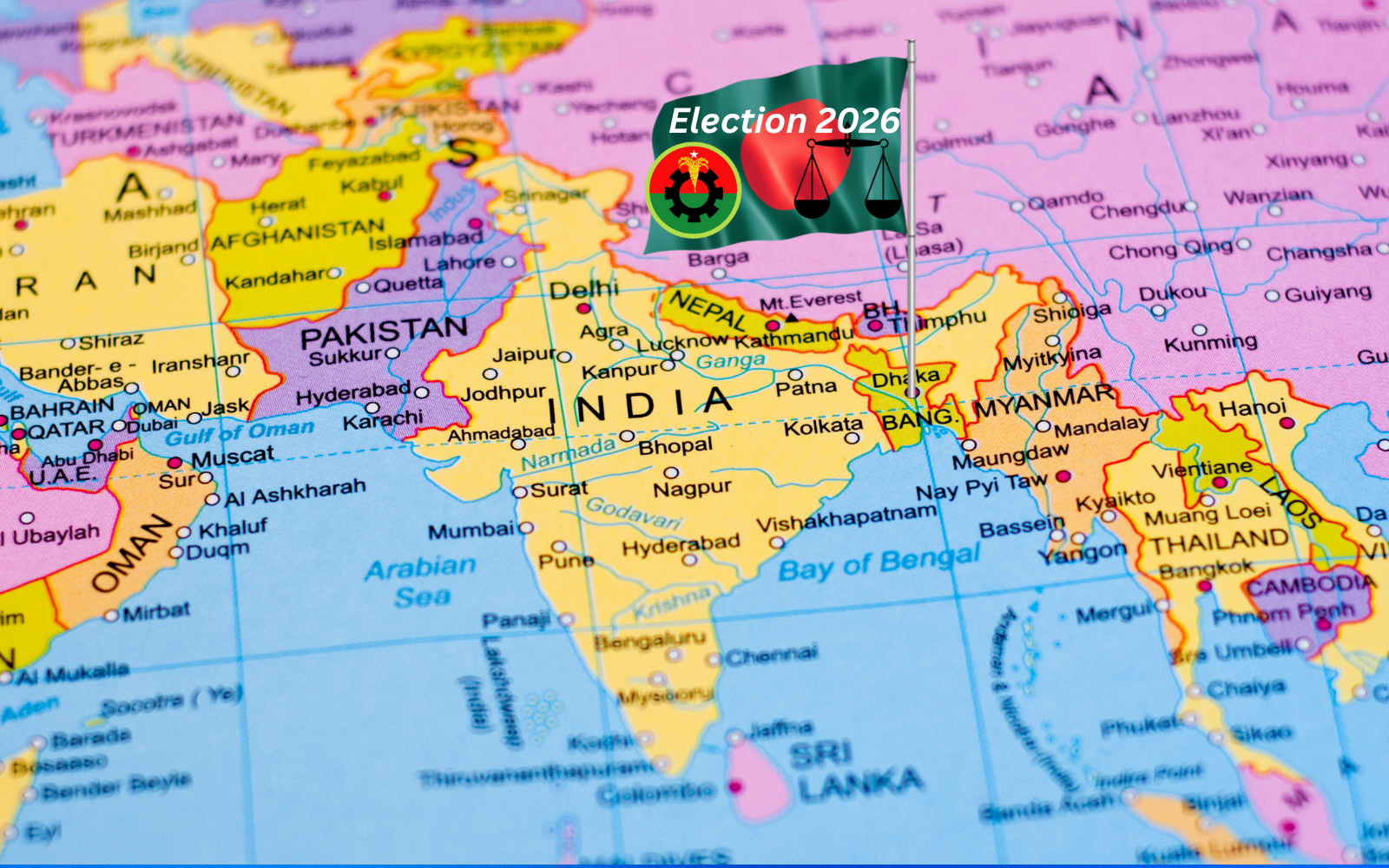
Illustration: Map highlighting Bangladesh ahead of the 2026 national election. Composite image created by the author using Canva-licensed design elements. Political symbols sourced from Wikipedia for editorial illustration.
On February 12, 2026, Bangladesh will hold a national election that many observers see as the most important since the country became independent. This is not a normal election. It comes after a popular uprising that ended a long period of one-party rule and left the country without a clear political direction.
For readers outside South Asia, Bangladesh is a Muslim-majority country of about 180 million people. It sits between South and Southeast Asia and borders India on three sides. It has close economic ties with China and growing importance in the Bay of Bengal region. Political change in Bangladesh often affects its neighbors and beyond.
This election will decide whether Bangladesh moves toward stability, faces long-term uncertainty, or shifts in a new ideological direction.
The fall of the old system
For nearly fifteen years, Bangladesh was ruled by the Awami League, led by Prime Minister Sheikh Hasina. During this time, the country saw economic growth and large infrastructure projects. At the same time, the democratic space became smaller.
Elections were widely seen as unfair. Opposition parties were weakened. Critics, journalists, and activists faced arrest or pressure. Over time, public anger grew.
In 2024, this anger turned into mass protests. High prices, political repression, and frustration with family-based rule pushed people into the streets. Security forces responded with force. Many people were killed or injured. The government lost control.
After weeks of unrest, Hasina fled to India. Her party collapsed politically. Many Awami League leaders went into exile or faced legal cases. The party is not allowed to contest the 2026 election.
An interim government led by Nobel Peace Prize winner Muhammad Yunus took charge. Its job was to calm the country and prepare for elections. Yunus promised fairness and reform. Still, critics say the transition helped some political groups more than others.
The result is a political vacuum. The old system is gone, but a new one has not fully formed.
Who is running now?
With the Awami League out, the election has become a contest mainly between two camps.
The first is the Bangladesh Nationalist Party (BNP). It was the main opposition during Hasina’s rule. For years, its leaders were jailed or forced into exile. Now, the BNP presents itself as the natural replacement.
The BNP says it can restore democracy, fix the economy, and improve relations with other countries. Many foreign diplomats see the party as familiar and predictable. It is not new, but it knows how to govern.
However, the BNP has serious problems. When it ruled in the past, the country was known for corruption and weak institutions. The party also depended on Islamist allies. Many voters do not trust it fully and question whether it has really changed.
The second camp is an Islamist alliance led by Bangladesh Jamaat-e-Islami. Jamaat was once politically isolated because of its ideology and its role during the 1971 independence war. But the collapse of the Awami League gave it new space.
Jamaat presents itself as disciplined, honest, and close to religious values. In many areas, its organization is stronger than that of secular parties weakened by years of pressure. Its supporters believe it can bring moral leadership and clean government.
For many secular Bangladeshis and religious minorities, Jamaat’s rise is frightening. For foreign observers, it raises questions about where Bangladesh could be heading socially and politically.
Why do some believe Jamaat could do well?
Although the BNP looks strong on the surface, many political observers warn against assuming an easy BNP victory. They say the Islamist alliance may be stronger than expected, especially among young voters.
Many young people grew up under one-party rule. They saw corruption, repression, and finally collapse. For them, neither the Awami League nor the BNP represents safety or justice. Both are seen as old parties that failed.
Among these voters, a controversial idea is spreading: if no government has truly protected minorities or delivered fair rule, why not test Jamaat and judge it by its actions rather than fear?
Religion and foreign policy also matter. Bangladesh is a Muslim-majority country. Jamaat supporters argue that the party could govern more independently, without relying on India. This belief was one of the main reasons people turned against the Hasina government. Many felt she followed India’s wishes too closely in key political and security decisions.
Similar accusations are now being made against the BNP. Critics say Tarique Rahman, the party’s acting leader, reached an understanding with India to avoid challenging its interests. His return to Bangladesh via India strengthened this perception. These claims are politically disputed, but they have fueled public anger toward Indian involvement in Bangladesh.
Several India-linked infrastructure and energy projects have reportedly been suspended or reviewed. This reflects strong public resentment. At the same time, pro-Pakistan messages have become more visible in parts of the media and on social platforms. They are often linked to calls for a stronger Islamic identity in foreign policy.
Whether these views will decide the election is unclear. But they show that this vote is about more than local politics. It is also about how Bangladesh sees its place in the region.
The silent voters
One of the least discussed factors in this election is the absence of Awami League voters. For years, the party had a huge support base. That support has not disappeared, but it has no clear political home.
Some of these voters may stay away from the polls. Others may vote for the BNP to block Jamaat. Some may follow local leaders rather than national parties. In close races, this silent group could decide the result.
Three possible outcomes
Most analysts see three main scenarios.
Scenario one: a BNP-led government.
If the BNP wins a majority or forms a stable coalition, Bangladesh will likely move toward cautious stability. Relations with India would probably improve. Ties with the United States and Europe would return to normal, focusing on trade and security.
At home, the BNP would try to calm politics and fix the economy. Still, deep reform would be slow. Old problems, including corruption and political deals with Islamist groups, could return.
For the outside world, this would be a familiar and manageable outcome.
Scenario two: a Jamaat-influenced government.
If Jamaat and its allies gain strong power, Bangladesh would enter a new territory. The country is unlikely to become a religious state, but public debate would move in a more conservative direction.
Minorities could feel more insecure. Women’s rights and secular education might face pressure. Internationally, Bangladesh could take a colder position toward India and Western countries, while keeping practical ties with China and others.
For Israel and Middle Eastern observers, this scenario could bring more openly hostile language, even if formal policy does not change.
Scenario three: no clear winner.
A hung parliament or disputed result would be the most dangerous outcome. Protests could return. Political violence could increase. The military, which never fully left politics, could step in as a power broker.
This is the outcome diplomats fear most.
Minorities and the question of safety
For Bangladesh’s Hindu, Buddhist, and Christian minorities, this election is not about ideology. It is about safety. Under every government, minorities have faced pressure at times.
Under the Awami League, they had protection but were also used politically. Under the BNP, protection was uneven. Under an Islamist-influenced government, many fear protection would depend on local power rather than law.
This fear shapes how millions see the election.
Why this election matters outside Bangladesh
Bangladesh has no formal ties with Israel. Still, its political direction matters. A more religious and nationalist Bangladesh could become louder in Islamist international forums. A stable civilian government would likely remain distant but predictable.
The election is not only about who wins. It is about what kind of country Bangladesh will become after a political collapse.
Is This a Turning Point for Bangladesh?
Bangladesh’s 2026 election is often described as a choice between parties. In reality, it is a choice between paths. The old system is gone. The new one is uncertain.
Whether Bangladesh finds stability, falls into long-term conflict, or moves toward a new ideology will depend on how the next government rules, whom it includes, and whether it learns from past failures.
For a country of Bangladesh’s size and importance, the consequences will be felt far beyond its borders.
February 4, 2026
Tokyo, Japan
Tokyo, Japan
Related Topics
Related Posts