Rabbi, Special Operations Police Officer, Award Winning Filmmaker
Before you vote, ask the hard questions
English-speaking olim confront Israel's future
Two major political events offer English-speaking Israelis an opportunity to hear from national leaders about the economy, education, security, antisemitism and the challenges of building a future in the Jewish state.
ISRAEL — They came from America, Canada, Great Britain, South Africa, Australia and other countries across the English-speaking world. They left behind familiar communities, careers, businesses and families to begin a new chapter in their ancestral homeland.
Some came because of their Zionist convictions. Others sought Jewish identity, religious fulfillment, greater security or a better future for their children.
But in 2026, many English-speaking olim are confronting difficult realities.
Can we afford to live here? Will our children receive a quality education? Can we build successful careers? Are our healthcare and insurance systems adequate? Will Israel face another major war? What is being done about rising antisemitism worldwide?
And perhaps most importantly, do Israel’s political leaders understand the challenges facing English-speaking immigrants?
These are questions about our homes, livelihoods, families and future.
Now, ahead of Israel’s anticipated October 27 Knesset election, two political events will give English-speaking Israelis an opportunity to hear directly from senior members of the country’s leadership.
Two Important Events: October 17 and October 19
On Saturday evening, October 17, at 8:15 PM, an English-language election conversation and live question-and-answer session will take place on Zoom, featuring two Likud representatives:
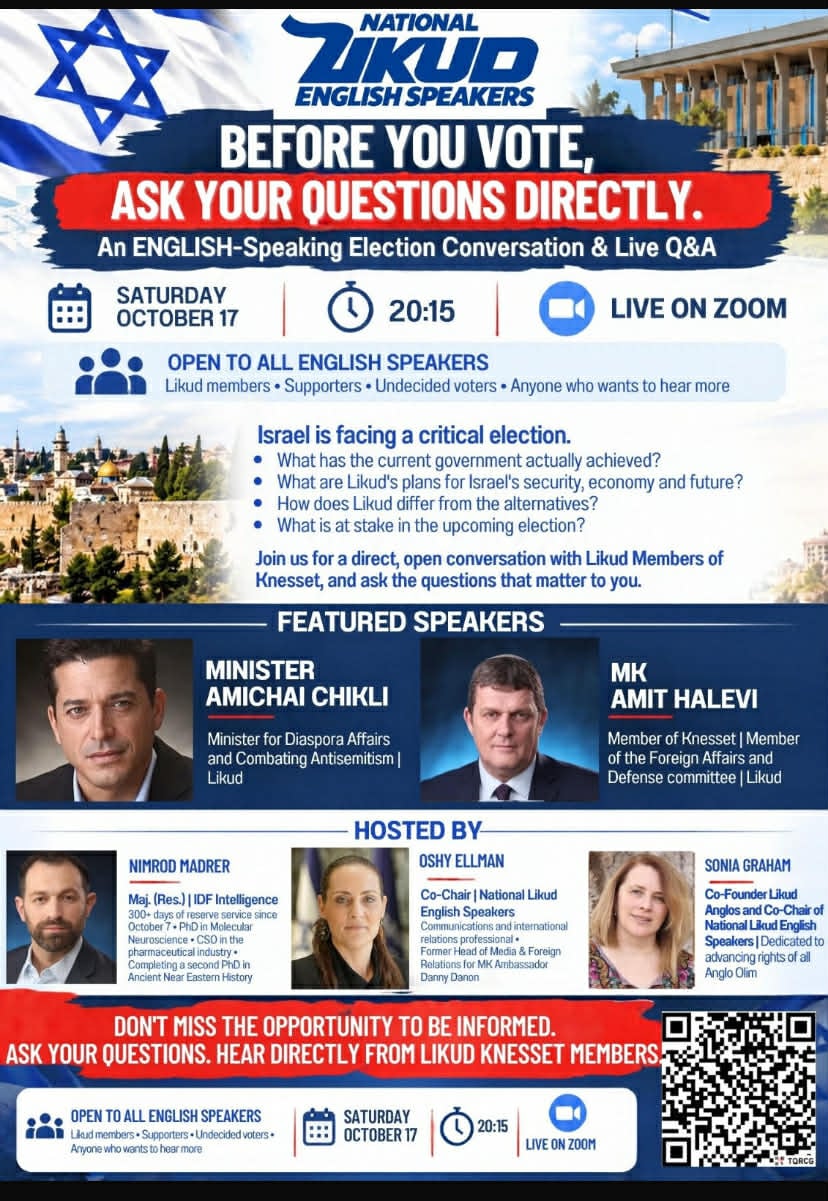
- Minister Amichai Chikli, Minister for Diaspora Affairs and Combating Antisemitism.
- MK Amit Halevi, a member of the Knesset’s Foreign Affairs and Defense Committee.
Hosted by Nimrod Madrer, Oshi Ellman and Sonia Graham, the discussion is open to English speakers, including Likud supporters, undecided voters and anyone interested in examining the party’s policies and record.
Participants will have an opportunity to ask questions about national security, economic policy, government achievements and the choices facing Israeli voters.
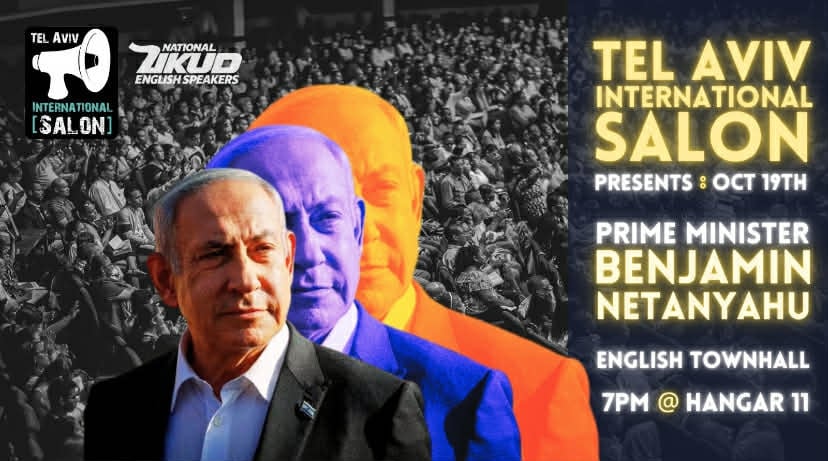
Two days later, on Monday, October 19, the Tel Aviv International Salon and National Likud English Speakers will present an event featuring Prime Minister Benjamin Netanyahu at Hangar 11 in Tel Aviv.
Doors open at 7:00 PM. Admission is free, although space is limited.
While the October 17 Zoom event explicitly includes a live Q&A, the October 19 announcement does not establish whether audience members will be able to question the prime minister directly.
Nevertheless, both events offer an important occasion to examine the issues affecting English-speaking Israelis.
The Economy: Can Ordinary Families Afford to Live in Israel?
Israel has achieved remarkable success in technology, medicine, agriculture and entrepreneurship. Yet for many families, everyday life remains financially demanding.
Housing, groceries, transportation, electricity, municipal taxes and childcare consume substantial portions of household income.
Immigrants who arrive with professional qualifications and decades of experience may discover that finding comparable employment is more difficult than anticipated. Others must rebuild businesses, develop professional networks, learn Hebrew or accept considerably lower salaries.
The International Monetary Fund’s July 2026 assessment projected 3.5% economic growth for Israel while warning about the consequences of prolonged regional conflict and defense spending.
But economic growth means little to a family struggling to pay its monthly bills.
What will the next government do to make housing affordable? How will it encourage small-business development and job creation? What opportunities exist for older immigrants rebuilding their careers? How will businesses recover from wartime disruptions?
Most importantly, how will economic success translate into greater financial security for ordinary citizens?
A prosperous country must provide opportunities not only for major corporations and investors but also for working families, entrepreneurs and retirees.
Healthcare, Insurance and Financial Protection
Israel’s national healthcare system provides important services, but navigating its various components can be confusing, particularly for newcomers.
Understanding the differences between health funds, supplementary coverage, private insurance and National Insurance benefits requires knowledge that many immigrants initially lack.
For older olim, these challenges can become especially serious.
What happens when someone develops a major illness? How does a person with limited Hebrew resolve a complicated medical or insurance dispute? Are elderly immigrants receiving adequate assistance?
Insurance concerns extend beyond healthcare.
Homeowners and business owners need to understand property coverage, damage compensation, liability and their rights when claims are disputed.
During wartime, these issues become even more urgent. Missiles damage homes, businesses close, families are displaced and income disappears.
What protections exist for affected citizens? How efficiently are compensation claims processed? What improvements are needed to help people recover financially?
For immigrants who have invested their life savings in Israel, financial protection is essential.
Education: What Future Are We Building for Our Children?
For many families, raising children in Israel is among the most meaningful reasons for making Aliyah.
Yet entering the Israeli education system can be a difficult transition.
Children accustomed to English-speaking schools may struggle with Hebrew instruction, unfamiliar teaching methods and social integration. Parents who lack sufficient Hebrew may find it difficult to communicate with teachers or assist with homework.
Older students face additional challenges involving matriculation examinations, university admissions, military service and career preparation.
Are schools receiving adequate resources for immigrant students? Are children experiencing emotional difficulties receiving appropriate support? What is being done for students whose education has been interrupted by war?
Higher education raises equally important questions.
Israel’s economic future depends on producing skilled professionals in medicine, engineering, science, technology, education and business.
Will young Israelis have access to affordable, high-quality education that prepares them for a competitive world?
Education is not merely another government expense. It is an investment in Israel’s future.
National Security: Can Israel Achieve Lasting Peace and Stability?
The Hamas-led attacks of October 7, 2023, profoundly changed Israeli society.
Three years later, national security remains a central concern for families, soldiers, reservists and business owners.
Parents worry about children serving in the Israel Defense Forces. Reservists face the possibility of prolonged military commitments. Communities near threatened borders remain concerned about renewed attacks.
The strategic questions are substantial.
What is Israel’s long-term policy toward Hamas? How will it confront the threats posed by Hezbollah and Iran? What measures are being taken to strengthen border defenses and protect civilians?
What lessons have been learned from the failures surrounding October 7? How will accountability be established, and what reforms will prevent similar failures?
And how will Israel balance military requirements with economic development, healthcare, education and social services?
Many English-speaking immigrants came to Israel seeking a secure national home for themselves and future generations.
They recognize the country’s unique security challenges. But they also want to know whether their children and grandchildren will inherit a nation capable of providing both safety and opportunity.
National security is more than military strength. It is the ability of citizens to live, work, study and raise families with confidence.
Antisemitism: Defending Jewish Communities Worldwide
The rise of antisemitism remains deeply troubling to Jews in Israel and throughout the Diaspora.
Since October 7, Jewish communities have experienced threats, harassment, intimidation and hostility. Political debates concerning Israel and Zionism have intensified, sometimes accompanied by antisemitic incidents.
Many English-speaking olim maintain close family and personal connections in the United States, Canada, Britain, Australia and elsewhere.
Their concerns do not stop at Israel’s borders.
What is Israel doing to protect Jewish students facing harassment? How is it strengthening cooperation with Diaspora communities? What measurable progress has been made against antisemitic incitement and misinformation?
Minister Amichai Chikli’s participation in the October 17 discussion is particularly relevant because combating antisemitism falls directly within his ministerial responsibilities.
The discussion should examine international partnerships, educational initiatives, online campaigns and the growing influence of artificial intelligence in spreading misinformation.
It should also address how governments can distinguish legitimate criticism of Israeli policies from antisemitic hatred.
These questions demand practical strategies and measurable results.
Aliyah: From the Dream to Everyday Reality
Making Aliyah is often described as the fulfillment of a lifelong dream.
For many, it is.
But immigration also requires adaptation, sacrifice and perseverance.
Professionals may encounter licensing difficulties. Entrepreneurs must understand unfamiliar banking and taxation systems. Families struggle with government bureaucracy, language barriers and the cost of living.
Older immigrants face concerns about employment, pensions and retirement. Young families must balance childcare expenses with limited incomes. Single immigrants may experience loneliness and social isolation.
These challenges deserve attention from policymakers.
English-speaking olim bring valuable professional experience, entrepreneurial skills, international connections and cultural perspectives to Israeli society.
They have the potential to contribute significantly to the country’s development.
But successful integration requires more than welcoming ceremonies and encouraging speeches.
It requires accessible government services, employment opportunities, language assistance, professional recognition and meaningful community support.
Aliyah should not end with arriving at Ben Gurion Airport. It should lead to a genuine sense of belonging.
Are English-Speaking Israelis Adequately Represented?
English-speaking immigrants are an important part of Israeli society, yet language barriers can make political participation difficult.
Understanding party platforms, legislative proposals, government decisions and public policy requires access to reliable information.
English-language political events can help bridge that gap.
However, communication must go beyond campaign slogans.
Political leaders should be prepared to discuss professional licensing, immigrant employment, housing, education, pension rights and government services.
They should explain not only what they intend to accomplish but also what they have already achieved.
English-speaking Israelis do not constitute a single political bloc.
Some support Likud. Others favor opposition parties. Many remain undecided.
They represent different religious traditions, economic circumstances, political philosophies and personal experiences.
Their diversity should be respected, and their concerns addressed on their merits.
Israel in 2026: What Kind of Country Will We Leave Behind?
Beyond immediate political disagreements lies a fundamental question:
What will Israel look like ten, twenty or thirty years from now?
Will young families be able to purchase homes? Will the economy provide opportunities outside major metropolitan centers? Will universities continue producing scientific and technological innovation?
Can Israel maintain a strong defense establishment while investing sufficiently in healthcare, infrastructure and education?
Will immigrants become fully integrated into society?
Can Israel strengthen its relationships with Jewish communities abroad while preserving democratic institutions and public trust at home?
These questions cannot be answered with campaign slogans or political accusations.
They require serious policies, responsible leadership and sustained public discussion.
Before You Vote, Ask the Hard Questions
The October 17 Zoom discussion and October 19 Tel Aviv event come at an important moment for English-speaking Israelis.
They offer opportunities to evaluate political leadership, examine competing visions and consider the direction of the country.
But attending a political event should involve more than applauding familiar speeches.
Leaders should be asked to explain their records, defend their decisions, acknowledge unresolved problems and present realistic solutions.
What have they accomplished? Where have they fallen short? What will they do differently? And how should voters measure their success?
Supporters, critics and undecided voters all benefit when public officials face substantive questions.
English-speaking olim have invested their money, professional experience, energy and hopes in Israel.
They have built homes, raised children, served, volunteered, worked and contributed to the nation’s development.
They are not spectators in Israel’s future.
They are participants in shaping it.
Upcoming Events for English-Speaking Israelis
Saturday, October 17, 2026 — 8:15 PM
English-Speaking Election Conversation and Live Q&A
Featuring Minister Amichai Chikli and MK Amit Halevi.
Location: Live on Zoom.
Open to English speakers interested in hearing the discussion and asking questions.
Monday, October 19, 2026 — Doors Open at 7:00 PM
An event featuring Prime Minister Benjamin Netanyahu.
Presented by the Tel Aviv International Salon and National Likud English Speakers.
Location: Hangar 11, Tel Aviv Port.
Admission: Free. Space is limited.
A Final Thought
Israel is more than a place on a map. For those who have made Aliyah, it is a home, a responsibility and an investment in generations yet to come.
Our political leaders must understand that our concerns are not abstract policy debates. They affect our families, our financial security, our children’s education and the future of the Jewish state.
We owe it to ourselves to demand thoughtful answers and accountable leadership.
Before you vote, ask the hard questions. Because the future of Israel is also your future.
Rabbi Avi Schwartz
Filmmaker, writer and commentator
Related Topics