Belated Anniversary Wishes
I’ve been thinking (which is what I do, per this column’s name) about my feelings toward America’s semiquincentennial as compared to its bicentennial, which I was old enough to celebrate in 1976. (Linguistic aside: I love the fact that 50 years adds two syllables and six letters to the event’s name.)
When we celebrated the 200th, Sharon and I, with our two older children, were living in a wonderful 11th-floor apartment on Riverside Drive in Manhattan. The view from our living/dining room windows overlooking the Hudson River from Hoboken all the way to the George Washington Bridge was magnificent, which in this instance gave us front row seats to something truly special.
One exceptional event of the 1976 festivities was Operation Sail, which, as recently noted, had “more than six million spectators, . . . the largest crowd in New York City’s history.” Op Sail was a parade of more than 200 ships that began at the Verrazzano Narrows Bridge and moved up the Hudson River, with a terrific sightline from our apartment. So we hosted a party for friends and family, where all present were able to experience the spectacular parade of tall ships almost right outside our apartment while enjoying a — dare I say equally spectacular (and delicious) — party inside it.
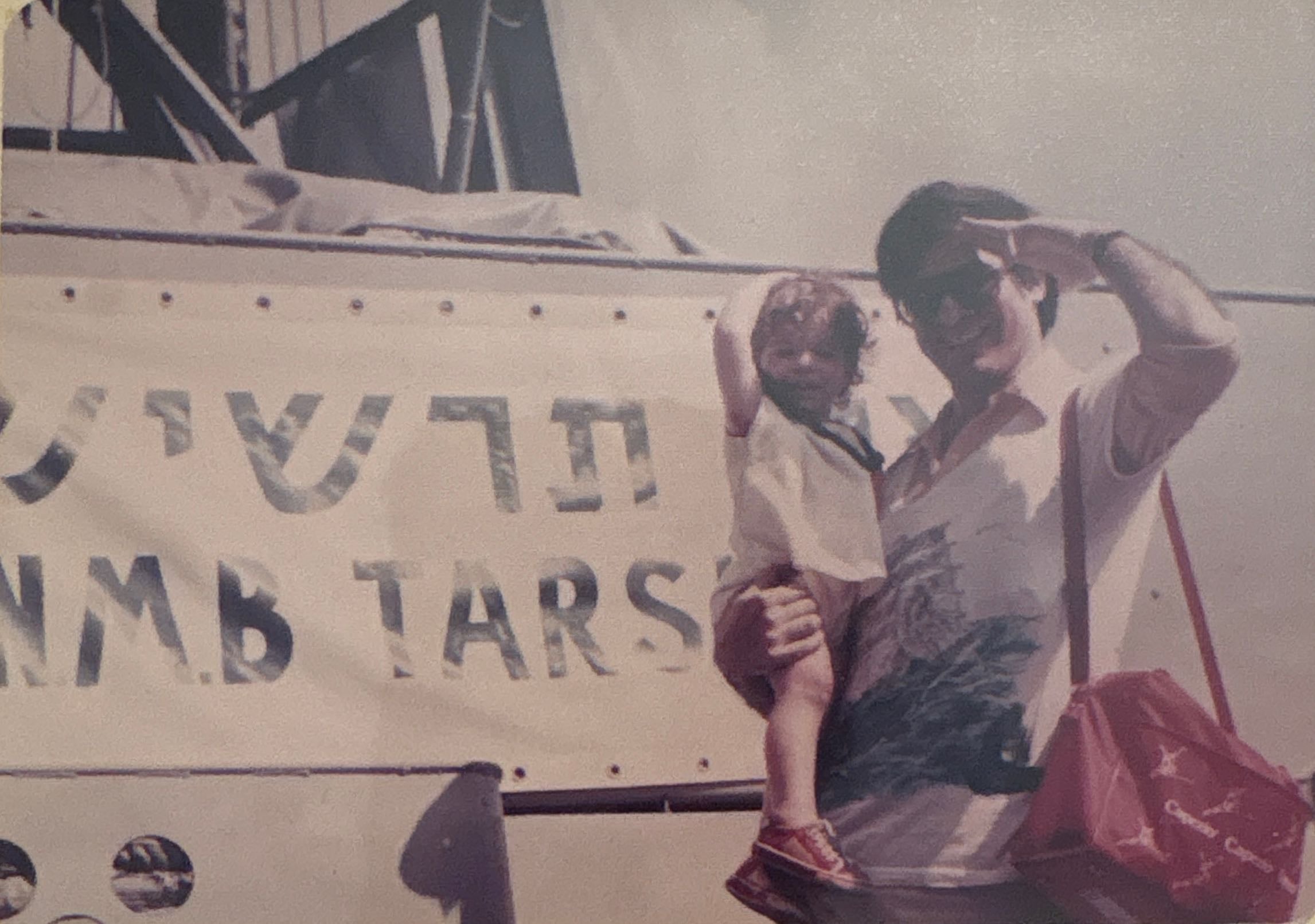
We had another reason to celebrate that day: the almost miraculous Entebbe raid and rescue (Operation Thunderbolt/Yonatan) the day before. So when we went down to the riverfront after the party to visit some of the tall ships, we also stopped by an Israeli naval vessel that had participated in the flotilla. Wishes of mazel tov were heaped upon the Israeli sailors, and as I was boarding, an elderly Jewish woman in front of me threw her arms around the 19-year-old-looking sailor welcoming visitors and planted a kiss on his cheek. He blushed adorably at the hug and kisses, clearly being more used to salutes as people boarded.
All in all, a wonderful way to celebrate a unique American birthday.
This year was different. I began it the same way I do all Independence Days. As is my July 4th minhag (tradition), I donned my Declaration of Independence tee shirt, bought on a visit to Jefferson’s Monticello, and then read the DOI, printed, as always on Independence Day, on the back page of Section A of the New York Times. Previously, the Declaration taking up the entire page was its “engrossed version” — the well-known handwritten copy residing in the National Archives, with John Hancock’s famous signature. More recently, however, that version appears only as a small picture that is surrounded by the full text in a larger and, to my 79-year-old eyes, easier-to-read font.
But afterward, no celebration for me. While I considered walking in our local July 4th parade together with the other members of Teaneck’s Advisory Board on Community Relations, my (hopefully temporary) mobility issues and the extreme heat and humidity made that impossible. That local parade aside, I wasn’t feeling the celebratory mood.
Why the difference? Why such wonderful memories of a past celebration, and almost no participation in the current one? The answer lies in the state of the country and the state of the celebration, then and now.
America had plenty of problems in 1976 to be sure, but it was the beginning of a time of healing, a time of hope. Our involvement in the Vietnam War had ended; draft resisters were beginning to be restored to full citizenship; détente with the Soviet Union was strengthening; Israel and Egypt, with U.S. assistance, had entered into the Sinai Disengagement Agreement in which the parties agreed that “the conflict between them and in the Middle East shall not be resolved by military force but by peaceful means”; and, as President Ford, a truly decent man, said in his speech upon assuming the presidency after Richard Nixon’s resignation, “our long national nightmare [was] over.”
As I’ve previously written, I strongly believe the state of our country today is appalling. I won’t repeat the details here; just read/watch the news or, better yet, the proliferation of judicial opinions describing how our country is being (mis)governed. We are, indeed, in the midst of a new, long national nightmare with no waking up in sight.
I will, however, discuss the state of our national celebration this year as compared to the bicentennial, which, in addition to Op Sail, had the American Freedom Train that brought artifacts, documents, and artwork to the 48 contiguous states, while Washington, D.C., hosted a 12-week Bicentennial Festival of American Folklife at the Smithsonian, a visit from Queen Elizabeth II, and the opening of the National Air and Space Museum on the National Mall.
This time around, American independence was celebrated by UFC Freedom 250 — a mixed martial arts cage fight in the “Claw” erected on the White House South Lawn. This “celebration” also included a nasty (non)joke by one of the fighters about Michelle Obama, right in front of the house that she once graced with such elegance.
A mixed martial arts cage fight at the White House? Really? Remember President and Mrs. Kennedy inviting Pablo Casals to perform in the White House in 1961? (Well, you might not, but I do.) Or Robert Frost reciting “The Gift Outright” at President Kennedy’s inauguration, which I watched on a black-and-white TV in my childhood home’s kitchen, and his reciting four of his poems in 1962 for Presidents Kennedy and Eisenhower at an American Pageant for the Arts? Or “In Performance from the White House,” sponsored by President Reagan, with creative and theatrical programs of classical, Broadway, country, jazz, and gospel music? And now we’ve sunk to celebrating 250 years of freedom and liberty with a vulgar MMA brawl in front of the People’s House?!
Other supposed commemorations of America’s 250th include pictures of the president adorning federal buildings and passports, national park passes, and commemorative coins, and a demolished East Wing, a proposed garish Arch, attacks on the Smithsonian and history, failed Reflecting Pool renovations, a problem-ridden “Great American State Fair,” and a presidential speech that turned what was to be an Independence Day celebration into a lengthy, poorly disguised MAGA political rally. Happy birthday, America?
I find it difficult to juggle these conflicting feelings and emotions about celebrating our country. But as I was discussing this issue with my two older daughters while writing an early draft of this column on Erev Tisha B’Av, the eve of the fast day that commemorates the destruction of the two Jerusalem Temples, they suggested that I consider the special kinot (elegies) we recite on that day. I quickly thought of one such Kinah, Eish Tukad Bekirbi (A Fire Burns Within Me), which compares the feelings of those leaving Egypt in the Exodus to those of the 70 CE Jewish survivors leaving Jerusalem under a cloud of smoke from the burning Temple to begin a long, still extant exile.
In this kinah, the unknown poet juxtaposes these two experiences through a series of couplets, each using a different motif as a prism for contrast. The effect is a paradox, where the highs and lows of Jewish history, the ecstasy of the Exodus (in my daughter Raquel’s words) and the degrading experiences on leaving Jerusalem in the aftermath of the destruction of the Temple, are two sides of the same coin — inexorably linked yet opposite worlds apart. Two examples:
“Then Moses sang an unforgettable song/When I left Egypt/Whereas Jeremiah lamented and wailed a woeful wail/When I left Jerusalem.” “Festivals and Sabbaths and signs and wonders/When I left Egypt/Fast days and mourning and vain pursuits/When I left Jerusalem.”
I write prose, not poetry, and I don’t have the ability to compose couplets contrasting my gratitude in celebrating the bicentennial to my depression during the semiquincentennial. But I find a touch of solace in the kinah’s final lines: “Happiness and joy; gone are the sorrow and sighing/When I return to Jerusalem.”
I therefore pray that an America that truly exemplifies the lofty ideals aspired to in the Declaration will return, hopefully soon, reborn and reinvigorated. We will then, once again, be able to celebrate July 4th with a full heart, just like I did 50 years ago.