Ben-Gurion Goes to the Movies

Before it settled on its hill in Jerusalem, Israel’s Parliament spent nine months in a Tel Aviv movie theater. Almost nobody remembers it, not even the Knesset.
Nothing on Tel Aviv’s seafront asks a walker to slow down. Cars race along it as if it were a highway, luxury hotels stand shoulder to shoulder with unremarkable apartment blocks, and the whole stretch looks more like Miami than the Middle East. Whatever once gave the place its charm has gone. It takes some imagination.
Follow the tayelet, the seaside promenade, and you come upon Kikar HaKnesset, Knesset Square: a pleasant plaza with a fountain, framed by old Middle Eastern-style buildings, carefully restored. For decades it hosted rallies, parades and protests, which people watched from the terraces of the neighboring hotels. Today, people cross it without noticing. It has lost its centrality and no longer plays any part in the social or political life of the city. Its name, though, is a clue. On the spot now occupied by the Opera Tower, the Knesset met for nine months in 1949 – the only time in its history that Israel’s Parliament has sat anywhere but Jerusalem.
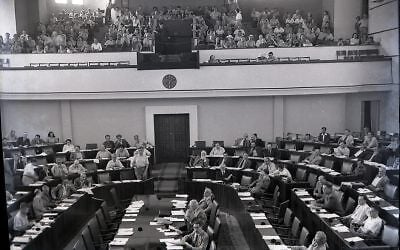
The official explanation fits in a sentence, one that David Ben-Gurion delivered to lawmakers and that his government later passed on to the United Nations: “When the first Knesset was opened in Jerusalem, there were no adequate facilities for its normal functioning in the capital, and it was necessary to transfer its sessions temporarily to Tel Aviv. The required arrangements in Jerusalem are on the verge of completion, and nothing now stands in the way of the Knesset’s return to the capital.” So much for the official version. The reality was less bureaucratic. Jerusalem was then a city cut in two by a front line, and since the war the government had been working out of the Kirya, its administrative compound in Tel Aviv. Parliament went where the state was.
The return to Jerusalem, by contrast, was a political act. In December, the United Nations reaffirmed its intention to place Jerusalem under an international regime. Ben-Gurion replied that “Jewish Jerusalem is an organic and inseparable part of the State of Israel,” and the Knesset promptly voted to move. The “adequate facilities” were no more ready than they had been the day before. The circumstances were.
A foiled attempt on Ben-Gurion’s life
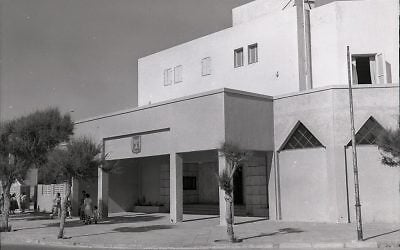
To house the lawmakers in Tel Aviv, the authorities had chosen the Kessem, one of the most luxurious movie theaters in town. Some 1,100 seats were pulled out to make room for a rostrum and a horseshoe of desks for the members. On the wall behind the platform, where the screen used to be, hung a portrait of Theodor Herzl.
This Tel Aviv interlude remains thinly documented, both on the Knesset’s official website and in the Knesset’s own museum. Collective memory has all but erased it. Yet it was the scene of an event that could have changed Israel’s history: an attempt to assassinate the prime minister.
On Monday, Sept. 12, 1949, a young man named Avraham Tzafati walked into the Knesset with a Sten submachine gun hidden under a pile of pamphlets. He passed the entrance check without trouble, climbed to the public gallery and concealed the weapon under a heavy coat. When Ben-Gurion entered the chamber in the middle of a debate, Tzafati rose, ran to the railing and aimed the Sten at the prime minister, seated at the end of the table directly below. An usher who had been watching him for some time threw himself on Tzafati before he could fire.
His motives remain murky, and the newspapers of the day described them according to their own politics. To some, he was simply unbalanced, with no political agenda. Others said he had meant to kill himself in the middle of the session to draw attention to his plan for world peace. Still others reported that once he had been pinned to the floor, he shouted, “I will kill Ben-Gurion!”
Tried for attempted murder and disturbing the public order, he was sentenced to two years in prison.
The Knesset goes back to Jerusalem
The Knesset stayed in the movie theater for only nine months. At the end of December 1949, it returned to Jerusalem, first to the offices of the Jewish Agency, then, from March 1950, to a temporary home, Froumine House, before moving in 1966 to its current site at Givat Ram. Changing cities did not settle the question of security. On Oct. 29, 1957, at Froumine House, a man named Moshe Dwek threw a grenade from the public gallery. Haim-Moshe Shapira, a cabinet minister, was seriously wounded; Ben-Gurion, Golda Meir and Moshe Carmel suffered minor injuries. Ben-Gurion later wrote to the attacker’s parents, who lived in a shack without electricity outside Tel Aviv, to tell them he forgave their son.
Israelis tend to regard the assassination of Yitzhak Rabin, on Nov. 4, 1995, as a break without precedent. It was not, however, the first attack by a Jew on an Israeli head of government. But Tzafati and Dwek left no mark on the country’s memory. Only Yigal Amir, who succeeded, entered it.
And the Kessem?
The building housed more than a Parliament, and the list of its lives is longer than one might think. First came a beach cafe, the Galei Aviv, which called itself a casino without ever seeing a roulette wheel. In 1945 the Kessem took its place: the most luxurious movie house in town, which would show films for only three years. In 1948 the Israeli Navy set up its headquarters there; in 1949 the Knesset moved in. The building then passed to municipal offices, and after them to the tax authorities. From 1958 to 1982, it was home to the Israel National Opera. In the early 1960s, a young Spanish tenor spent three years there, learning the great roles of his repertoire before the world knew his name: Plácido Domingo. Demolished in 1988, the building gave way to a residential tower, completed in the early 1990s, that kept the opera’s name. Eight lives in half a century: the place never had time to get bored.
Around the square, most of the buildings have been restored to their original architecture. Only the theater was razed; the ground floor of the tower is supposed to echo its arcades. That, and the name of the square, is all that remains of it. The memory of the Knesset’s Tel Aviv year has been put away in the back of a closet.
Kessem means “magic” in Hebrew. The theater lived up to its marquee. One by one it made the films vanish, then the sailors, the lawmakers, the civil servants and the singers, before pulling off the hardest trick of all: making itself disappear. A masterly performance.
Translated from the French. The original version appeared on Tel-Aviv | beyondthecitymag.com