A Moroccan Journalist
Eisenkot is a Moroccan Amazigh name, not a German one
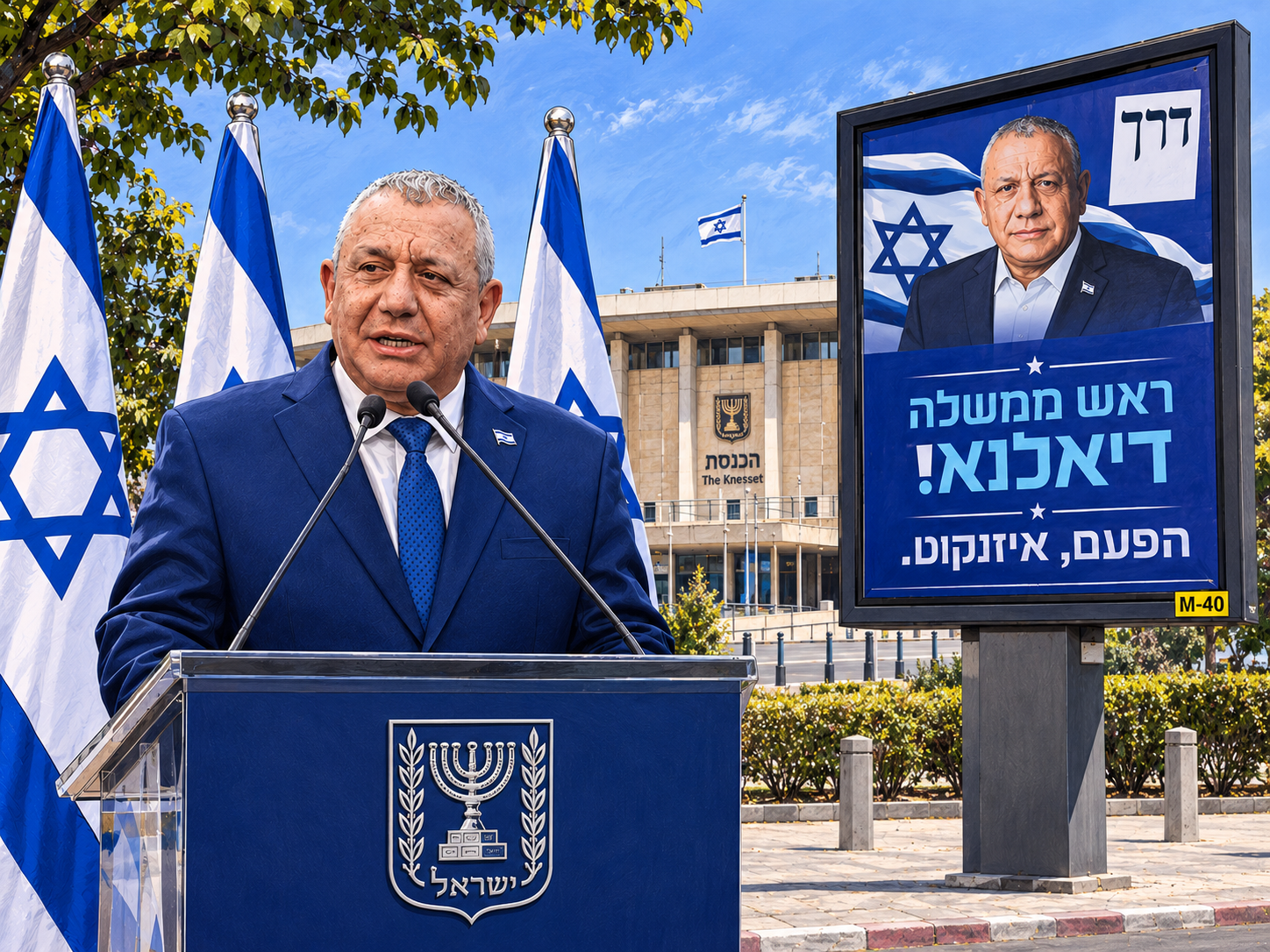
AI-generated illustration of Israeli politician Gadi Eizenkot alongside a Hebrew campaign billboard featuring “ראש ממשלה דיאלנא!” (“A prime minister of our own!”), incorporating Moroccan Darija, with the Knesset in the background.
For seventy-eight years, everyone who has governed Israel has carried a name from Europe. Ben-Gurion, Meir, Begin, Rabin, Peres, Sharon, Netanyahu – the family trees run back to Poland, Ukraine, Russia, Belarus. Fourteen prime ministers, one continent. Jews of the Middle East and North Africa, now the demographic majority of the country, have given Israel presidents, army chiefs, and foreign ministers. They have never once given it a head of government.
That streak is a single coalition away from ending. On November 8, President Isaac Herzog handed Gadi Eisenkot the mandate to form a government, with 67 of the Knesset’s 120 members behind him. Eisenkot is the former chief of staff of the Israeli army and leader of Yashar, the son of a father from Marrakech and a mother from Casablanca. If he closes the deal, Israel gets its first Mizrahi prime minister – and, more precisely, its first Moroccan one.
Here the story turns strange. The man poised to break the Ashkenazi monopoly carries what looks like the most Ashkenazi name imaginable. “Eisenkot.” The surname Eizenkot is often assumed to have German origins.
In German, Eisen is iron and Kot is excrement or dung. Put together, the name of Israel’s would-be Moroccan premier reads, in German, as “iron feces.” No European family chose to carry that. This is a name no one would invent, and few European Jews have ever borne it. It is vanishingly rare among them, and that alone should have put an end to the guessing. As German, the name means nothing anyone would want, and that is the first clue it is not German at all. The German reading never made sense.
As far back as 2014, when he became the first Moroccan chief of staff, a Yedioth Ahronoth front page puzzled over how the first Moroccan to reach the top of the army ended up with such an Ashkenazi-sounding name. The guesses followed the usual script. On Army Radio, Eli Biton, an expert on Moroccan Jewry, floated the idea that the name pointed to Ashkenazi ancestors and offered a theory. His explanation: in the 19th century and during World War II, Jewish families from Russia and Poland had drifted into Morocco, immigrated there, and over time some “forgot their Yiddish, but the last names” – Goldberg, Wassermann, Shapira, Eisenkot – “stayed.”
It is a tidy theory. It is also false, and the falseness is the point. In a 2014 Haaretz report, Elon Gilad judged the “plausible explanation… almost certainly false.” The name is rare among European Jews for the obvious reason – its German meaning is one no family would choose – while Azenkot and its spellings, from an Amazigh (Berber) word meaning “deer,” have been “quite popular among the Jews of Tunisia and Morocco” for centuries, long before the “small trickle” of European Jews that Biton described.
The name is not German. It never was. It is Amazigh (Berber), and it is one of the oldest Jewish names of southern Morocco, recorded among Sephardic Jews as early as the 17th century. ANU – Museum of the Jewish People traces Azancot to the Berber azenkadh, “gazelle,” and to the tribes that carried it: the Azza Izenkadh around the Tata oasis, part of the larger Sektana confederation spread between the Draa and the Atlantic, and the Oulad Izenkadh of Aït Djemel in the southwest. It is a toponymic name as much as a personal one – a trace of where a family lived, traded, or came from.
The name travels under many spellings: Azancot, Azenkot, Azincot, Azincout, Azencoth, Azencotte, Levi-Azancot. One of them, Azencourt, owes its shape to French influence – proof that the name has always been rewritten by whoever held the pen. The Ashkenazi clerk was only the last in that line. And it belongs to a wider family of North African Jewish names built on the same image: Ghozal, Bar Ziron, El’opher all carry the very same meaning – gazelle, deer – in Arabic or Hebrew.
Its carriers are no footnote. The name enters the Jewish record in the 17th century, in Rabbi Saadiah Ben Levi Azancot – rabbi and orientalist, who taught in Holland (the Netherlands) and tutored the renowned Swiss theologian and Hebraist Johann Heinrich Hottinger (1620-1667). He left important works behind him: an interpretation of the Book of Esther in rhymed prose, and two manuscripts now held in the Bodleian Library in Oxford. One is a copy of Maimonides’ Guide for the Perplexed (Dalalat Al-Hayarin) in Arabic characters, attributed to Golius; the other, a Hebrew translation of Lamiat Al-Ayam by Hussain Ben Aly, attached to a printed copy of that work.
By the 1800s, the Azencots were among the first families of Tangier: David, interpreter to the French consul and a wealthy, prominent man; Moise, who left for Argentina and became a writer; and Avraham, who by the 1880s headed the city’s Jewish community.
This is not folk etymology. A case in point is linguist Alexander Beider. The latter is not the kind of scholar who indulges in sentimental or mythic origin stories. His 2017 study “Jews of Berber Origin: Myth or Reality?,” in the University of Évora’s journal Hamsa, sets out to dismantle the very myth that Moroccan Jews descend from Berber converts. Even he concedes this name without hesitation.
He is a skeptic – his whole project is tearing down the romantic legend that Moroccan Jews descend from ancient Berber converts. The rhetorical point is a “hostile witness” move: even the man dedicated to debunking Berber-origin myths still accepts that this name is genuinely Berber. That makes his concession worth more than an enthusiast’s would be.
In his survey of Maghrebi Jewish surnames, he files Azencot (אזנקוט) among the “doubtless” Berber names: from azenkoḍ (also azenkuḍ), “gazelle,” a 17th-to-18th-century Moroccan surname whose final consonant even preserves a distinctive feature of how Moroccan Jews pronounced their Judeo-Arabic. In Azencot – along with Aferiat, Bohbot, and Ouakrat – the final “t” of the French spelling, and the tet (ט) in Hebrew, stand exactly where the Berber etymon has /ḍ/. That devoicing, Beider explains, traces to a distinctive feature of Moroccan Judeo-Arabic: the /ṭ/-pronunciation (as for the Arabic letter ṭâ’) in place of /ḍ/, which other Judeo-Arabic dialects keep for both ḍâd and ẓâ’.
So how did azenkoḍ become Eisenkot? The same way much of Mizrahi identity was processed on arrival. When Eisenkot’s father stepped off the boat, the official recording his name was, in all likelihood, an Ashkenazi clerk, and he wrote a sound he did not recognize in the spelling that came naturally to him – the German-Yiddish one. A Berber gazelle walked into an Israeli immigration office and walked out as a piece of German iron dung. Nobody asked the family.
That small act is the whole argument in miniature. The early state did not only route Moroccans to development towns and the bottom of the wage ladder. It rewrote them at the level of the name – the one thing a person carries out of the old country without asking anyone’s permission. The hierarchy was linguistic before it was anything else. Your reality had to pass through an Ashkenazi ear to be entered into the record, and whatever that ear could not parse was reshaped into something it could.
This is why the Eisenkot moment cuts deeper than a representation headline. The man carries the erasure on his own ID card. Every outlet that still calls his name German overwrites a Moroccan family again, in public, by people who cannot hear azenkoḍ underneath it.
Morocco hears it. For weeks, Moroccan newspapers have asked whether the son of immigrants from Marrakech and Casablanca might lead Israel, and the interest runs past diplomacy. It is recognition of a name that belongs to the Atlas and the Draa, to a Jewish community woven into Amazigh Morocco for centuries before it was ever Israeli.
Eisenkot has been guarded about his roots, but in the last days before the vote, his posters carried the Darija phrase Rosh Memshala Dialna – “our prime minister,” half Hebrew, half Moroccan Arabic. The slogan said what the misspelled surname keeps trying to say. He also expressed his desire to “strengthen” Israel’s alliances with its Arab partners, although he did not explicitly mention Morocco.
If he forms his government, the headlines will announce Israel’s first Mizrahi prime minister and move on. The slower correction is learning to read the name on the door. It was never iron dung. It was a gazelle, out of the Moroccan south, and it stood there long before anyone decided it should sound like it came from somewhere else.
Related Topics