
Ben Shapiro’s Lions and Scavengers – which are you?
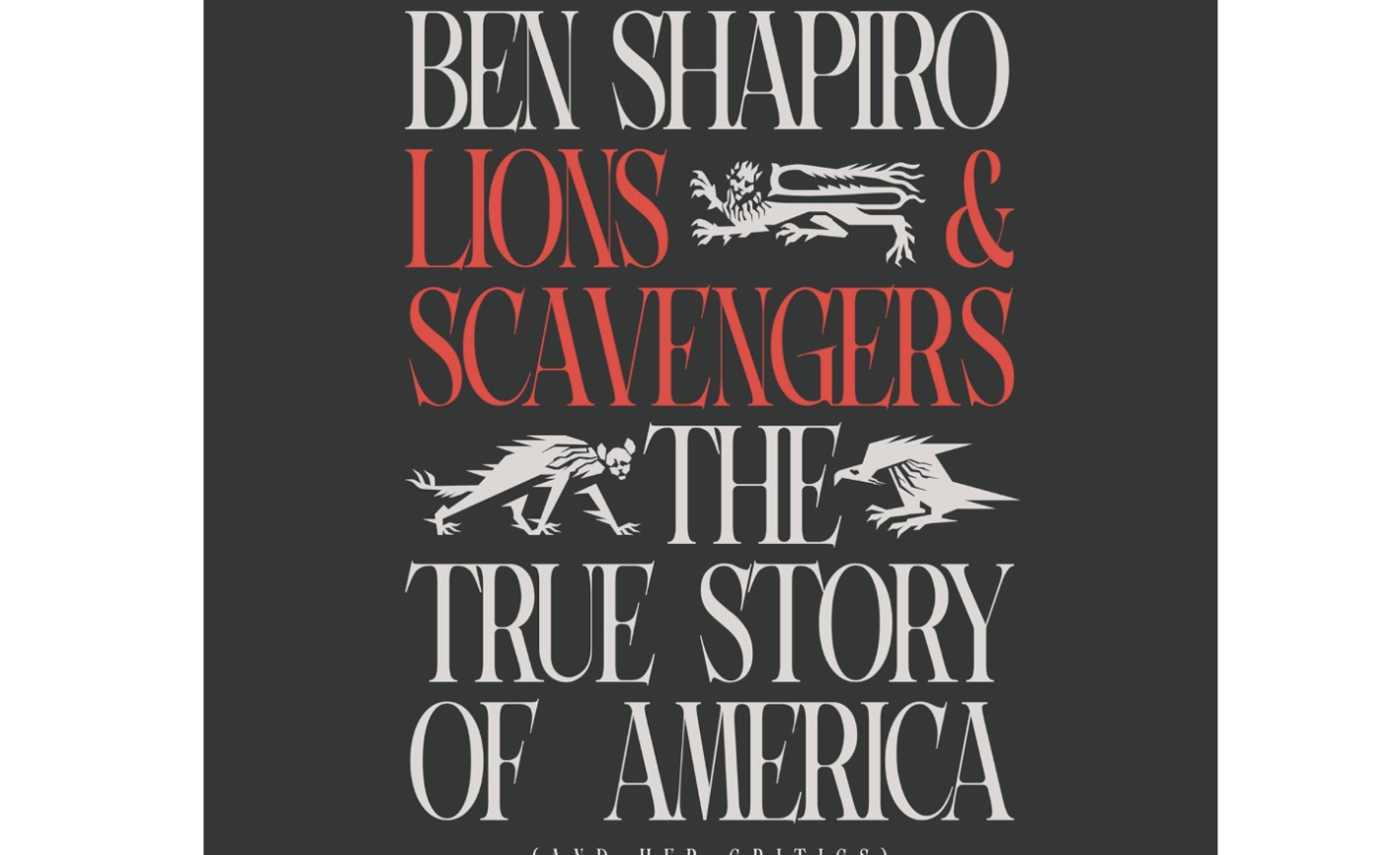
Are you a lion or a scavenger?
Are you a hunter, a warrior and a weaver who builds and defends Western civilisation? Or an envy-ridden looter seeking to destroy this civilization from within?
In Lions and Scavengers Ben Shapiro draws a clear distinction between the two fundamentally different characters as he articulates what typifies, motivates and sustains them. The salt-of-the-earth hard workers whose labour continues to build America, against the scavengers who conspire to topple it. Shapiro shows how the lions’ Pride protects free minds, free markets, public virtue, rule of law, church and family, while the scavengers’ Pack is on a mission to bring down the Pride, gain power and overthrow the existing order.
Most importantly, he demonstrates how time and time again, throughout the West, lions’ values and sacrifice translate into success, growth and innovation, where scavengers’ toxic-envy breeds resentment, stagnation and ruin.
This might well strike some as a gross generalisation of humankind into two ‘types’ of people, but stay with Shapiro as he paints a clear image of what separates these two conflicts of vision. Also remember that there is a lion and a scavenger in all of us, and it is our duty to ward off scavenging calls within us.
It is worth noting that the title of the book refers to The true history of America but it clearly speaks of Western civilisation at large, the degradation of its Judea-Christian values and the consequential weakening and decline. The bottom line is that it is lions’ sacrifice, innovation, work ethics, courage and dedication to family and society, that have constructed and elevated Western civilisation, creating affluence, endless opportunity and prosperity. The contrasting scavenging spirit however, creates nothing but demands everything – instead of gratitude for enjoying the fruits of lions’ labour, it projects resentment, animosity and even openly expressed hatred because as Shapiro explains, in the scavengers’ mind, “all inhumanity against the Lions is justified.”
London has fallen

A prime example of this comes to the fore in London, where Shapiro embarks on his journey, several weeks after the October 7th massacre, the deadliest attack on Jews since the Holocaust.
England’s capital leaves Shapiro with “disappointment and horror and dismay – for London has been conquered by the Scavengers.” He speaks of a “massive river of protesters” spread through the capital, with “hundreds of thousands strong, marching, their banners unfurled: the banners of terrorist groups and of communists and of transgender activists, gathered together to revolt against the civilization that has given them their rights and their prosperity and their power, gathered to protest in favour of the terror group Hamas.”
Shapiro goes on to write of “the slaughter of 1,200 Jews and kidnapping of 250 others” where “members of Hamas and Palestinian civilians flooded into villages, a music festival, homes; they dragged out men, women, and children. They live streamed their crimes” but as Shapiro concludes, “the Scavengers have risen in rage, in support of Hamas” and not the Israelis just attacked.
We hear of The British Communist Party issuing a statement condemning the Israeli government “before Israeli military action had even begun”, we learn that former Labour Party leader Jeremy Corbyn, appeared at rallies flanked by Palestinian flags, and of “the hilariously bizarre group Queers for Palestine”, expressing their solidarity “with people who would throw queers off buildings at the first available opportunity if given half a chance” – this is what “a united, coalition hatred of the West” looks like, and it is the same throughout the West.

“This is not mere antisemitism” stresses Shapiro, to the scavengers, thoroughly Western Israel embodies the lion spirit. “Israel exists in a region of Scavengers” he explains, “the Scavengers never sleep. They have allies around the world: in the press, in the universities, in governments.”
But these protests are symptomatic of more than just envy of the innovators who transformed a desert into a technological empire, there are other factors at play here, such as Gen Zers everywhere being bored – living in economic comfort but with a spiritual void. Once filled by god, it has now been consumed by the cause of activism, and the mission to tear down the very systems that have awarded them this great wealth. They attribute their prosperity to them having a privilege that was earned by exploiting others, and so it is not just Israel that merits tearing down but any institution responsible for creating wealth.
These stark observations are heightened when Shapiro visits Oxford, facing hostility unlike anything his security guards ever witnessed – “one frothing stew of hatred – all in the birthplace of Richard Lionheart, leader of the Third Crusade to liberate Jerusalem from Muslim invasion. Now the invasion has come home, aided by the West itself.”
But it is not just London who lost its way and has allowed the scavenging rage to tear cracks at its once magnificent structure. Throughout the Western sphere people have stopped defending their values, many parents have neglected to pass on the virtue of personal responsibility to them, turning many into habitual victims – any struggle they encounter is always other people’s fault. Scavengers rest on the ‘oppressor – oppressed narrative, associating any form of success with the exploitation of others. The successful, or even the ‘just living comfortably off the fruit of their labour’, must therefore be ridden with shame and guilt. Most importantly, the victim is justified in their animosity, hatred and acts of violence.
Shapiro’s book was penned on the move, whilst traveling through different countries and cities. He draws us in as he shares his thoughts on the state of places he visits, questions it raises and the historical connotations it evokes. We hear of him pondering the ideas and history of Western civilization with the likes of Jordan Peterson and Jonathan Pageau in Italy, delving into Israel’s trying reality with Douglas Murray, pondering antisemitism after visiting Auschwitz with Elon Musk, and conversing with Donald Trump – the latter is bound to lead to game-changing epiphanies for many. During a fundraiser at the Trump National Doral club in Miami, Trump told Shapiro
do you know why Vladimir Putin never invaded Ukraine while I was president? It’s because I said, ‘Vladimir, if you go into Ukraine, I will bomb the s*** out of you.’ “And Vladimir said, ‘Mr President, no, you won’t.’ “And I said, ‘Well, Vladimir, I might.’ And here’s the thing: If our enemies think there’s a five percent chance that they will end up at war with the most powerful military in the history of the planet, they tend not to risk it.”
The first Trump administration saw the most peaceful world of any modern president because “Trump made clear to the world that if he was
pushed too far, the consequences would be disastrous for America’s enemies.” The lesson here is that politics is a game of power – one must project power and strength to keep enemies away.
We also learn from Shapiro’s personal family experiences – his early attempts to set up DailyWire and the lessons learned from that experience, his wife the weaver, how an innocent outing with friends in LA ended up with their friends being mugged, the lawless city’s decline and his family shifting from LA to Nashville.

Eternal truths
Within Shapiro’s observations and wise quotes are many eternal truths – from intellectually trying philosophical concepts to simply describing Jerusalem as “The city of David. The city of Jesus. The city where the West was born.”
Shapiro grasps the toxic nature of envy, the resentment it breeds and the ever-presence of this universal acid. A force “destroying the mechanisms by which passions become assets, and transforming those assets back into passions.”
He understands that we are part of a continuum within the human experience – part of what was here long before we were born, and will be here long after we are gone. Through his son’s brit ceremony he explains that “we are born into roles that predate us and will outlast us.” To the scavengers however, history is but an irrelevant collection of dead notions.
He gets that Lions must fight, or else they effectively commits suicide – that if they weaken, the scavengers attack. The scavengers gather at the gates, waiting for any sign of vulnerability and for a crack to appear.
Shapiro recognises that where churches and families decline, the West falls into decay, and brings to light the scavenger fallacy that “all human beings are born equal in their qualities and capabilities.” For nearly all of human history, no one was wealthy, at least not by today’s standards, he explains, so the scavengers should be asking not why is there poverty, but what creates wealth and prosperity? The fight should be for equal opportunity, not outcome.
Kensington “this is what Hell looks like” Avenue
Shapiro gives many examples of the consequences of scavengers’ policies. Particularly haunting is Florida’s ‘zombie apocalypse’ Kensington Avenue, the worst thing Shapiro has seen in America.“People are shooting each other up with fentanyl, heroin, and tranq..People, their legs or arms missing, feet without toes—all rotted away thanks to the tranq. People talking to themselves, babbling nonsensically as they scratch their festering bodies. People bent at the waist, frozen, gazing into nothingness..This zombie reality is obviously the extreme of the extreme but the question Shapiro would like us to ask is “how do societies of Lions devolve so far”?How do the Scavengers gain the upper hand?
“The Scavenger has one tool, and one tool only: the decency of his enemy” – because Lions believe in sin, Scavengers can accuse lions of sin, and Lions will tend to believe them, and to apologize, atone, and confess. Scavengers use that confession as ammunition to destroy the Lions – what follows lions’ apology isn’t forgiveness, but destruction.
Instigating feelings of guilt within the lions is a super efficient way to neutralise the Pride. Quoting the great Thomas Sowell he writes “guilt has so furtively stolen into many hearts and minds that people feel apologetic about being civilized, educated and productive when others are barbaric, uneducated and parasitic. When civilization apologises to barbarism, something has gone very wrong at a very fundamental level.”
Speaking of determinism
Shapiro tells of an Israeli soldier who lost his legs and an arm in the war and still asked him “how else can I help?”
Shapiro asserts that “this attitude isn’t unique to Israel” noting that “every parent who goes the extra mile”, workers who stay the extra hour, and Western soldier mounting up to fight evil. I agree but argue that there is something unique to Israel with regards to the decline of Western civilisation – that because it is in a constant fight for survival, it is naturally filled with unity, loyalty and sacrifice for the group. All Israelis live with the reality of war, have lost sons, daughters, fathers, mothers, friends..they know fellow Israelis living with life long injuries, both emotional and physical – Israel is always at that first generation stage of fighting for survival – this creates a society unlike any other on earth.

Lions and Scavengers
Lions and scavengers is an arresting intellectual journey. Although highly articulated, it is accessible and fluid. It is Shapiro’s versed interplay between the current state of affairs, references to history and striking quotes, that brings his message home. You clearly see how envy-driven policies lead to chaos, authoritarianism, tyranny and decrepitude, just as you appreciate that when church and family fall apart, society crumbles. You sense why his urgent call for lions to rise against the scavenger narrative is justified, and you certainly grasp the immense, at times unfathomable power of ideas. Particularly potent is the Great Conspiracy Theory – “the same myth told over and over again since Cain and Able: the myth of the Haves and the Have-Nots, in which those who Have are the great oppressors of those who Have-Not.”