
Geopolitical Analyst: Bridging Somaliland & Israel to the world
Beyond the e-Visa Trap: Somaliland Must Build Sovereignty That Works
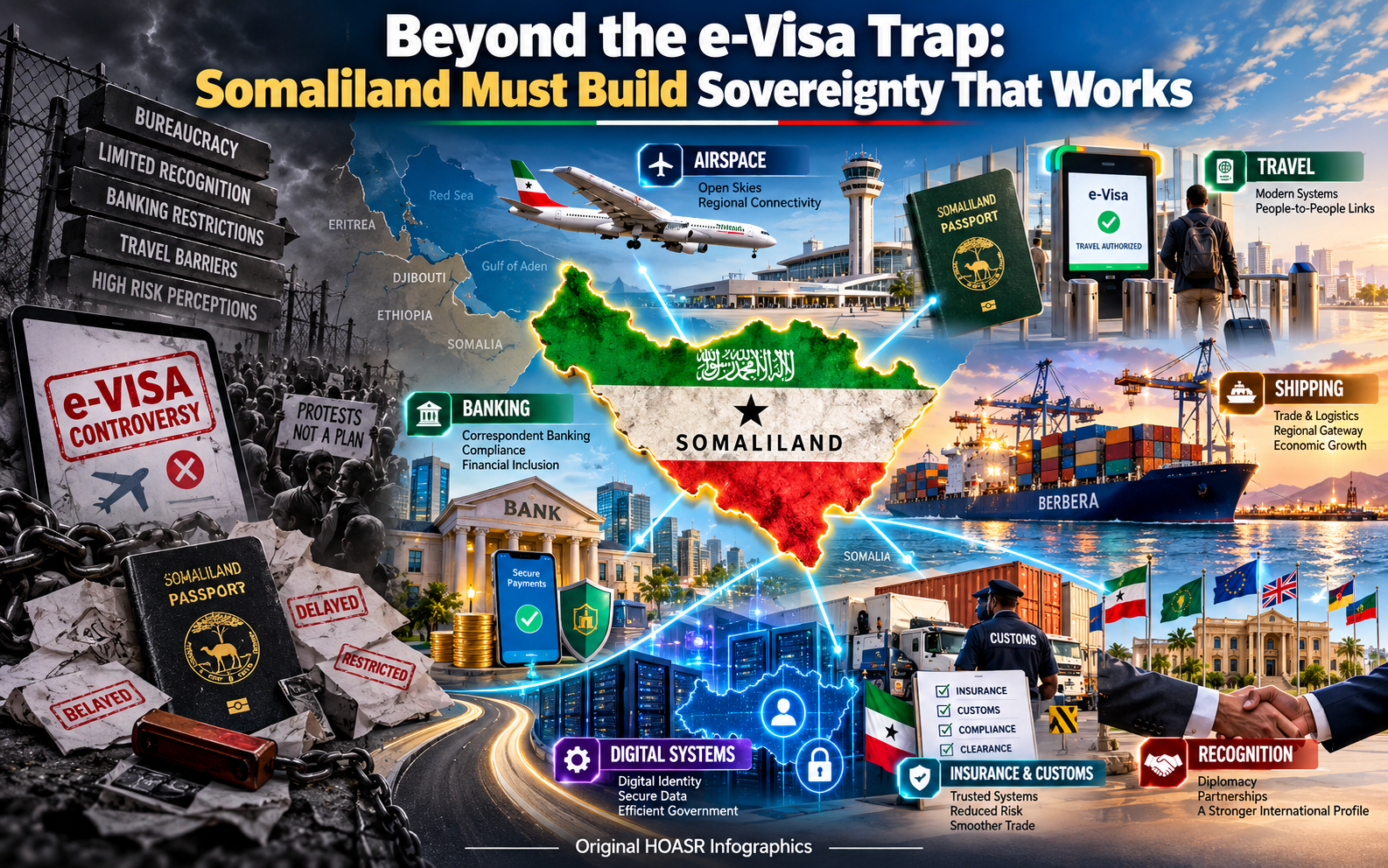
Somaliland’s sovereignty challenge extends beyond the e-Visa dispute to aviation, finance, shipping, digital systems, customs and international recognition. Original HOASR Infographics.
In my earlier analysis, “Somaliland Has a Strategic Exit From Somalia’s e-Visa Trap,” I argued that Hargeisa does not have to remain trapped inside an aviation and travel system designed around Mogadishu’s international recognition.
The immediate answer was to stop treating the e-Visa as an isolated insult and start behaving operationally like the sovereign authority Somaliland says it is and build a verifiable Somaliland electronic travel authorization, correct airline and IATA documentation, negotiate directly with carriers and partner governments, use Dubai as an established international gateway, turn Israel’s recognition into practical aviation arrangements, and revive the unfinished 2013 airspace agreement.
Sovereignty becomes more credible when Somaliland can make its own systems work from the airline booking screen to the immigration desk in Hargeisa.
The e-Visa was only one trap. There are others.
That is only the tip of the iceberg. The same structural vulnerability appears wherever international systems still default Somaliland to Somalia. Somaliland therefore must prepare now—not by protesting each new trap after it closes, but by identifying the traps in advance and building lawful alternatives. Acting sovereign means more than defending a flag or issuing a communiqué. It means making Somaliland increasingly difficult to route through Mogadishu’s authority.
The e-Visa fight is only one of several systems that can constrain Somaliland—and why Hargeisa must build sovereign capacity now as I argued in this blog earlier in
Somalia’s Strategy.
The Somalia e-Visa controversy exposed something larger than a dispute over a travel document. It exposed Somaliland’s most important strategic vulnerability.
For thirty-five years, Hargeisa has built many of the institutions of a state while remaining dependent on international systems that still routinely route Somaliland through Mogadishu. That contradiction can remain quiet for years. Then suddenly it appears at an airline counter, inside a banking compliance screen, on an insurance form, in a travel advisory, through a shipping document or inside an international organization’s database.
Airspace is another. International banking is another. Travel advisories, correspondent banking, shipping documentation, insurance classification, digital identity, international country coding and access to multilateral institutions can all become pressure points through which Somalia’s recognition is converted into practical authority over Somaliland.
That is why the next phase of Somaliland’s sovereignty strategy cannot consist mainly of protesting each new restriction after it appears. Somaliland must begin acting like a sovereign state wherever international law, commercial practice and technical capacity allow it to do so.
Not recklessly. Not by issuing declarations that cannot be enforced. Not by creating dangerous rival aviation instructions or circumventing financial regulations. But by building systems that work.
That is the central argument. Somaliland’s survival as an independent political project will increasingly depend on whether it can transform sovereignty from a constitutional claim into a network of functioning international relationships.
The Financial Trap
The e-Visa trap is visible because travelers feel it immediately but the financial trap is less visible, but potentially far more serious.
A country can control its parliament, police, airports and ports yet remain economically constrained if its banks cannot establish normal correspondent relationships, companies struggle to make international payments, investors face excessive compliance uncertainty and diaspora remittances operate through expensive or restricted channels.
Washington is beginning to recognize this problem. H.R. 7993, the Somaliland Economic Access and Opportunity Act, would require the U.S. Treasury to examine the legal, regulatory and policy barriers preventing Somaliland from gaining fuller access to the American financial system. The initiative places KYC compliance, anti-money-laundering standards, counterterrorism financing safeguards, remittances and access to international financial infrastructure at the center of the discussion.
In September, Representative John Rose raised the issue directly with Treasury Secretary Scott Bessent. Bessent agreed that Treasury staff would review the proposal and engage further.
That is an opportunity and Somaliland should expedite the follow up process. The government is thankful to supportive members of Congress and should already be preparing answers to the files Treasury would need: updated AML/CFT rules, beneficial-ownership disclosure, sanctions screening, transaction monitoring, suspicious-activity reporting, correspondent-banking readiness and a credible national risk assessment. These questions may sound technical but they are important sovereignty questions.
Stop Waiting for Recognition to Fix the Plumbing
For too long, Somaliland diplomacy has sometimes followed an understandable sequence: first recognition, then everything else. That sequence is no longer sufficient. Recognition matters enormously. Israel’s formal recognition in December 2025 broke a barrier that had stood since 1991. It demonstrated that the diplomatic wall was not permanent.
But recognition alone cannot solve Somaliland’s structural weaknesses. If Israel recognizes Somaliland while Somaliland’s businesses still cannot easily transact internationally, the job is unfinished. If a government recognizes Somaliland but international passengers remain routed through Somalia’s travel-document system, the job is unfinished. If Somaliland controls Berbera but shipping, insurance and financial documentation continue to treat the country as an administrative extension of Somalia, the job is unfinished.
Recognition must become infrastructure.
It must become airline agreements, financial channels, insurance classifications, customs interoperability, investment treaties, direct government-to-government documentation and commercial relationships.
Otherwise Somaliland risks acquiring flags abroad without acquiring sufficient functionality at home.
America Is Pointing to Another Trap: Travel and Investment
There is now a second American policy avenue that Somaliland should treat with equal seriousness.
The Somaliland Travel and Investment Act, introduced in the U.S. House in September 2026, calls for consideration of a U.S. representative office in Hargeisa and a separate travel advisory treatment for Somaliland.
Again, this is not recognition. But it demonstrates precisely how sovereignty can advance through systems before the final diplomatic question is settled.
Travel advisories affect insurance. Insurance affects investors. Investor risk assessments affect capital. Capital affects employment. One line on a government website can therefore impose millions of dollars in indirect economic costs.
Somaliland must learn to dismantle this trap systematically. Instead of merely complaining that foreign governments lump Somaliland together with Somalia, Hargeisa should provide them with the evidence required to separate the two: crime statistics, airport-security records, terrorism incidents, road-security assessments, emergency medical capacity, evacuation procedures, hotel-security information, political-risk data and consular-access arrangements.
Hargeisa must build the evidence package before asking for the policy change. That is what acting like a state looks like.
The Financial System Is the Next Airspace Trap
Hargeisa should study the e-Visa episode and recognize what may come next. Financial exclusion can become the next airspace dispute.
Imagine a Somaliland company attempting to purchase industrial equipment from Europe. Its bank transfer is flagged. The compliance system cannot identify Somaliland independently. The bank classifies the jurisdiction through Somalia. The transaction requires additional review. An insurer demands a higher premium. A correspondent institution refuses exposure. The investment slows or disappears.
In fact, no soldiers crossed the border. No decree was issued. Yet Somaliland’s economic sovereignty has been constrained.
That is why the government should establish a Sovereignty Systems Task Force reporting directly to the Presidency.
Its job should not be ceremonial. It should map every international system where Somaliland remains administratively subordinated to Somalia and rank those systems according to economic and strategic impact.
Aviation. Banking. Shipping. Insurance. Travel documentation. Customs codes. Telecommunications. Postal systems. International statistics. Investment databases. Digital identity. Country-of-origin classifications. Government procurement platforms. Academic and professional accreditation.
Somaliland needs an inventory of the traps and to build strategic exits from them.
Berbera Must Become More Than a Port
The UAE provides perhaps the clearest example of what functional sovereignty can look like.
DP World’s investment has connected Berbera more deeply to international logistics and the Jebel Ali commercial ecosystem. That relationship should now be expanded far beyond port handling.
Berbera should become the place where Somaliland demonstrates that international commerce can interact directly with Somaliland institutions.
Digital customs. Electronic certificates of origin. Internationally recognized cargo tracking. Warehousing. Insurance services. Trade finance. Export inspection. Veterinary certification. Fisheries certification. Industrial processing. Commercial arbitration. Port cybersecurity. Regional distribution.
The Berbera Economic Zone should not merely attract buildings. It should attract systems.
Every container cleared through a functioning Somaliland customs platform is a small exercise of sovereignty. Every foreign company that signs directly with a Somaliland authority creates another international relationship. Every insurer that prices Berbera based on measurable Somaliland risk instead of Somalia’s political category weakens the structural trap. That is how sovereignty becomes operationally sticky.
Taiwan Understands This Better Than Most
Taiwan remains one of Somaliland’s most relevant partners precisely because it understands how technical competence can sustain political space.
Taiwan and Somaliland have maintained representative offices since 2020, and cooperation has expanded across agriculture, healthcare, ICT, education, energy, minerals, infrastructure, business and trade.
Somaliland should now push that partnership into the machinery of government itself. Secure digital identity. Electronic customs. Cybersecurity standards. Land registries. Business registration. Tax administration. Government cloud infrastructure. Digital signatures. Secure document verification. Electronic health systems. Interoperable ministries.
A modern state should not require foreign governments to believe every claim Hargeisa makes. Its systems should prove the claim.
A customs certificate should verify electronically. A business licence should authenticate online. A Somaliland visa should be checkable internationally. A commercial record should have traceable legal standing. A government signature should be digitally verifiable. These may look like administrative reforms. They are instruments of sovereign sustainability.
Israel’s Recognition Must Produce Machinery
Israel’s recognition has strategic value precisely because it can create precedents.
The relationship has already moved beyond symbolism. Somaliland has established diplomatic representation in Israel and expanded official contacts. The next stage must be practical.
Somaliland should ask Israel for practical recognition: aviation agreements, investment protection, agricultural certification, banking and fintech cooperation, cybersecurity, water technology, professional training, commercial arbitration, university partnerships, tourism procedures and direct recognition of Somaliland government documentation.
Recognition becomes strategically valuable when it changes the behavior of institutions. One embassy is important. A hundred working institutional connections are by far much stronger.
But Somaliland Must Not Replace One Dependency With Another
There is a danger in this strategy. Somaliland should not escape administrative dependence on Mogadishu only to become excessively dependent on Jerusalem, Abu Dhabi, Taipei or Washington. Israel should help Somaliland build aviation capacity, not operate Somaliland’s skies.
Taiwan should help secure digital government, not own Somaliland’s databases. The UAE should invest in Berbera, not become the sovereign authority over Berbera. The United States should help open financial pathways, not dictate Somaliland’s domestic financial architecture. Partners provide capability. Somaliland retains ownership. This strategy must remain non-negotiable.
Sustainable sovereignty means having many partners and no master.
China Is Part of the Pressure—but Somaliland Should Not Become a Proxy
China’s opposition to Somaliland’s relations with Taiwan and its support for Somalia’s territorial-integrity position create an obvious geopolitical pressure point.
But Somaliland should resist turning its state-building project into an anti-China campaign.
The stronger strategy is diversification. Israel. Taiwan. UAE. United States. United Kingdom. European states. India. Japan. South Korea. African partners. Ethiopia. Kenya. Gulf markets. The objective should be to create so many legitimate international relationships that isolating Somaliland becomes commercially and diplomatically expensive.
That is much more durable than choosing one geopolitical camp. A small state survives by multiplying options.
Government Ministries Must Stop Working in Silos
Another trap is domestic. Somaliland often treats aviation as an aviation issue, banking as a finance issue, recognition as a foreign-ministry issue and Berbera as a commerce issue. They are now one issue. Sovereignty.
The Ministry of Foreign Affairs cannot win recognition if the financial system is not internationally usable. The Ministry of Civil Aviation cannot solve airline documentation without Immigration. Immigration cannot solve it without digital systems. Digital government cannot function without cybersecurity. Investment cannot grow without insurance and correspondent banking. Berbera cannot reach its potential without customs, finance, logistics, energy and international certification.
The government therefore needs a single strategic architecture connecting these ministries. Not another conference. Not another committee that issues communiqués.
A government delivery mechanism with measurable targets must include which international database has been corrected? Which airline accepts Somaliland documentation? Which bank opened a compliant correspondent channel? Which government separated its travel advisory? Which insurer revised its Somaliland risk classification? Which state began recognizing Somaliland-issued certificates? Which international company registered directly in Hargeisa? Those are sovereignty metrics.
The Next Recognition Campaign Should Be Built Around Function
Somaliland’s diplomats should continue asking governments for formal recognition.But the pitch should evolve. Do not only tell governments what happened in 1960. Tell them what they are doing today and ask them to:
Recognize Somaliland passports. Recognize Somaliland visas. Accept Somaliland certificates of origin. Negotiate air services. Open liaison offices. Allow development finance. Create direct customs cooperation. Separate travel advisories. Establish university agreements. Create investment guarantees. Recognize professional qualifications. Permit direct banking engagement under proper compliance standards.
Each one establishes another piece of international personality. Recognition then becomes less like jumping over a wall and more like crossing a bridge that has already been built.
THE SCOOP: Sovereignty Must Become a Daily Government Function
The e-Visa dispute may eventually be remembered as useful. Not because Somaliland wanted it. But because it exposed the weakness of assuming that effective control at home automatically produces functional sovereignty abroad.It does not.
Somalilanders should stop treating sovereignty as something that begins the morning after universal recognition. Act on it now wherever law, capacity and international partnership permit.
Build the aviation system. Build the financial compliance system. Build the digital state. Build the maritime regime. Build the investment architecture. Build the diplomatic network. Build the commercial precedents.
Then recognition is no longer being asked to create Somaliland. it is being asked to acknowledge what Somaliland has already made impossible to ignore.
And that is the difference between claiming sovereignty and sustaining it. And after the e-Visa trap, Somaliland can no longer afford to confuse the two.
Related Topics
Related Posts