Geopolitical Analyst: Bridging Somaliland & Israel to the world
Berbera: The Missing Shore Of The Middle East Defense Shield
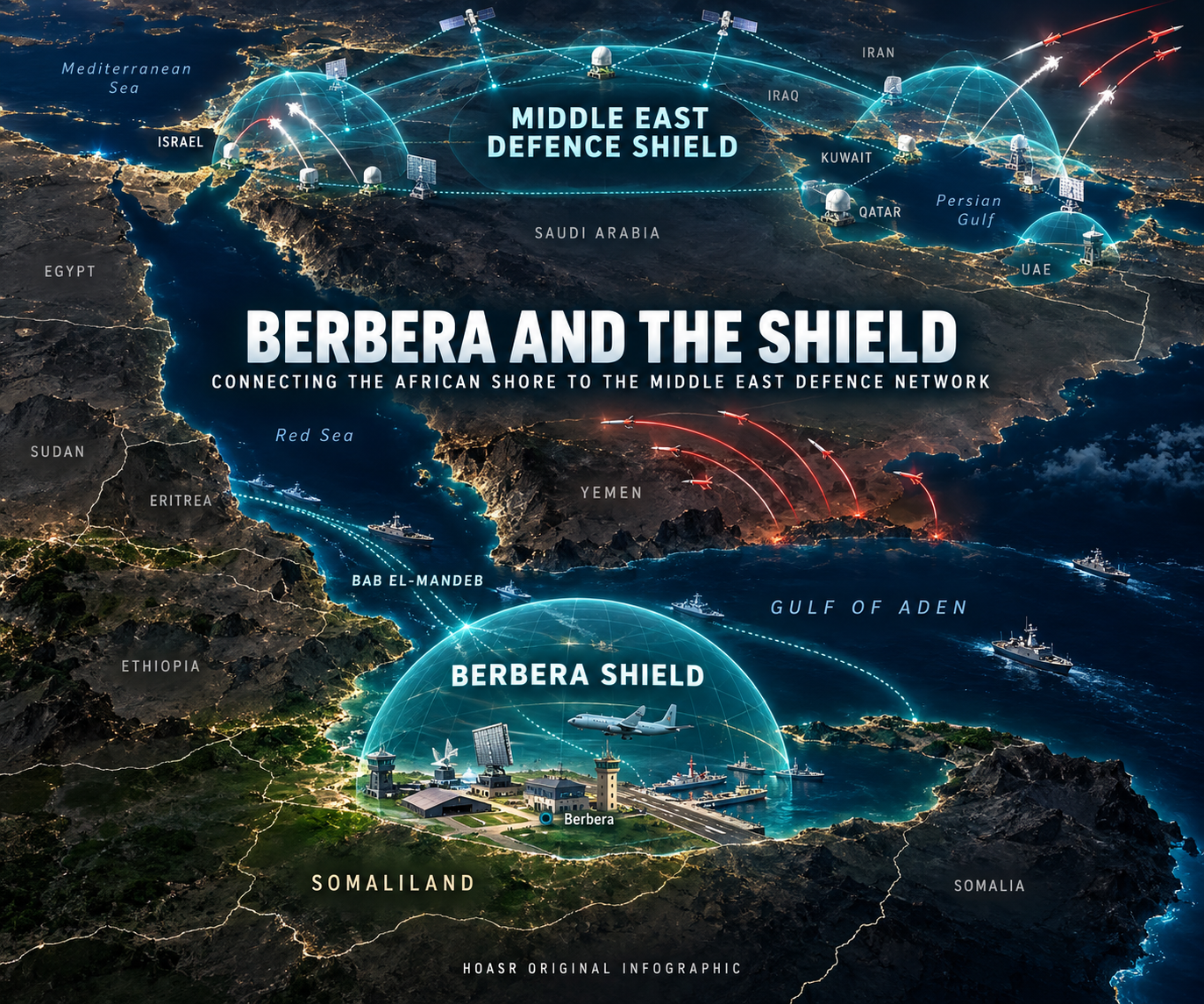
Berbera could provide the African-side surveillance and contingency depth missing from the emerging Middle East regional defence network.
A regional air-defence network is taking shape against Iranian and Houthi missiles and drones. Its southern blind spot places Somaliland and Berbera directly inside the next geopolitical strategic debate.
A regional air-defence system is emerging across the Middle East, built less through treaties than through necessity. Iran and the Houthis have forced the United States, Israel and several Arab states to share information, coordinate interceptions and connect military systems that once operated separately. The structure remains politically discreet, but it is becoming operationally real. Its next weakness is also becoming harder to ignore: the network is strongest around Israel and the Gulf while the African shore facing Yemen remains thinly connected.
A Jerusalem Post analysis published on 22 September drew attention to a recent US inspector-general report on Operation Epic Fury. It described American forces embedded in partner air-operation centres and a Middle East defence network that reportedly intercepted more than 6,000 one-way attack drones and more than 1,500 ballistic missiles. The report also outlined coordination between US Patriot and THAAD batteries and Israel’s Arrow, David’s Sling and Iron Dome systems, supported by liaison officers and shared operational awareness. Those figures come from the US report as presented by the newspaper and should be attributed accordingly, but the larger direction is unmistakable: regional defence is moving from parallel national efforts towards a connected warning and interception system.
This development did not begin in 2026. Israel’s transfer from the area of responsibility of US European Command to US Central Command created the institutional opening. In a 2022 Senate Armed Services Committee hearing, CENTCOM’s commander said Israel’s entry had created opportunities, particularly in integrated air and missile defence. The Pentagon later confirmed that American officials had convened regional working groups on integrated air and missile defence and maritime security. CENTCOM’s published strategy now places interoperable capabilities and the sharing of critical intelligence at the centre of its regional security model.
The October 2023 war disrupted open political normalization, but missiles and drones produced a different form of cooperation. Iranian and Houthi attacks created an immediate need to exchange radar tracks, identify flight paths, prevent friendly-fire incidents and decide which country or system was best positioned to intercept an incoming weapon. A shared threat began doing what diplomacy alone had failed to accomplish. Governments that remained cautious about visible relations with Israel still had strong reasons to coordinate their airspace and protect cities, energy facilities, military bases and shipping routes.
The maritime front made the same lesson visible. The Pentagon reported that American and partner vessels had intercepted dozens of Houthi missiles and unmanned systems over the Red Sea, while later US statements said the Houthis had launched more than 100 drone and missile attacks against American and allied ships. Operation Prosperity Guardian brought more than two dozen countries into a maritime security effort, and US-Gulf discussions linked that mission to wider missile-defence cooperation. Yet ships can patrol only part of the threat environment. Warships are costly interception platforms, their coverage moves with deployment patterns, and naval operations do not by themselves provide a permanent surveillance picture across the southern entrance to the Red Sea.
That is where Berbera enters the argument. Somaliland’s port and airfield sit on the Gulf of Aden across from Yemen and east of the Bab el-Mandeb approaches. From that position, Berbera could support radar coverage, maritime-domain awareness, unmanned surveillance, search and rescue, logistics, aircraft dispersal and emergency access. It would not replace Djibouti, Gulf installations or naval forces. It could give the wider network depth on an African coastline that has become increasingly important as Houthi capabilities, Iranian reach and commercial-shipping risks converge.
The geography is compelling, but the bureaucracy is awkward. Yemen, the Gulf and Israel fall within CENTCOM’s operating area; Somaliland lies within US Africa Command’s. A missile or drone launched across the Gulf of Aden does not respect that organizational boundary. Sensors, permissions and decision-making, however, can be divided by it. Berbera therefore sits close to a strategic seam between two American commands at the precise point where Middle Eastern air defence, African security and Red Sea maritime protection meet.
For Washington, this creates a policy question larger than recognition alone. The United States does not need to settle every diplomatic issue before considering practical security cooperation. It could begin with technical assessments, coastguard support, maritime information-sharing, airfield-safety work, joint contingency planning and carefully defined access arrangements. Each step would require Somaliland’s consent, transparent terms and protection of civilian infrastructure. Such cooperation would also need clear limits so that Berbera did not become an exposed forward platform without the defences needed to protect the city, port, airport and surrounding communities.
Somaliland should approach the opportunity with the same discipline. Strategic location is not a policy by itself. Hargeisa would need to decide what forms of cooperation serve Somaliland’s national interest, what level of foreign presence it would accept, which authorities would oversee agreements and how Parliament and the public would be informed. It would also need guarantees on training, infrastructure, local employment, environmental protection and liability. A vague promise of future diplomatic favour would be a poor exchange for open-ended military exposure.
The risks are real. Any visible role in operations against the Houthis or Iran could make Berbera a target for missiles, drones, sabotage, cyberattacks or proxy activity. It could also sharpen opposition from Somalia and generate pressure from governments that reject Somaliland’s international position. The answer is not to deny the strategic reality, but to manage it. Early-warning and defensive cooperation carries a different political and military profile from offensive strike operations. Somaliland should insist that those categories remain clear in both public language and written agreements.
Israel’s formal recognition of Somaliland in December 2025 gave this debate a new diplomatic foundation. It also created expectations that political recognition would produce practical cooperation. But recognition should not be confused with automatic military integration. A durable partnership would require technical teams, secure communications, legal arrangements, investment in protective infrastructure and coordination with the United States and regional partners. Public claims that Israeli or American forces are already operating from Berbera should still be treated cautiously unless supported by official agreements, identifiable deployments or independently verified evidence.
The emerging shield also offers Somaliland a stronger argument in Washington. For years, advocates presented recognition mainly through history, democracy and legal continuity. Those remain central. The new security environment adds a more immediate proposition: Somaliland can help protect the southern approach to one of the world’s most important maritime corridors. Its value lies not only in the port or runway, but in the ability to connect African geography to a defence system now being assembled across the Middle East.
American policy has often treated Somaliland as a question to be postponed while regional conditions mature. The conditions have now moved ahead of that caution. Iran’s missile reach, Houthi advances, operations and the development of integrated regional defence have changed how planners must view the Gulf of Aden. A security map centred only on the Arabian side is unfinished. Djibouti remains indispensable, but dependence on a single crowded location creates operational and political concentration. Berbera offers redundancy, distance and another line of observation across the water from Yemen.
The first responsible step would be a joint technical assessment rather than a dramatic basing announcement. American, Somaliland and willing partner specialists could examine radar horizons, communications links, runway and port resilience, air-defence requirements, emergency logistics and the protection of civilian areas. The findings could define what Berbera can realistically contribute and what investments would be necessary. This would replace speculation with evidence and allow political leaders to decide from a clear operational picture.
The Middle East’s new defence architecture is being built because threats arrived faster than formal alliances. Berbera should not be inserted into that structure through exaggeration, secrecy or wishful thinking. It should be considered because the geography, the threat direction and the need for a southern layer all point toward the Somaliland coast. The shield is taking shape. Its African edge remains incomplete, and Berbera is the strongest place to begin closing the gap.
Selected Sources:
The Jerusalem Post. How Arab Israeli air defense coordination is developing into a regional security shield. 22 September 2026.
US Central Command. Senate Armed Services Committee Hearing on the Posture of United States Central Command. 15 March 2022.
US Central Command. US Central Command Theater Strategy. accessed 23 September 2026.
US Department of Defense. Remarks on integrated air and missile defence and maritime security working groups. 13 February 2023.
US Department of Defense. DOD Takes Steps to Restore Stability in Red Sea Area. 27 February 2024.
US Department of Defense. At Gulf Cooperation Council US Participates in Maritime Missile Defense Working Groups. 22 May 2024.
US Department of Defense. Campaign Against Houthis Will Be Unrelenting Until Hostilities Cease. 17 March 2025.
Mada Masr. How Guinea Bissaus planned recognition of Somaliland fell apart. 10 August 2026.
Related Topics
Related Posts