
Geopolitical Analyst: Bridging Somaliland & Israel to the world
Berbera: Turning Red Sea Rivalry into Somaliland’s Strategic Power
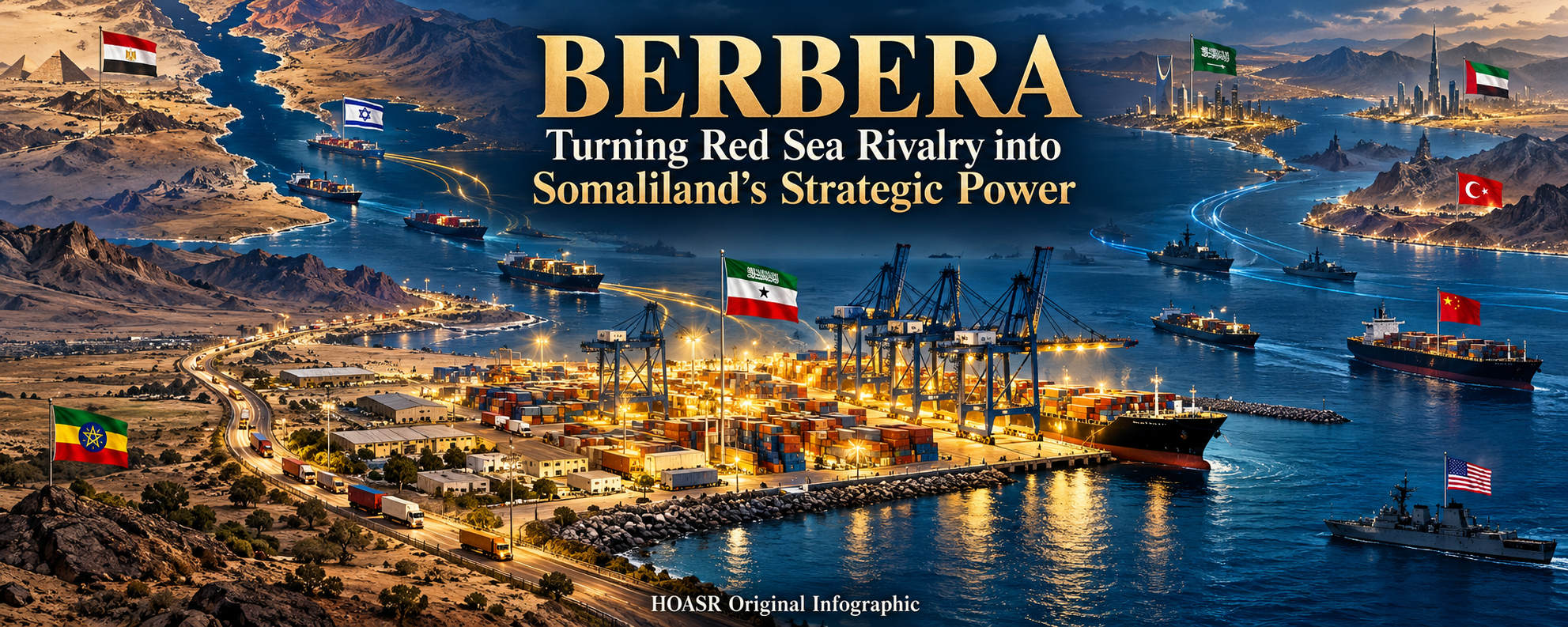
Berbera’s port and Ethiopian corridor place Somaliland at the intersection of trade, maritime security and regional competition. Credit: HOASR Original Infographic.
As the Horn of Africa and West Asia become increasingly interconnected, Berbera gives Somaliland greater bargaining power. Its port, Ethiopian corridor and potential security partnerships offer an opportunity to turn competing foreign interests into lasting investment, diplomatic support and national influence.
A Sea That Has Always Attracted Power
The Red Sea’s history is a history of trade routes becoming instruments of power. Long before today’s naval deployments and port concessions, its shores connected African commerce with Arabian markets and the wider Indian Ocean. The opening of the Suez Canal in 1869 transformed that regional passage into a central artery of global trade, sharpening competition over its gateways.
British and French involvement in the canal demonstrated how commercial infrastructure could become a means of exercising political authority far beyond the waterfront. Egypt’s nationalisation of the canal in 1956 brought sovereignty and foreign control into direct confrontation. Suez Canal history Historical analysis
Berbera’s place in this imperial contest was firmly established during the British Somaliland Protectorate. Its port supplied livestock and provisions to the British garrison at Aden, linking Somaliland’s inland trade routes to Britain’s strategic foothold across the Gulf. Aden, in turn, served Britain’s maritime communications with India, making the security of the Somaliland coast important to the wider imperial route.
British interest effectively combined the practical need to provision Aden with the strategic ambition to protect the passage towards India from rival powers. Berbera’s importance arose from the same connection between inland resources and maritime access that shapes its geopolitical value today. A Modern History of the Somali British parliamentary record, 1910
During the Cold War, the contest extended southward into the Horn of Africa. Berbera became a significant Soviet naval and aviation facility, placing the African shore of the Gulf of Aden within the strategic calculations of Washington and Moscow.
When Somalia expelled Soviet advisers and ended Soviet access in November 1977, the installation became available for the United States. American officials subsequently utilized Berbera’s potential contribution to their wider Indian Ocean strategy. The lesson remains relevant: the port’s geography survived, while the political relationships surrounding it changed. Soviet facilities End of Soviet access US strategic assessment
Today’s competition builds on that history, but it involves more actors and more ways of exercising influence. Naval facilities operate alongside commercial ports, transport corridors, investment agreements and security partnerships.
By 2018, the International Institute for Strategic Studies was already identifying expanding Turkish, Gulf, Chinese and American activity around Bab el-Mandeb. The conflicts now unfolding across the region have intensified a contest that was established well before the latest crisis. Access to the shore increasingly carries consequences for trade, diplomacy and the balance of power inland. IISS analysis
Two Shores, One Geopolitical Arena
The Horn of Africa and West Asia can no longer be adequately understood as separate strategic theatres. CARPO’s WASSAP discussion, Two Shores, One Sea, describes how Gulf competition, Sudan’s war, Yemen’s instability and the Iran crisis increasingly interact across the Red Sea.
Governments on the African shore also shape these relationships through their own ambitions and choices. Their partnerships influence how external rivalries develop and where they acquire a foothold. The sea connects political struggles as effectively as it connects markets. Two Shores, One Sea
For Somaliland, this convergence creates an opening centred on Berbera. The port sits within a wider contest involving Ethiopia’s maritime needs, Gulf investment, regional security and competing claims to political authority. Its importance grows when those interests overlap, giving Hargeisa several reasons for international partners to engage.
My central argument is that Somaliland can convert Berbera’s strategic value into lasting national influence by securing economic and diplomatic commitments that serve its own priorities. Geography supplies the opportunity; the substance of the partnerships will determine the outcome.
Rivalries Are Reordering the Region
Saudi Arabia and the United Arab Emirates increasingly approach the Horn through competing relationships and different preferences for regional order. Priyal Singh’s analysis for ISS Africa describes how investment, political patronage and security partnerships are drawing African states into these rivalries.
Türkiye’s mediation and engagement in Somalia add another dimension, while Egypt’s dispute with Ethiopia links Nile politics to maritime access. These relationships remain fluid, with cooperation in one arena coexisting with competition in another. Berbera enters a crowded field of overlapping interests rather than a settled division between two permanent camps. ISS Africa analysis
The El-Alamein declaration of 4 October illustrates how separate disputes can be assembled into a common diplomatic position. Egypt, Eritrea, Somalia and Sudan combined opposition to Somaliland recognition with a claim that Red Sea governance belongs exclusively to coastal states and an emphasis on protecting downstream Nile water uses.
In geopolitical terms, that combination places pressure on both Hargeisa’s international ambitions and Addis Ababa’s regional objectives. It does not establish that every participant shares an identical strategy, but it creates a mechanism for coordination. For Somaliland, the direct rejection of recognition makes the alignment consequential in its own right. El-Alamein declaration
Meanwhile, renewed fighting in northern Ethiopia threatens to deepen the connections between domestic conflict and interstate rivalry. Chatham House’s Ahmed Soliman and Abel Abate Demissie warn that the war could extend into Eritrea and become further entangled with Sudan.
Ethiopia’s maritime ambitions unfold against this increasingly difficult security background. Berbera’s potential importance to Addis Ababa therefore rises alongside uncertainty about Ethiopia’s ability to sustain commercial and diplomatic commitments. A major inland market offers opportunity, but instability within that market can also limit what the corridor delivers. Chatham House analysis
Berbera’s Power Begins with Its Commercial Foundations
Berbera’s strongest claim to lasting influence rests on infrastructure that can support sustained economic activity. DP World’s port development and the corridor towards Ethiopia provide a foundation for moving goods between an inland economy and international markets. A 2021 agreement with Ethiopia’s transport ministry predicted further logistics infrastructure, including warehouses, dry ports and freight services.
Those proposals indicate the corridor’s economic scope, although proposed investment must be differentiated from completed delivery. The strategic value of the route ultimately depends on cargo moving through it reliably, safely and competitively. DP World corridor agreement
For Hargeisa, an effective corridor could create relationships that reach beyond any single diplomatic encounter. Ethiopian importers, exporters, transport operators and investors would acquire practical interests in the route’s continuity.
Commercial dependence could give Somaliland a stronger place in regional negotiations, while expanding opportunities for its own businesses and workers. Port revenue matters, but so do the services and industries that develop around it. A functioning economic network gives partners reasons to remain engaged after the immediate security crisis has passed.
Recent events also demonstrate that Berbera’s commercial relationships have political resilience. In January, DP World told Reuters that its operations continued under existing agreements despite Mogadishu’s decision to cancel agreements with the UAE.
This exposed the distance between Somalia’s diplomatic claims and the relationships operating on the ground in Somaliland. It also showed why Berbera has become part of the regional struggle over authority, investment and external partnerships. The port is already consequential because decisions concerning it affect interests beyond Somaliland’s borders. Reuters reporting
Security Interest Must Produce National Gains
Maritime insecurity adds another dimension to Berbera’s appeal. Carnegie’s Andrew Leber and Lesley Anne Warner connect Houthi advances to growing strategic interest in Somaliland and discussion of greater American engagement.
Their analysis also considers the constraints surrounding Djibouti and the wider security consequences of cooperation between the Houthis and Al-Shabaab. For Berbera, these developments could increase interest in logistics, surveillance and other forms of security cooperation. They strengthen the case for engagement without establishing that a specific foreign basing arrangement has been concluded. Carnegie analysis
Berbera’s position on the Gulf of Aden gives it potential value as a supporting facility, but it cannot by itself restore safe passage through Bab el-Mandeb. Its contribution would depend on the capabilities, agreements and wider strategy associated with its use which makes the terms of any security partnership especially important for Somaliland.
Access that serves a partner’s operational needs should also produce identifiable benefits for local institutions, infrastructure and public security. Otherwise, increased strategic attention could bring greater exposure without a comparable national benefit.
Singh’s warning is relevant here: African countries may gain investment and diplomatic backing while becoming more controlled by competing security relationships. Applied to Berbera, the risk is that commercial and defence arrangements gradually reduce Hargeisa’s space to negotiate.
The same infrastructure that attracts several partners could become closely tied to the priorities of one. Somaliland’s bargaining position is strongest when agreements preserve its authority and leave room for additional relationships. Strategic usefulness carries greater value when it supports continuing choices. ISS Africa analysis
From Strategic Attention to Diplomatic Weight
Berbera can strengthen Somaliland’s diplomatic case by making engagement materially useful. A partner with investments, commercial traffic or security cooperation at stake has a practical reason to support stability and continuity in its relationship with Hargeisa.
That creates opportunities to seek deeper representation, clearer agreements and broader international participation. However, commercial cooperation and recognition remain separate political decisions. Carnegie’s September analysis found no public indication that increased interest had produced a change in American recognition policy at the time of publication. Carnegie analysis
Nevertheless, each durable agreement can widen Somaliland’s international relationships and demonstrate its capacity to implement commitments. Economic performance can reinforce the argument for political engagement, while effective institutions can increase confidence in future cooperation.
Berbera can contribute to that process by giving international partners concrete interests to consider. Its greatest diplomatic value lies in helping turn occasional attention into a sustained relationship with Somaliland itself.
The Scoop: Berbera Must Turn Access into Influence
Red Sea history shows that outside powers repeatedly return to useful shores, even as their alliances and priorities change. Berbera has experienced that cycle before. What is different today is Somaliland’s opportunity to negotiate the port’s role through its own institutions and connect foreign interest to its national future.
The objective is to secure relationships whose value extends beyond the needs of a temporary deployment or a passing regional crisis. That requires commercial strength, credible commitments and political authority over the decisions shaping the port.
Regional interdependence can increase Somaliland’s bargaining power, provided Hargeisa actively shapes the relationships it enters. Berbera offers a meeting point for maritime security, Ethiopian trade and international investment.
A successful strategy would make those interests reinforce Somaliland’s prosperity and diplomatic standing. The measure of success will be what remains when the current crisis changes: productive infrastructure, sustained commerce, stronger institutions and partners committed to the country’s future.
Berbera’s opportunity is to make Somaliland’s stability part of other countries’ strategic calculations. A port that partners use is valuable; a country whose continued prosperity matters to those partners carries greater influence. The new Red Sea contest gives Hargeisa an opening to build that position. Its lasting achievement would be to turn access to Berbera into a durable stake in Somaliland’s development.
Related Topics
Related Posts