Geopolitical Analyst: Bridging Somaliland & Israel to the world
From Berbera to Washington: Military Reality Behind Somaliland’s Strategic Rise
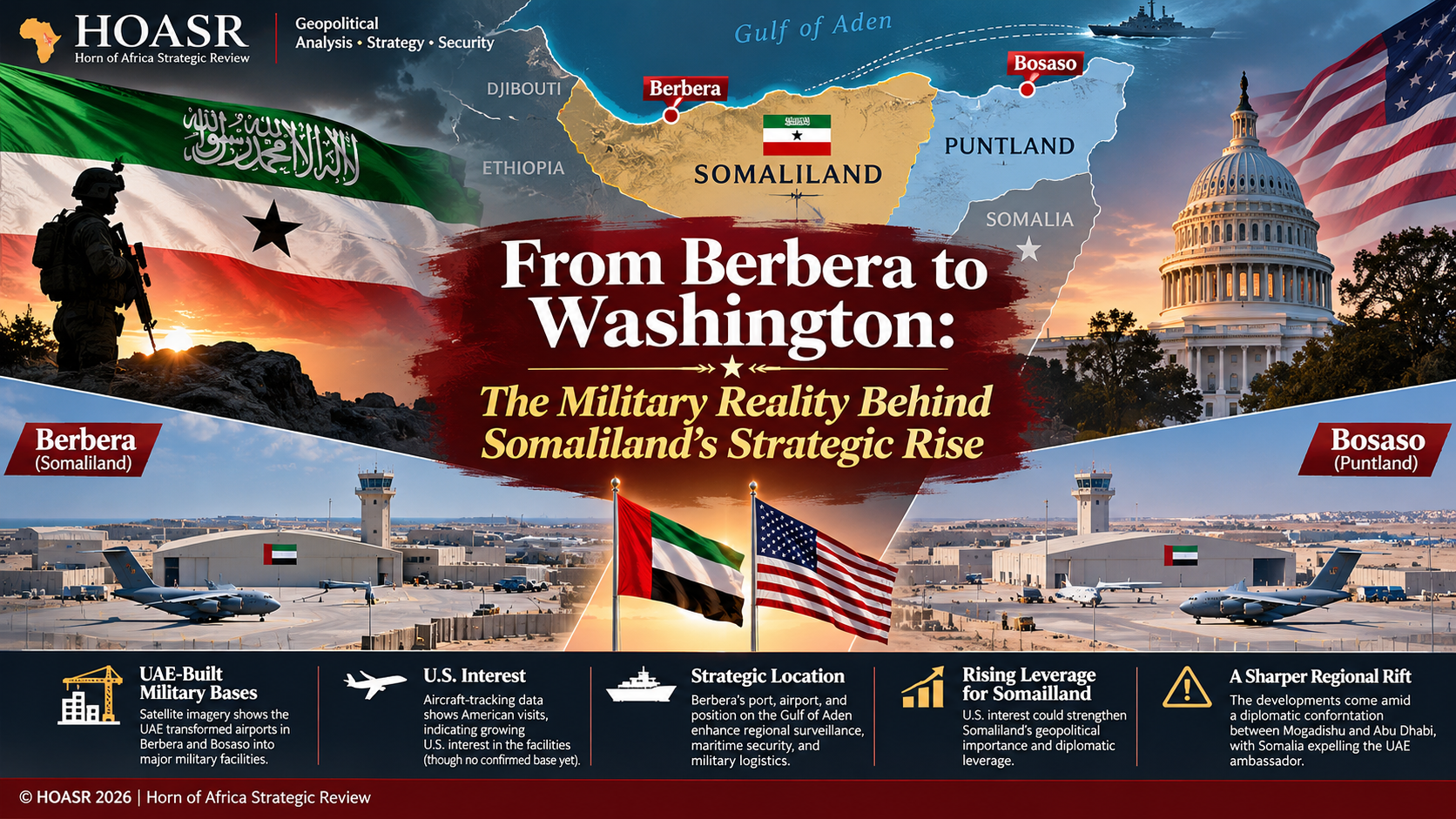
From Berbera to Washington: UAE military infrastructure, American strategic interest, and Somaliland's growing importance in Red Sea security. © HOASR 2026.
How new American interest in UAE-built military facilities is changing the strategic debate over Somaliland, the Red Sea and international recognition.
The New York Times Confirms a Growing Strategic Reality
A major investigation published by The New York Times on November 20, 2026, has brought renewed international attention to the United Arab Emirates’ military infrastructure in Somaliland and Puntland.
Titled “The U.A.E. Quietly Built Two Bases in Somalia. Now the U.S. Is Eyeing Them”, the investigation examines how civilian airports have been developed into substantial military facilities and presents flight-tracking evidence of American visits.
The investigation, produced by Christoph Koettl, Ainara Tiefenthäler, Jay Liquori and Zach Caldwell, adds a new dimension to a story that has been developing for several years.
What began as Emirati investment in ports and aviation infrastructure has become part of a broader struggle over military access, maritime security and political influence along the Gulf of Aden.
The importance of the report extends beyond the construction of military facilities. It raises a strategic question for Somaliland: can the growing value of Berbera to American security interests help transform Somaliland’s long-standing relationship with Washington into a more substantial political and diplomatic partnership?
The answer remains uncertain, but the evidence of American interest is becoming increasingly difficult to dismiss.
Berbera Was Already on Washington’s Strategic Map
The New York Times is not the first international publication to investigate the military significance of Berbera. On July 6, 2026, the French newspaper Le Monde reported that the UAE was developing military infrastructure at Berbera airport that could serve American and Israeli interests.
The International Institute for Strategic Studies reached a similar conclusion in January. Its analysis of satellite imagery and aviation activity identified infrastructure at Berbera consistent with military logistics and protective storage arrangements. The IISS assessment also examined the possibility that Israel’s recognition of Somaliland could eventually facilitate military access.
These separate investigations point to an important development. Berbera’s strategic significance is no longer explained simply by the commercial ambitions of DP World or Ethiopia’s search for alternative maritime routes.
The airport and port have become relevant to military planning in a region where shipping security, regional conflict and international competition increasingly overlap.
The clearest official American evidence came in November 2025, when General Dagvin Anderson, commander of U.S. Africa Command, visited Somaliland and met President Abdirahman Mohamed Abdullahi Irro and senior military leaders.
According to AFRICOM’s official announcement, American military officials toured Berbera Port to assess its security environment and operational capacity. This was not a routine diplomatic visit by civilian officials. It involved the leadership of the American military command responsible for operations across Africa.
The visit demonstrated that Washington was examining Berbera’s operational value directly, rather than relying exclusively on assessments conducted through Mogadishu or Djibouti.
Why the Gulf of Aden Is Becoming More Important
Berbera occupies a strategic position on the southern coast of the Gulf of Aden, along the approaches to the Bab el-Mandeb Strait. Beyond that narrow passage lies the Red Sea, the Suez Canal and one of the principal maritime connections between European and Asian markets.
The security of this corridor has become increasingly important because of Houthi attacks on commercial shipping, the wider confrontation involving Iran and its regional adversaries, and the growing presence of outside powers around the Horn of Africa.
For the United States, these developments create practical military concerns. Protecting shipping requires intelligence, surveillance, aircraft access, logistical support and reliable regional partnerships.
Existing American facilities in Djibouti remain central to those requirements, but additional access points may provide operational flexibility.
Berbera offers several possible advantages. It combines an international airport with an expanding deepwater commercial port and access to open waters along the Gulf of Aden. Its position also places it near maritime routes affected by instability in Yemen.
Berbera’s importance lies in the possibility of providing additional options to military planners who increasingly face overlapping threats across the Red Sea, Gulf of Aden and western Indian Ocean.
Therefore, cooperation with Hargeisa can strengthen the regional security network already operating in this increasingly contested maritime environment.
The UAE Built the Infrastructure. Washington Is Examining Its Value.
The United Arab Emirates has spent years developing a network of commercial and military relationships around the Horn of Africa. Its interests extend from Berbera and Bosaso to wider operations connected with Yemen, Sudan and the Red Sea.
A January 2026 investigation by The Washington Post documented the UAE’s airfield and port presence at Berbera and its military base at Bosaso. The newspaper described Bosaso as an important Emirati logistics hub, including facilities associated with drone operations.
Earlier, Reuters investigated military-related cargo movements involving the Horn of Africa. Its December 2024 reporting included accounts of aircraft movements connected to Bosaso and military equipment reportedly arriving at Berbera.
The latest New York Times investigation adds attention to the possible American use of facilities originally developed through Emirati relationships.
Such cooperation could bring advantages in maritime surveillance, counterterrorism, military training, emergency logistics and protection of strategic infrastructure.
Somaliland would need clear agreements defining the permissible use of its territory, the authority of its institutions and the limits of foreign military activity.
Partnerships become lasting national assets when they operate through transparent political authority and serve Somaliland’s long-term interests.
Mogadishu’s Sovereignty Claims Meet the Reality of Control
The military significance of Berbera exposes a fundamental contradiction in Somalia’s approach to Somaliland.
Mogadishu continues to claim sovereignty over Somaliland and opposes independent security and diplomatic agreements concluded by Hargeisa.
Yet Somaliland has maintained its own government, security institutions and administration since restoring its independence in 1991.
This contradiction became particularly visible in March 2025. According to Reuters, President Hassan Sheikh Mohamud offered Washington access to strategic facilities that included the port and airport at Berbera.
The offer was politically embarrassing. Mogadishu was proposing American access to facilities that Somaliland’s government actually controls and administers.
This is the contrast between an internationally asserted territorial claim and the practical authority required to operate a military or commercial facility. Any agreement involving Berbera cannot function at all without engagement with the Somaliland authorities exercising full control there.
The latest diplomatic confrontation between Somalia and the UAE reinforces this reality.
On November 19, 2026, Reuters reported that Mogadishu ordered the Emirati ambassador to leave within 72 hours, accusing Abu Dhabi of violating Somali sovereignty. The UAE responded that its embassy had already closed and its diplomatic personnel had departed in January.
The confrontation illustrates the limited practical reach of Somalia’s pressure campaign against Abu Dhabi’s partnerships beyond Mogadishu’s control in
My earlier analysis.
Somaliland’s political authority and functioning institutions are key to reliable security arrangements and partnerships that other governments consider valuable.
Military infrastructure alone does not establish sovereignty. But the ability to administer territory and maintain international agreements is highly relevant to how outside powers assess a potential security partner.
Israel Adds a New Strategic Dimension
Israel’s formal recognition of Somaliland on December 26, 2025, changed the diplomatic environment in which these military developments are taking place.
Recognition introduced a new relationship between two governments with interests in Red Sea security, maritime surveillance and countering threats from armed groups operating in the region.
For Jerusalem, Somaliland’s geographical position offers opportunities to strengthen its understanding of developments across the Gulf of Aden and the southern approaches to the Red Sea. For Hargeisa, the relationship offers potential cooperation in intelligence, military training, technology and strategic infrastructure.
The relationship has already moved beyond diplomatic symbolism.
In June 2026, Somaliland Defence Minister Mohamed Yusuf Ali confirmed to Reuters that Israel was providing training to Somaliland police and military personnel. He also denied that an Israeli military base had been established or that negotiations for one were underway at that time.
One must clearly differentiate military training, intelligence cooperation and possible future access arrangements do not necessarily imply a permanent foreign base.
Nevertheless, Somaliland’s expanding relationships with Israel and the UAE create opportunities for a broader security partnership. American involvement could make that arrangement strategically more significant.
Washington understands that cooperation with a Somaliland government already engaged with Israel, the UAE and Ethiopia may offer practical advantages in a region where competing powers are attempting to shape the security environment. It is a good reason for American policymakers to re-examine Somaliland’s potential.
Washington’s Recognition Dilemma
The United States has traditionally maintained its diplomatic support for Somalia’s territorial integrity while engaging Somaliland through security, development and political channels.
As the strategic importance of Berbera grows, that policy faces a more visible contradiction.
Washington may find increasing military value in a territory whose independence it has not formally recognized. It may also discover that its regional security objectives require closer direct cooperation with the Somaliland authorities who control the infrastructure involved.
This creates two separate questions:
The first is operational: how can the United States obtain reliable access to facilities and partnerships that help protect its interests?
The second is political: whether continued nonrecognition remains consistent with America’s evolving interests in the Horn of Africa.
A military access agreement would not automatically answer the second question. Washington could expand cooperation without changing its recognition policy.
Yet such an arrangement could strengthen the argument that Somaliland deserves a more direct and permanent place in American strategic planning.
Somaliland does not assume that strategic geography alone will produce recognition. It appreciates the political, security and economic value of a long-term partnership while at the same time continuing to make its historical and legal case for sovereignty.
Hargeisa’s objective is to convert geographical advantage into relationships that produce measurable benefits, including investment, institutional cooperation, military training and stronger international engagement.
From Military Geography to National Opportunity
The growing interest in Berbera should also be understood within Somaliland’s broader economic ambitions.
DP World’s investment has already helped establish Berbera as a major commercial gateway. Ethiopia’s interest in diversified maritime access gives the port additional regional significance. The airport and surrounding infrastructure introduce another dimension to its development.
Together, these assets create opportunities for Somaliland to develop a logistics and security partnership extending beyond commercial shipping.
Berbera’s success will ultimately be measured by more than the number of foreign aircraft landing at its airport. The greater achievement is to translate strategic interest into infrastructure, employment, technical capacity and enduring diplomatic relationships.
A secure commercial port, a capable coast guard and a professional national defense force would provide Somaliland with lasting advantages irrespective of changes in foreign governments.
The Scoop: Washington Is Looking at the Reality on the Ground
The significance of the New York Times investigation lies in the broader picture that it reinforces.
American military interest in Berbera is no longer an abstract argument made only by Somaliland’s advocates. Earlier reporting by Le Monde, Reuters, The Washington Post and the IISS, together with AFRICOM’s acknowledged visit, provides substantial evidence that Berbera has entered serious international security discussions.
The precise nature of future American military access remains uncertain. Washington has not publicly established a permanent basing agreement through the evidence reviewed here, and its diplomatic recognition policy has not changed as a result of these reports.
But Somaliland’s strategic position has changed considerably.
Israel’s recognition, Emirati investment, Ethiopia’s maritime interests and growing American attention have created a diplomatic environment very different from the one Somaliland faced a decade ago.
President Hassan Sheikh Mohamud can continue opposing Somaliland’s international partnerships. He can challenge the UAE and demand that foreign governments deal exclusively through Mogadishu.
But the practical question confronting outside powers is increasingly about which authorities control the infrastructure, provide security and can deliver reliable cooperation.
Berbera has become more than a commercial port. It is emerging as one of the strategically important locations linking the Horn of Africa, the Gulf of Aden and the Red Sea.
Washington is examining the military reality on the ground. Somaliland’s task is to ensure that the political reality receives equal attention.
Related Topics
Related Posts