Geopolitical Analyst: Bridging Somaliland & Israel to the world
Türkiye’s Expansion in Somalia and Berbera’s Rising Military Power
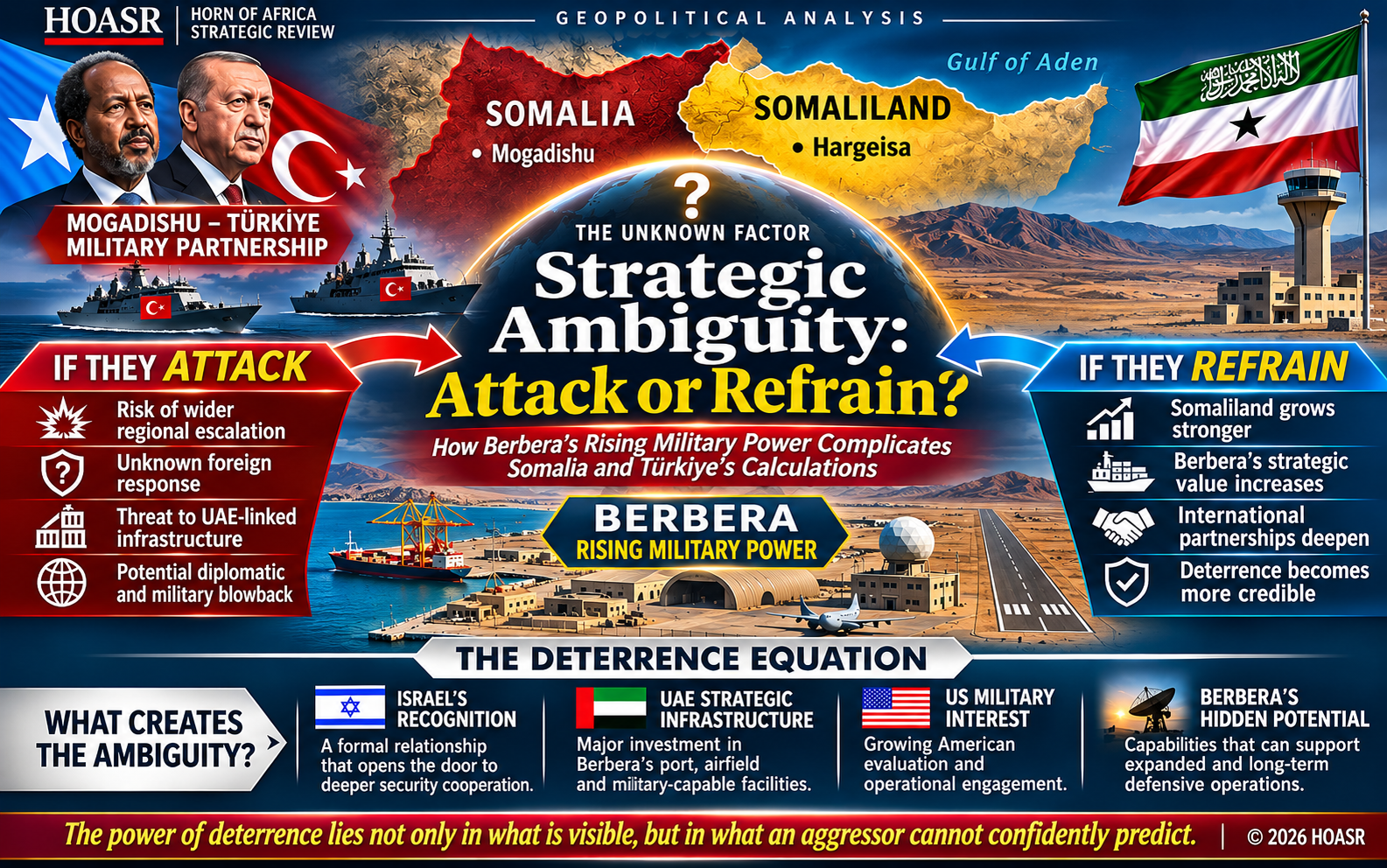
Strategic Ambiguity: How Berbera's military infrastructure and Somaliland's international partnerships could influence the cost of aggression. HOASR Original Infographics
Mogadishu may understand the capabilities it is developing with Turkish assistance. What it cannot confidently determine is the full political and strategic cost of testing Somaliland’s emerging security relationships
The Strategic Question Mogadishu Cannot Ignore
Two developments on November 20 and 21 have revealed an important change in the military balance around the Gulf of Aden. One concerns the expansion of military facilities at Berbera, while the other involves Türkiye’s growing naval and defence cooperation with Somalia.
Both developments are part of long-term projects, but their timing reveals how the strategic balance around the Gulf of Aden is changing.
On November 20, The New York Times published a visual investigation documenting how the United Arab Emirates has transformed the airports at Berbera in Somaliland and Bosaso in Puntland into substantial military facilities.
Satellite images showed aircraft shelters, fortified structures, underground storage facilities and defensive positions. The investigation also found that the United States was exploring greater military access to these facilities.
A day later, President Hassan Sheikh Mohamud welcomed Türkiye’s Chief of General Staff, General Selçuk Bayraktaroğlu, to Mogadishu. Together, they attended the groundbreaking ceremony for a new Somali Navy headquarters and related maritime facilities.
The visit came as Türkiye confirmed that a naval group of four frigates and two support vessels was continuing operations to protect Turkish offshore drilling activities near Somalia.
These events raise an important question for Somaliland: Will Berbera’s growing military capabilities and international partnerships create a credible deterrence against the expansion of Turkish-supported military power in Somalia?
Türkiye’s Expanding Military Presence Faces a More Complicated Environment
Türkiye’s military partnership with Somalia has entered a new phase. Ankara has trained Somali forces for years and established a substantial military presence in Mogadishu.
Under the ten-year defense agreement signed in February 2024, Türkiye committed to helping Somalia build, train and equip its naval forces. The events of November 21 demonstrated the continuing implementation of that agreement.
According to the Somali National News Agency, President Hassan Sheikh Mohamud and Türkiye’s military chief participated in the inauguration of the naval headquarters construction project.
At the same time, Turkish naval vessels have continued protecting offshore energy operations. Anadolu Agency reported on November 21 that a naval group including four frigates and two additional vessels was supporting the mission. These deployments demonstrate Türkiye’s growing ability to sustain maritime operations in the region.
Somaliland’s Warnings About Türkiye Are Becoming a Strategic Reality
Somaliland’s concerns about Türkiye’s expanding military presence in Somalia did not begin with the November 21 meeting between President Hassan Sheikh Mohamud and General Selçuk Bayraktaroğlu.
Senior Somaliland officials had already publicly warned that Ankara’s growing military support for Mogadishu could eventually threaten Somaliland’s security.
What makes the latest developments significant is that Türkiye is now helping Somalia establish the permanent naval institutions and command facilities needed to sustain military operations. These developments give greater urgency to warnings that Hargeisa has been raising for months.
In early October, President Irro’s senior foreign affairs adviser, Mohamed Osman Fadal, told Middle East Eye, as reported by The Jerusalem Post, that Somaliland wanted Israeli assistance in acquiring modern air-defence systems to counter Türkiye’s expanding military presence in Somalia.
Fadal, specifically identified Turkish fighter aircraft, drones and military cooperation with Mogadishu as reasons for Somaliland’s concerns. Mohamed Abdirahman Hassan, Director-General of Somaliland’s Foreign Ministry, also expressed concern that Somalia might consider using military force against Somaliland with Turkish assistance.
Their statements showed that the threat was already being discussed at senior levels of Somaliland’s government, although no Turkish plan to attack Somaliland had been independently established yet.
The concern reached another international audience on November 19, when Somaliland’s ambassador to Israel, Dr. Mohamed Hagi, addressed The Jerusalem Post Australia Summit in Sydney. Hagi discussed Türkiye’s expanding military and economic role in Somalia while emphasizing the importance of cooperation among Somaliland, Israel, the UAE, Ethiopia, the United States and India.
He made clear that Somaliland did not want a confrontation between Israel and Türkiye but considered stronger international partnerships essential for regional stability. His remarks reinforced the relationship between Somaliland’s growing diplomatic recognition and its need for credible national defence.
The Jerusalem Post reported on November 22 that Somalia’s defence minister described Turkish support as contributing to the country’s unity and statehood. From Somaliland’s perspective, that political language raises legitimate questions because Mogadishu continues to claim sovereignty over Somaliland and disputes its independent foreign partnerships.
Berbera’s Military Construction Is a Statement of Long-Term Intent
Modern military infrastructure is not built merely to occupy land or decorate an airport. Hardened aircraft shelters, underground storage facilities, protected logistics areas and preparations for defensive installations require planning, financing and strategic purpose.
Such facilities are generally designed to support military capabilities, including the possibility of rapid activation or expansion when circumstances require. They can provide the foundations for sustained operations, improve the protection of equipment, and reduce the time needed to deploy additional resources.
In July 2026, Le Monde documented extensive military-related construction at Berbera Airport. Satellite imagery revealed underground structures and raised platforms that military analysts considered potentially suitable for air-defence installations.
Earlier, the International Institute for Strategic Studies examined the growing military importance of Berbera following Israel’s recognition of Somaliland.
Together, these investigations establish that Berbera’s development is more than a political declaration. The physical infrastructure exists, and its construction reflects substantial long-term investment. What remains to be seen is what can potentially be deployed or activated and when.
Outside observers may identify runways, shelters and defensive positions through satellite imagery. They cannot necessarily determine the full operational arrangements, readiness levels or future deployment options associated with those facilities.
For military planners considering a confrontation, this lack of complete information creates uncertainty. And uncertainty can indeed influence decisions.
Israel’s Recognition Changed Somaliland’s Strategic Position
Israel’s recognition of Somaliland on December 26, 2025, was a diplomatic breakthrough. It was also an event with potentially significant security implications.
For more than three decades, Somaliland maintained its independence and built its institutions without formal recognition from a United Nations member state.
Somaliland now has a formally recognised state-to-state relationship with a country possessing advanced military technology, intelligence capabilities and considerable strategic interests in Red Sea security.
Recognition creates opportunities for formal cooperation between governments. It provides a diplomatic framework through which economic, technological, intelligence and security relationships can develop over time.
From the perspective of military planning, it also introduces an additional question: how might Israel respond to a serious threat against a state it has recognised and with which it is developing relations?
The absence of a publicly declared military guarantee does not eliminate the possibility of future cooperation or the uncertainty surrounding the response of international partners to a regional crisis.
A potential aggressor must calculate not only Somaliland’s own defensive capabilities, but also the broader political consequences of confronting a country with increasingly significant international relationships.
Israel’s recognition therefore has a security dimension even before the full practical extent of bilateral cooperation becomes publicly evident.
The Unknown Factor: Deterrence Through Strategic Ambiguity
Deterrence does not always depend on publicly displaying every capability or declaring exactly how a government will respond to aggression. Sometimes the uncertainty surrounding a possible response becomes part of the calculation. In military strategy, this principle is known as “strategic ambiguity”.
A potential adversary contemplating military action must consider several questions. What capabilities might be available? How quickly could additional resources be deployed? Which foreign interests might be affected? What diplomatic or military response could follow an escalation?
When those answers cannot be established confidently, the costs of aggression become harder to calculate. Berbera presents precisely this kind of strategic uncertainty.
Its expanding infrastructure is visible. The UAE’s substantial involvement is documented. Israel’s recognition of Somaliland is an established diplomatic fact. American military interest in Berbera has also been reported.
What outside observers cannot fully measure is how these different relationships might interact during a serious regional security crisis.
Military planners in Mogadishu and Ankara cannot responsibly examine Berbera solely in terms of Somaliland’s publicly visible military resources. They must also consider the possibility of wider consequences involving international partners.
Berbera’s deterrent value plays a key role in the gap between what potential adversaries can observe and what they cannot confidently rule out.
Mogadishu’s Strategic Dilemma: The Cost of Action and the Cost of Restraint
Military power does not operate independently of political circumstances. Türkiye has important commercial and diplomatic relations with the UAE.
It has interests in regional stability, maritime trade and energy exploration. It also maintains relationships with other countries whose interests are connected to the Gulf of Aden.
A confrontation involving Berbera could therefore carry consequences extending beyond Türkiye’s bilateral defence relationship with Mogadishu.
Berbera’s importance to the UAE, its developing relationship with Israel and the interest shown by the United States add further uncertainty to that calculation.
For Turkish military planners, the question is not simply what Somalia’s growing military capabilities make possible. It is whether a confrontation would remain limited to Somalia and Somaliland or produce wider diplomatic and security consequences.
That uncertainty places limits on the usefulness of military pressure as a political instrument.
The changing balance presents President Hassan Sheikh Mohamud’s administration with a difficult strategic choice. From Mogadishu’s perspective, these developments complicate efforts to challenge Somaliland’s independent decision-making and its growing international relationships.
Military pressure might appear to offer him a means of reinforcing Somalia’s sovereignty claims. But the consequences of using force against increasingly important infrastructure could be unpredictable and potentially dangerous for Somalia.
Restraint presents another complication. If Mogadishu avoids confrontation, Somaliland’s existing institutions, commercial partnerships and diplomatic relationships can naturally continue developing.
This “damn if you do. And damn if you don’t” confrontation creates what may be described as the “attack-or-refrain dilemma”.
Mogadishu continues to oppose Somaliland’s independence and its separate foreign partnerships. It has strongly objected to Israel’s recognition and to the UAE’s arrangements with Somaliland. However, it must consider that Somaliland’s international position has changed.
Berbera Port has become a major investment and logistics center. The UAE has invested substantial resources in the area. Ethiopia has commercial interests in access through the Berbera Corridor. Israel has formally recognized Somaliland, and the United States has demonstrated interest in Berbera’s strategic facilities.
In Berbera’s case, military-capable infrastructure stands alongside a commercial port and trade corridor vital to Somaliland’s economy. Berbera Port, its associated facilities and the surrounding logistics infrastructure represent substantial economic investment.
The security of these assets is important not only to Somaliland, but also to the companies and international partners operating there.
Countries and investors do not normally develop strategic infrastructure while remaining indifferent to whether that infrastructure can continue functioning during a crisis.
A serious threat to Berbera could affect Somaliland’s economic lifeline and foreign investments simultaneously. Military escalation could produce consequences that Somalia cannot easily control.
Avoiding escalation leaves Somaliland’s growing international relationships in place. The dilemma does not mean that Mogadishu has no political or diplomatic options. It means that the cost-benefit calculation surrounding the use of force has become more complicated.
Berbera Changes the Balance Without Firing a Shot
An important lesson of military history is that defensive preparations are intended not only to resist an attack, but also to influence whether an adversary attempts one.
The strongest deterrent is often the one that prevents a confrontation from occurring in the first place. Berbera’s expansion should be assessed in this context.
Its infrastructure can support military logistics, protected storage and potential future defensive deployments. Its international relationships increase the political significance of its security. Its commercial importance raises the economic consequences of disruption.
A potential adversary does not need precise knowledge of every available defensive option to recognise that an attack could create substantial risks.
Indeed, uncertainty can reinforce deterrence when the adversary considers the possible consequences serious enough to warrant restraint. This is the connection between Berbera’s military construction and Israel’s recognition of Somaliland.
The infrastructure provides a physical foundation for security operations. Recognition adds a formal international relationship with a militarily capable state. Other partnerships bring additional commercial and strategic interests.
Together, these factors make the possible costs of aggression harder to dismiss. The combination may create a broader deterrent effect than any single element could provide independently.
The Scoop: The Power of What Mogadishu Cannot Know
The developments of November 20 and 21 reveal two long-term military transformations occurring simultaneously in the Horn of Africa.
Türkiye is helping Mogadishu build maritime institutions and expand its military capabilities. At the same time, Berbera is developing into a major strategic facility supported by substantial foreign investment and security connected to Somaliland’s growing international relationships.
For Somalia and Türkiye, Berbera is consequently more than an airport or port. It is a location where military, economic and diplomatic interests converge. A confrontation affecting that location would need to be assessed against a wider range of possible responses and consequences.
The difference between them is not simply the number of weapons or military installations. It is the degree of uncertainty surrounding the wider consequences of a military confrontation. These developments alter the calculations of governments considering military pressure and that uncertainty is itself a valuable deterrence.
Attack, and the consequences could extend beyond the immediate confrontation. Refrain, and Somaliland continues strengthening the economic, diplomatic and security foundations of its independence. This is how deterrence can operate without a public military confrontation.
It’s Also the strategic ambiguity that Berbera’s rise increasingly presents. In this sense, Berbera’s rising importance could strengthen Somaliland’s security before every planned military capability becomes publicly visible or fully operational.
In the end, this “strategic ambiguity” and the consequences of “attack-or-refrain dilemma”, I argued in my analysis of possible military confrontation may explains why the most important contribution of Berbera’s growing military power and international relationships may ultimately be the conflict it helps prevent.
Related Topics
Related Posts